
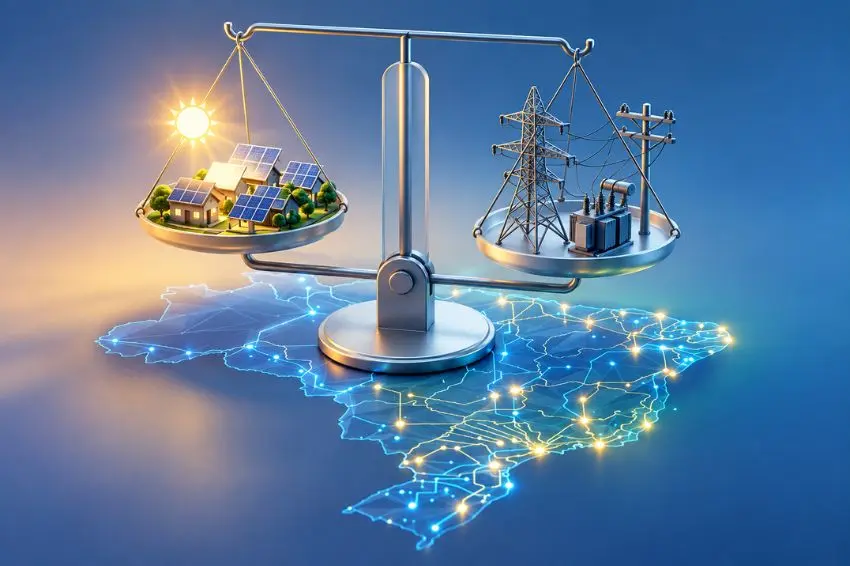
We are witnessing chaos in the Brazilian electricity sector due to policies that failed to consider the development of new technologies, especially in the distributed generation field.
Due to several misguided decisions stemming from a lack of modernization in the electricity market, Brazil is unable to manage the energy transition, resorting instead to expensive solutions that are reflected in the final consumer price.
For some time now, blame has been placed directly on distributed micro and mini-generation (DMG) and the "net-metering" incentive, which was a successful response from consumers investing in their own generation to offset their load.
Recent articles from important entities have revived the notion that MMGD is an example of Robin Hood in reverse. These publications lack quantification and end up remaining only in rhetoric, without deeply analyzing the positive and negative effects of MMGD.
This perspective ultimately does a disservice to the search for efficient and less costly solutions for all consumers, including those who do not have solar panels.
This article presents a series of analyses of electrical and energy attributes that may better elucidate these points.
The first important concept is that one cannot discuss an electrical system with distributed generation (DG) without mentioning the degree of penetration in these networks, which differ locally in terms of configuration and usage (load curve).
In short, generalization or the adoption of a worst-case scenario as an example ends up distorting the facts and creating false narratives.
In a recent study conducted by ABGD (Brazilian Association of Distributed Generation) entitled "Cost and Benefit Analysis of Distributed Generation," motivated by the determination of Law 14300/22, it was observed that the penetration level of distributed generation is still low compared to other countries such as Australia, Germany, Spain, etc.
Extracting from the BDGD (Distributor's Geographic Database) of ANEEL (National Electric Energy Agency) notes that today we have more than 27 medium voltage (MV) networks and almost 6 million low voltage (LV) networks, commonly referred to as primary and secondary networks, respectively.
Although the ABGD study evaluated the effect of MMGD not only on these networks but also on HV (high voltage) and RV (basic network) networks, this article focuses its analysis on LV, MV networks and HV/MV transformers, which are usually underexplored and where there is a large information asymmetry.
To better organize the analysis of the impact of MMGD, it is recommended to segment it into attributes that will cause costs or benefits to the system.
In this article, we start with the Distribution Development Plan (PDD) to determine the investment involved, then move on to the expansion of the network in its three layers — LV, MV and HV —, and finally discuss the effect on technical losses and network voltages.
Check out all the details in the full article, available at [link]. Magazine Canal Solar Vol. 7, No. 3 – August/2026.
The opinions and information expressed are the sole responsibility of the author and do not necessarily represent the official position of the author. Canal Solar.

Comments (1)
Comments are moderated before publication.Comments should be respectful and contribute to a healthy debate. Offensive comments may be removed. The opinions expressed here are those of the authors and do not necessarily reflect the views of the author. Canal Solar.
We have to shut down the big ones, leave them only for houses, greed only benefits the poor, shut down the rich ones.