
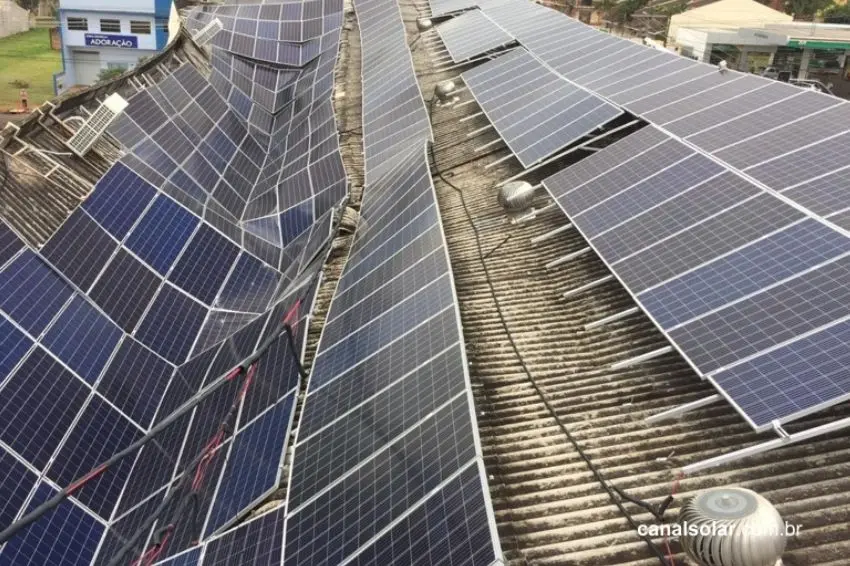
When a roof collapses during or after the installation of a photovoltaic system, the image of solar energy inevitably becomes central to the news. The causes of each accident need to be technically investigated.
It is not correct to automatically attribute responsibility to solar panels without a conclusive expert assessment. But neither can we treat episodes of this nature as isolated incidents and move on without asking an uncomfortable question: who guarantees that the professional responsible for the installation is truly qualified to perform the service?
The Brazilian solar sector has grown in the number of companies, installations, and workers. However, training, supervision, and quality control have not kept pace with this growth.
Qualified professionals and companies have begun competing with service providers that reduce prices by eliminating precisely the steps that consumers cannot see: prior coverage analysis, planning, documentation, safety, technical supervision, and final installation verification.
Consumers often lack the tools to differentiate between someone who has only completed basic training and someone who has truly demonstrated competence in working on a roof, interpreting a blueprint, and identifying a hazardous condition.
There are safety requirements and instruments of technical responsibility. All of this is necessary, but it doesn't completely solve the problem. Brazil still lacks a specific, easily verifiable national standard for certifying professionals who perform photovoltaic installations.
The consequence is a gap between attending a course and proving that one is actually qualified to perform the service. This discussion should not be confused with creating more bureaucracy or with an attempt to reserve the market.
Gymnasium roof with solar panels collapses in Mato Grosso do Sul.
This is not about replacing engineers, technicians, professional councils, or technical responsibility documents. It's about protecting the consumer, valuing those who work correctly, and preventing the expansion of solar energy from being accompanied by the normalization of improvisation.
A photovoltaic installation is not simply a matter of assembling equipment. It interferes with the structure and electrical system of a building and will remain there for decades. In churches, hospitals, schools, supermarkets, warehouses, and other high-traffic areas, a failure can put many people at risk.
Even so, we continue to allow the consumer to be the primary inspector of the qualifications of those they hire — even if they lack the technical knowledge to perform this function.
The sector needs to start discussing a certification that can represent real competence, and not just the delivery of yet another document. The criteria, the form of evaluation, the responsibility of the institutions involved, and the relationship of this mechanism with existing requirements will still need to be developed.
Acknowledging this vulnerability does not weaken solar energy. On the contrary, it is a way to protect its reputation and ensure that market growth is accompanied by safety, professionalism, and trust.
The question, therefore, is no longer whether the sector needs to move in this direction. The question is how many more warnings will be needed before this discussion is treated as a priority.
The opinions and information expressed are the sole responsibility of the author and do not necessarily represent the official position of the author. Canal Solar.


Comments (5)
Comments are moderated before publication.Comments should be respectful and contribute to a healthy debate. Offensive comments may be removed. The opinions expressed here are those of the authors and do not necessarily reflect the views of the author. Canal Solar.
Skilled labor shortage
It's become a mess; anyone can install it. Any "electronic security technician" without any training can do this installation without any supervision.
Well, they cracked mine, they broke the poorly installed eternit roof. I spoke to the person in charge, they're going to redo the whole job.
top.
The customer who pays the least amount of money is the one who certifies the installer. Simple as that.