

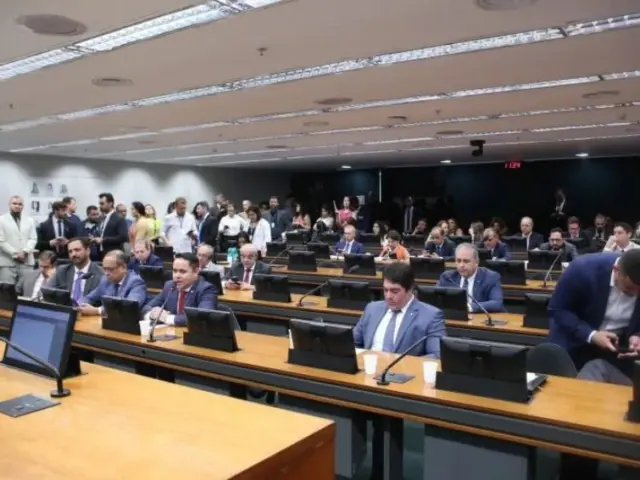
The public hearing to discuss possible changes to the energy compensation rules currently provided for in RN 25 took place this Monday (11/482) at the Legislative Assembly of the State of São Paulo (ALESP). The hearing was called by the legislature led by federal deputy Vinicius Poit and state deputy Rodrigo Mellão (Novo/SP) and was attended by members of the boards of ANEEL, ABSOLAR (Brazilian Solar Energy Association) and ABRADEE (Brazilian Association of Electric Energy Distributors), as well as the participation of representatives from the Ministry of Mines and Energy (MME). The event, which filled the plenary, was also attended by businesspeople and workers who work in the photovoltaic solar energy sector.
In his speech, the director of ANEEL Rodrigo Limp, justified the agency's position in seeking balance between consumers with their own generation and other consumers, alleging the existence of cross-subsidies in the current energy compensation model. The director defended himself against the various criticisms suffered by the agency, saying that the agency's decisions ANEEL are guided by research and technical arguments, and will not distort the facts to favor any market agent.
The director of ANEEL stated that “in 2015 it was already signaled that a new review of the regulations would be carried out by the end of 2019, focusing on the economic aspect. He also highlighted that, in the agency's view, the alternatives presented at the board meeting held on 15/10 do not make the growth of generation systems next to the load unfeasible, but admitted that remote generation will be greatly affected.
Rodrigo Sauaia, executive president of ABSOLAR, highlighted two main issues: when to make the changes and how much to charge in a fair and balanced way for the use of the network. The executive confessed to being surprised when the ANEEL changed its speech about how long already connected ventures would remain under the current rules, from 25 years to 10 years. This could cause a large number of lawsuits from investors against the regulatory agency and the government itself, since they may feel harmed.
A ABSOLAR believes that the timing for changing the rules is not right, since, of the 84,4 million consumer units in the country, only 163 thousand units have a distributed generation system, which represents only 0,2% of the consumer base. The association highlighted that the cross-subsidies caused by distributed generation do not have a significant weight in the Brazilian electrical system, especially when compared to the socioeconomic benefits presented, and, therefore, a change as proposed by ANEEL would only bring unnecessary damage to the sector.
Sauaia reiterated that the socioeconomic and environmental benefits are not being contemplated by the ANEEL. In the executive's view, the agency is wrong to only discuss costs (an increase of up to 0,06% in the energy bill in the near future) and ignore the already known advantages of distributed generation, such as postponing investments in growth in the network, reducing carbon gas emissions and generating jobs.
“Distributed generation generates benefits for the entire society; in saving water, reducing the use of thermoelectric plants, transmission and distribution lines, losses and reducing investment in new plants” said the executive.
Responding to his own question, Rodrigo Sauaia stated that he sees it as fair for changes to the current rules to only occur when distributed generation reaches a 5% share in the energy matrix.
He also argued that the reduction in injected credit should not exceed 10,5% of the tariff to be deducted (contrary to the current proposal of the ANEEL of 60%), citing as a reference the successful case of the US state of California, in which changes only happened when the modality was already mature and developed. The executive also asked the ANEEL on holding meetings and public hearings in more states in the country. Currently, the hearings are concentrated in Brasília and São Paulo, which makes it difficult for entrepreneurs from other states to participate in the meetings.
ABRADEE was represented by its president, Marcos Madureira. Madureira recognizes the importance of discussion and participation of distributed generation on the grid. According to the president of the association, the distribution network grows together and becomes stronger with the implementation of distributed systems, an argument that was repeated in the speech of the representative of the Ministry of Mines and Energy Antônio de Abreu. The concerns of the concessionaires, according to Madureira, are only about the supposed cross-subsidies and transfer of costs to consumers who do not have distributed generators, an argument that was harshly criticized during the hearing.
Ronaldo Koloszuk, president of ABSOLAR, criticized the campaigns of ANEEL on social media, where the agency presented a bias against distributed generation, focusing its arguments only on the increased costs caused by the modality, ignoring the social benefits. Koloszuk also showed the contradiction in the agency's discourse, which boasts of having created the current compensation system and having made distributed generation viable in 2012, but which now in its proposed review will be killing investments in solar energy. Corroborating the initial discourse of the ABSOLAR, Ronaldo brought two international examples: the cases of Spain and California.
Spain is often used as an example of how misguided changes can cause disastrous damage to the sector. In 2008, the Spanish government abruptly removed a series of incentives that solar sources had, and in 2014 it even created an extra tax on solar energy produced.
This decision by the Spanish government caused stagnation in the sector that only began to be reversed in 2018, a decade after the first changes, when the government reversed its decision. During this period, it is estimated that thousands of companies linked to solar energy closed their doors, decimating thousands of jobs, in addition to excessive judicialization, exceeding more than 1500 lawsuits against the government.
The case of the state of California was brought as a regulatory success. In the American state, regulatory changes occurred gradually, only when the sector reached a significant share in the matrix of around 5%, which took around 20 years, with a reduction in injected credit of just 10,5%.
Another topic reported several times by audience participants was the issue of reducing electrical losses and improving network safety and efficiency. Technical losses (electrical losses in the conversion, transmission and distribution of energy), and non-technical losses (arising from energy theft, measurement and billing errors), are also passed on to all consumers of electrical energy, and in 2016 they already surpassed the R$13 billion mark.
Participants argue that distributed generation, by its very nature of being connected close to the load, reduces technical losses by alleviating the use of wires for energy transport. With the reduction of technical losses, the public grid as a whole gains energy efficiency, which is one of the basic premises of ANEEL.
Entrepreneurs also questioned the agency about the adaptation period after the new revision was enacted. In 2012, when RN 482 was approved, the ANEEL gave a comfortable adaptation period for the concessionaires, which according to the public, brings an irony, as there is no adaptation period foreseen for entrepreneurs and customers to prepare for the changes in RN 482. Lastly, the change in the analysis method and the agency's choice to no longer take into account the socioeconomic benefits of distributed generation were questioned.
To check the audience, the ABSOLAR provides full coverage of the event at:

Comments
Comments are moderated before publication.Comments should be respectful and contribute to a healthy debate. Offensive comments may be removed. The opinions expressed here are those of the authors and do not necessarily reflect the views of the author. Canal Solar.