
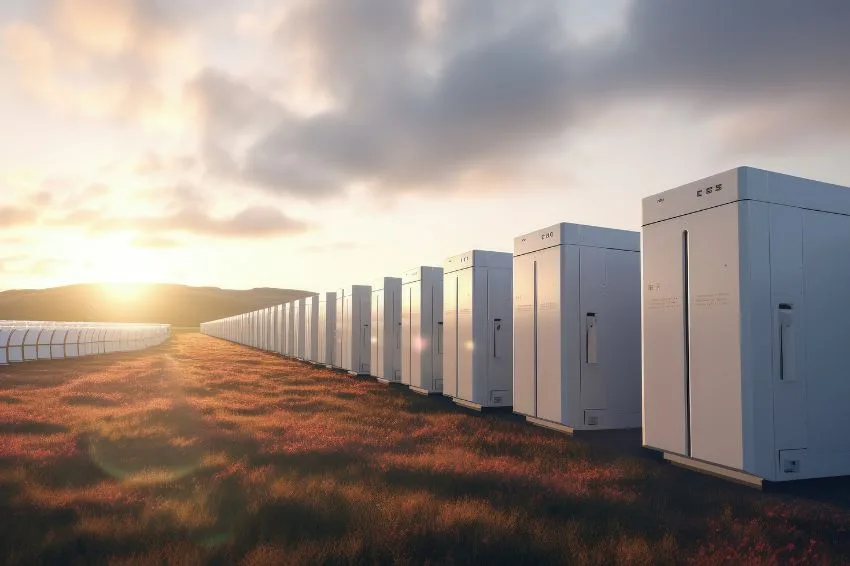
Axia Energia confirmed its focus on developing battery energy storage projects, indicating that the company has been studying the technology for quite some time, analyzing the various possibilities and modalities.
Asked during a results conference held on Thursday (06), the executive vice president of Strategy and New Businesses, Elio Wolff, said that this is a necessary solution for the Brazilian system and that its implementation is considered inevitable.
According to him, although Brazil is only just beginning in this field, the company sees the advancement of batteries as quite consolidated in several other markets.
The main driver for short-term investment that Axia Energia sees is the battery auction announced by the MME (Ministry of Mines and Energy) for March 2026. The executive noted, however, that the rules of the auction have not yet been released.
Despite the interest, Wolff stressed that the way the Brazilian system is currently structured imposes a significant barrier to the full development of battery marketIn other words, it is not yet possible to capture intraday value, which is considered quite important for the operation of the technology.
Eletrobras adopts a new identity and is now called AXIA Energia
"The lack of market mechanisms for same-day energy trading prevents batteries from operating at their full economic potential," Wolff explained.
The ideal scenario for the sector's development would be one in which the battery market evolves not only through government auctions, but also through effective market solutions, he emphasized.
This model is implemented globally.
The intraday market is a near real-time energy trading environment where generators, traders, free consumers, and battery operators can buy or sell energy with only a few hours—or even minutes—in advance.
In the context of energy storage, large batteries participate in the intraday market as instantaneous balancing agents. They function as "buyers" and "sellers" of energy in real time, according to price conditions and grid needs.
Intraday platforms allow for automatic and continuous trading, with buy and sell bids in real time. The batteries, integrated via digital systems, can respond in a matter of seconds, which is impossible for conventional thermal or hydroelectric power plants.
There are several sources of revenue for batteries in the intraday market: price arbitrage; ancillary services such as frequency stabilization, voltage control, and capacity reserve; compensation for deviations in renewable generation contracts; and supplying sudden demands from large consumers.
In Europe and the US, the intraday market is already highly developed and represents one of the main sources of revenue for battery projects. In Brazil, this system is still under study.
all the content of Canal Solar is protected by copyright law, and partial or total reproduction of this site in any medium is expressly prohibited. If you are interested in collaborating or reusing part of our material, please contact us by email: redacao@canalsolar.com.br.


Comments (1)
Comments are moderated before publication.Comments should be respectful and contribute to a healthy debate. Offensive comments may be removed. The opinions expressed here are those of the authors and do not necessarily reflect the views of the author. Canal Solar.
These batteries should be installed near the distribution substations. It makes no sense to install them at the power plants as previously announced, since they are not accounting for transmission grid failures.