
"The future will be increasingly solar”, this is the analysis of industry experts. According to Ronaldo Koloszuk, Chairman of the Board of Directors of ABSOLAR (Brazilian Association of Photovoltaic Solar Energy), the expectation is for accelerated growth in projects for 2021. Lucas Freitas, CEO of Genyx, also commented that with the technology even more widespread, the payback more than proven and prices becoming more accessible, the forecast is for an explosion in demand.
There is no doubt that the photovoltaic market has been following an exponential growth curve in recent years and the trend is to grow even more in the future. Therefore, companies from various segments are investing in solar, such as financial institutions. BNDES (National Bank for Economic and Social Development), for example, approved a financing of R$191 million for Powertis, specialized in large-scale solar projects in Brazil, Italy and Spain, for the construction of a photovoltaic system in the state of São Paulo.
Banco do Brasil was not left out either, it already has solar plants installed across the country and will also make R$200 million available in credit limits to finance investments in the installation of panels on farms for Brazilian multinational in the food sector BRF.
And it doesn't stop there, a survey carried out by Canal Solar pointed out that at least four banks expect growth in operations in their credit lines aimed at renewables this year: Banco do Nordeste, Banco do Brasil, Santander and Caixa. Below are the amounts contracted in 2020 and the expectations for 2021.
Banco do Nordeste
In 2020, Banco do Nordeste contracted R$ 264,12 million through the FNE Sol financing line. The credit intended for micro and mini distributed energy generation was attributed to companies, rural producers and individuals, in 4.548 operations distributed across states in the Northeast and north of Minas Gerais and Espírito Santo, the company's area of activity.
Among the sectors that hired the most FNE Sol last year, the highlights were individuals located in urban areas, with the amount of R$ 112,9 million in 3.713 operations, and the commerce and services sector, with R$ 68,7. 539 million in XNUMX operations.
According to Banco do Nordeste, the target for 2021 for FNE Sol contracts for individuals is R$80 million.
As for centralized photovoltaic generation, the values were R$1,2 billion in 2020. In 2021, the company announced that R$482 million had already been contracted.
Bank of Brazil
Banco do Brasil reported that, in 2020, a volume of more than R$165 million in quotas related to the acquisition and installation of renewable energy systems was sold. BB Consórcios provides customers with solutions for the acquisition of renewable energy systems through consortium quotas in the Tractor/Truck and Other Movable Goods segments, with values ranging from R$7 to R$240. Below:
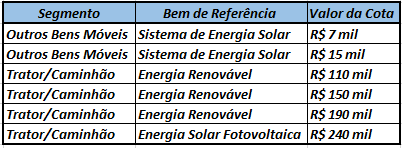
Regarding the amount disbursed in the 2019/2020 Harvest, for example, an increase of 43% was observed compared to the previous one. “This reaffirms our commitment to financing clean and sustainable energy sources,” said Banco do Brasil in a note.
For 2021, the financial institution expects that the company's movement in lines aimed at financing the implementation of micro and mini renewable energy generating plants will continue on the rise.
Santander
According to Fernando Charrone, Commercial Superintendent at Santander Financiamentos, the company's projections regarding financing point to an increase in the photovoltaic market in 2021.
“Santander is the photovoltaic bank. The finance company is prepared to meet this demand and also encourage new business this year. Santander Financiamentos expects to double its production in 2021 compared to 2020. This means releasing twice as many credits for photovoltaic financing throughout Brazil, for companies and individuals”, highlighted Charrone.
“The solar energy market is constantly expanding both due to environmental awareness and energy savings. Furthermore, our commercial conditions associated with the emergence of new commercial partners allow this market to become even more attractive”, he assessed.
The executive also highlighted that photovoltaic financing through Santander, in addition to being competitive, is very simple and fast. “It is worth highlighting that we have increased our commercial strength, allowing better service to partner companies in the national market, in addition to working with integrators.”
Caixa
Caixa's credit lines for financing energy eco-efficiency projects grew 35% last year. The institution expects to double this number in 2021. The company reported that machinery and equipment for the following purposes are eligible for financing:
- Micro and mini energy generation system using renewable sources;
- Solar water heating system;
- Energy efficiency.
The BCD Ecoefficiency line is aimed at entrepreneurs seeking to finance equipment for generating solar energy. It allows financing up to 100% of the products to be installed in the company for photovoltaic energy. The Durable Consumer Goods for Companies credit line also allows financing up to 100% of the value of the goods acquired for energy ecoefficiency.




Comments (1)
Comments are moderated before publication.Comments should be respectful and contribute to a healthy debate. Offensive comments may be removed. The opinions expressed here are those of the authors and do not necessarily reflect the views of the author. Canal Solar.
This is if the government does not get in the way and the associations that defend the sector do not move to prevent these political tax interferences, which could result in consumer disincentives.