

Report published in the 16th edition of the Magazine Canal Solar
The production of electrical energy by consumers is a phenomenon that occurs in various parts of the world, such as the United States, Germany, Spain, United Kingdom, Japan and Australia, to name a few examples.
This was only possible thanks to the technological advancement of photovoltaic energy and the creation of public policies to encourage the expansion of this market.
As with any new technology, as the market matures, the rules are changed and incentives are progressively removed. In this report, we will talk about three emblematic cases that reinforce this scenario of regulatory transformation.
California
The state of California was one of the pioneers in creating policies for the development of distributed solar generation. Not by chance, the Californian model served as a reference for the construction of Normative Resolution 482/2012, which initiated the DG market in Brazil.
There, as here, the incentive mechanism used was the net metering energy compensation system, in which 1 kilowatt-hour injected into the grid would compensate for 1 kWh consumed (1 to 1 rule).
According to Rodrigo Sauaia, president of ABSOLAR (Brazilian Solar Energy Association), net metering 1.0 began in California in 1996 and lasted until July 2017. During this period, it was possible to eliminate electricity bills there, since Californians, unlike what happened in Brazil, did not need to pay for minimum consumption.
The situation for Californian consumers changed a little with the entry of net metering 2.0 (in force), in which, on credits, a discount of US$ 0,02/kWh (two cents per kilowatt- hour), just for the injected energy. This amount goes toward financing energy efficiency, low-income customer assistance, and other related programs.
The consumer also began to bear a connection charge and the tariffs began to vary over time (hourly tariff), applied to both consumed and injected energy.
Even so, the distributed solar generation market in the US has remained attractive, as California's energy rates are quite high for small and medium-sized consumers. Average electric rates in California are $0,30 (kWh).
Hourly pricing initially increased the attractiveness of solar energy because energy consumption in California was highest during the day. With the penetration of solar energy, this scenario has changed over the years.
The value of energy during the daytime began to decrease, which ended up encouraging the use of batteries for energy storage. In Brazil, the creation of hourly tariffs has been discussed since 2018. For the ABSOLAR, the hourly rate can add value to GD here.
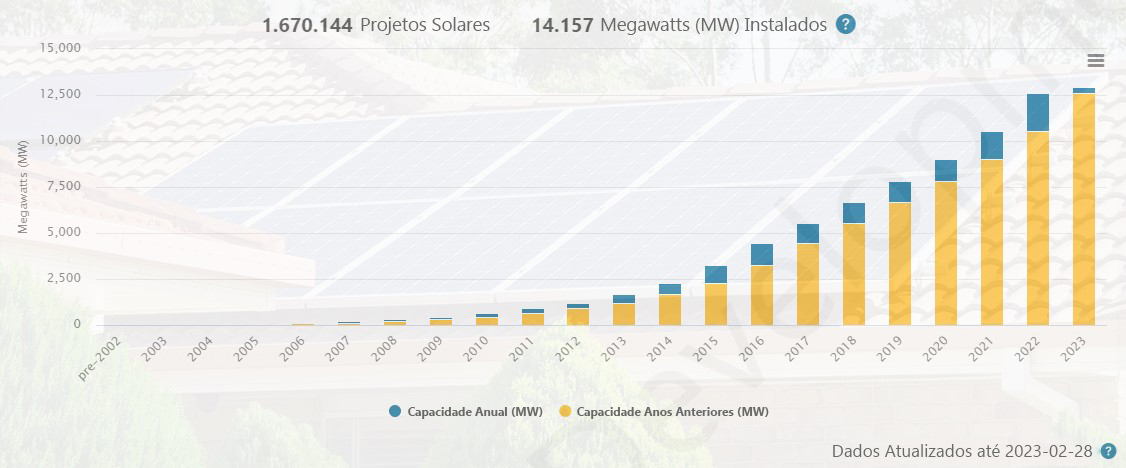
Today, California has approximately a total of 80 GW of installed capacity, 14,1 GW of which is distributed solar generation, according to the California Solar Initiative.
There the market is partially open, with residential consumers having the option of migrating to the free market. In Brazil, only medium and high voltage consumers have this possibility.
New change in rules
At this time, the North American state is discussing a new change in energy compensation rules, called net metering 3.0. The proposal foresees a reduction in the value of credits arising from the injection into the network of around 75%.





Comments
Comments are moderated before publication.Comments should be respectful and contribute to a healthy debate. Offensive comments may be removed. The opinions expressed here are those of the authors and do not necessarily reflect the views of the author. Canal Solar.