
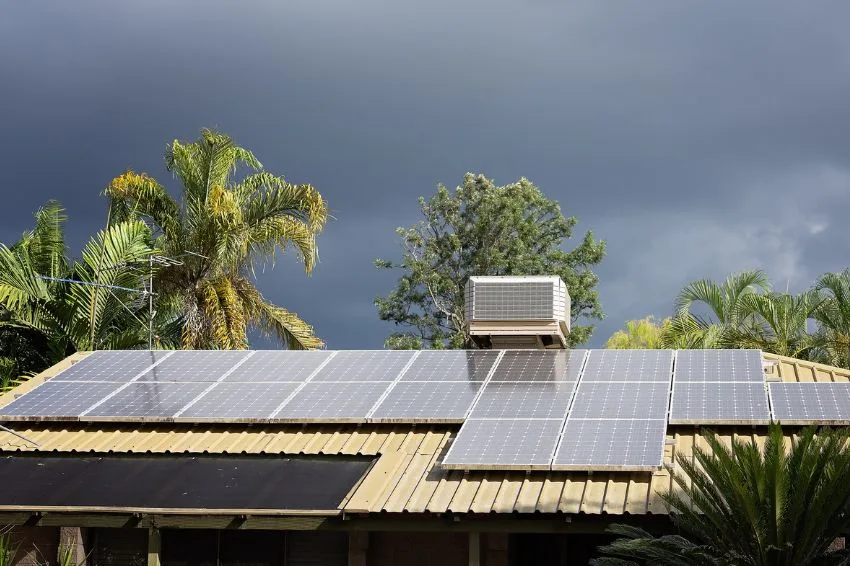
After dropping temperatures across much of the South region — with snowfall in municipalities in Rio Grande do Sul and Santa Catarina — the biggest cold front of the year advanced with force across other regions of the country.
According to Climatempo, at least seven Brazilian capitals recorded cold records on the morning of this Friday (30), with emphasis on Curitiba (PR), where thermometers marked 4,1 ºC.
In São Paulo (SP), the minimum temperature was 9,8 ºC, while Porto Alegre (RS) and Campo Grande (MS) reached 6,3 ºC. Florianópolis (SC) woke up with 8 ºC and even Cuiabá (MT), known for its intense heat, recorded a minimum of 13,7 ºC.
With the sudden drop in temperatures, a recurring question in the photovoltaic sector resurfaces: can intense cold harm the generation of solar panels?
João Frederico Souza de Paula, researcher at LESF-MV (Photovoltaic Solar Energy Laboratory – Marcelo Villalva) from Unicamp (State University of Campinas), explains that the cold, in itself, does not hinder — and can even benefit the performance of solar panels, as long as solar irradiance remains at reasonable levels.
“It is inevitable that photovoltaic modules will experience performance losses due to rising temperatures. However, during cold fronts, these losses can be mitigated and may improve if the irradiance remains relatively high,” he said.
According to the professional, the ideal generation scenario occurs when there is high irradiance combined with milder temperatures, a climatic condition that rarely happens perfectly.

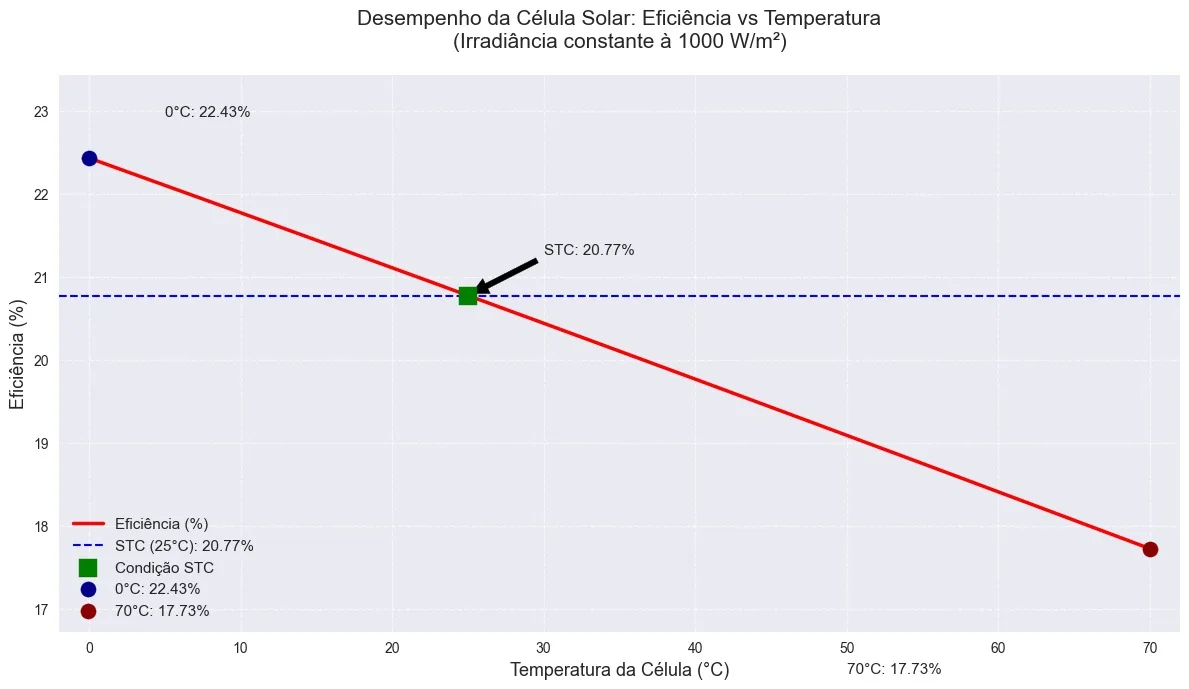
To illustrate this behavior, the researcher shared with the report of Canal Solar a graph developed by LESF-MV. The study simulates the efficiency of the solar cell at different temperatures, with constant irradiance of 1.000 W/m².
The image below shows that while the module efficiency under standard conditions (25 °C) is 20,77%, this performance increases to 22,43% at 0 °C. At higher temperatures, such as 70 °C, the efficiency drops to 17,73%.
“It is unlikely that we will have the perfect combination of 1.000 W/m² of irradiance with a cell temperature of 25°C. Therefore, it is more realistic to adjust expectations and consider that, during cold fronts, temperature losses will be lower, but will still be present,” he commented.
What influences performance the most?
In addition to temperature and irradiance, Frederico explains that the behavior of photovoltaic modules is also impacted by climatic factors, such as wind speed and the way the system is installed.
“Locations with poor air circulation tend to accumulate more heat in the modules, which can compromise performance, even on cold days. Well-ventilated environments help dissipate heat more quickly, keeping the cells at the ideal operating temperature,” he adds.
Another relevant point mentioned by the researcher is the so-called maximum power temperature coefficient of each technology. This index, represented by a negative constant, indicates how much the module's power drops as the temperature increases.
“The lower this coefficient, without looking at the negative sign, the better the performance in warmer climates (above 25°C). This is an important point to observe when comparing different technologies available on the market”, he concluded.
all the content of Canal Solar is protected by copyright law, and partial or total reproduction of this site in any medium is expressly prohibited. If you are interested in collaborating or reusing part of our material, please contact us by email: redacao@canalsolar.com.br.



Comments
Comments are moderated before publication.Comments should be respectful and contribute to a healthy debate. Offensive comments may be removed. The opinions expressed here are those of the authors and do not necessarily reflect the views of the author. Canal Solar.