
Brazilian solar energy has accumulated capacity, investments, and an extensive chain of equipment spread across the country, but it is now beginning to face a question that is likely to gain importance in the coming years: what to do with all of this when it reaches the end of its useful life.
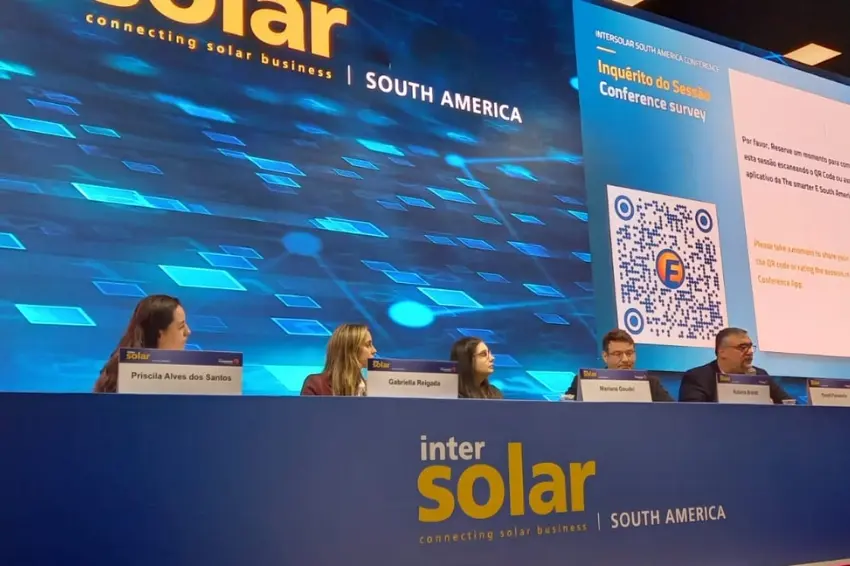
The recycling of photovoltaic modules dominated the final debate of the panel “The Solar PV Energy Value Chain in a Transforming Global Context”, held this Thursday, the 27th, on the third and final day of the Intersolar South America Conference, in São Paulo.
And while the disposal and reuse of solar panels is already an urgent issue, participants indicated that the next frontier will be even more complex: the recycling and reuse of batteries, which are beginning to gain traction in the Brazilian electrical system.
The discussion began with a provocation presented by reverse logistics specialist Priscila Alves dos Santos, a consultant at Eco Desenvolve. The photovoltaic chain has grown rapidly, but the circular economy has not yet kept pace with this expansion.
In her presentation, she questioned the future fate of Brazil's 74 GW of installed capacity and the millions of pieces of equipment that will, at some point, need to be repaired, reused, or disposed of.
Proposed law aims to make reverse logistics for solar panels and batteries mandatory.
According to Priscila, the problem is not limited to modules that naturally reach the end of their useful life. Climatic events, such as hail and strong winds, can also accelerate disposal and transform seemingly small volumes into a logistical challenge of great proportions.
According to her, the concern is to prevent the sector from solving the problem of clean energy generation by creating an environmental liability in the future.
The expert reported having already identified modules being sent to landfills and drew attention to the lack of information and infrastructure to guide installers, distributors, cooperatives, and consumers.
"We are forgetting to solve the problem of the final destination" of this chain, he summarized, while defending a vision that considers the equipment from its manufacture to its decommissioning.
However, the economic potential was also a central point. Priscila highlighted that approximately 97% of a photovoltaic module can be recycled, including materials such as glass, aluminum, polymers, silicon, copper, and silver.
In his assessment, the Brazilian challenge is not the lack of valuable materials, but the absence of a structured industrial chain to collect, process, and reintroduce them into new markets.
From "drip irrigation" to the waste boom.
For now, the sector is still experiencing what Priscila described as a "trickle-down" phase: modules and other equipment reach the end of their useful life in a scattered way, without sufficient volume to justify, in many cases, a large processing structure.
This reality, however, is expected to change as the first systems installed in the country age and begin to lose efficiency.
Her projection is that, between 2035 and 2044, the volume of equipment destined for a second life or disposal will begin to increase more significantly, with a subsequent peak.
The estimates cited in the panel point to hundreds of thousands of tons of photovoltaic materials in Brazil, and this could reach even greater volumes as solar power generation matures.
The window for structuring this chain, therefore, would still be open. Priscila summarized the issue in three points: the installed park should also be seen as a future stock of materials; the modules have high recycling potential; and the country needs to prepare before the volume of waste becomes a national-scale environmental and logistical problem.
In the final debate, the discussion moved towards how to transform this need into economic activity. Participants pointed out that countries like China already have processes in place to separate and reuse materials found in modular construction.
According to estimates cited in the discussion, a recycling unit could require an investment of around US$500 to US$600 in a processing line capable of separating, among other components, silicon, silver, and copper. The conclusion was that recycling can cease to be merely an environmental obligation and become a new stage in the solar energy value chain.
The issue of logistics, however, remains one of the main obstacles. It's not enough to develop recycling technology; it's necessary to decide where to install these facilities and how to transport equipment that will be scattered throughout the country. For Priscila, Brazil needs to develop regional hubs and identify where the largest future volumes will be, instead of simply collecting the equipment and sending it to other countries.
Batteries are on the circular economy agenda.
If modules represent the problem that is already beginning to appear, batteries emerge as the next big wave. The discussion was stimulated by the expected expansion of storage systems and the possibility of reusing equipment before final disposal.
The lead-acid battery supply chain was cited by Secpower CEO Gabriela Reigada as an example of a more mature model, supported by obligations for collection, recycling, and traceability.
Lithium batteries, on the other hand, do not yet have a fully consolidated equivalent infrastructure. At the same time, the expansion of electric vehicles could considerably increase the future availability of these devices.
One of the possibilities discussed is precisely the second life. Batteries used in vehicles, subjected to more demanding conditions, may still retain sufficient capacity for stationary applications.
During the discussion, the case of an automotive battery received for study and possible reassembly into a stationary solution was mentioned. After this stage, the challenge would be to separate the cells that are no longer usable and dispose of them properly, completing a cycle that could involve a second and even a third life.
Storage already covers the cost.
Before the panel culminated in the issue of the circular economy, the presentations showed how batteries are ceasing to be just a prospective technology and are becoming part of the economic equation for solar energy.
Rubens Brandt, from Grupo Energia Consult, presented two case studies. In the first, he analyzed different alternatives to continuously supply a consumer with a flat load of 300 MW in the Southeast region of Brazil. The comparison involved solar, wind, and solar combined with storage.
The conclusion presented was that, when considering the cost required to modulate variable generation, a solar plant with BESS can already achieve competitiveness in delivering energy continuously.
The second case involved logistics complexes. The analysis began with the hypothesis of an integrated solution for the entire project, but indicated that, given the differences in consumption and available roof space, the best strategy might be to individualize the projects by warehouse or consumer.
According to Brandt, the results already indicated rates of return capable of justifying the investments, combining cost reduction and improved supply quality.
For him, one of the main virtues of storage is its speed of response. In systems subject to fluctuations, the battery can take over the load almost instantly and act as a bridge until another source comes online.
Brandt argued that storage should be sized according to the specific needs of the system, without automatically making battery life an end in itself.
BESS as a response to curtailment
Mariana Goudel, Sales Director for South America at Trina Storage, focused her presentation on the ability of energy storage to recover some of the renewable energy lost due to generation restrictions.
She cited data from August presented during the panel, according to which 1,34 TWh of solar generation had been cut off by the 25th of that month. In July, according to the figures mentioned, approximately 30% of the solar energy generated for the system had been cut off.
For Mariana, this scenario highlights that the problem has ceased to be merely a theoretical discussion about the expansion of renewables and has begun to directly affect the economics of the projects.
BESS, he explained, allows energy to be shifted over time because it absorbs power when there is a restriction and returns the electricity later. The goal would not necessarily be to eliminate all curtailment—which could require an excessively expensive system—but to find the sizing that captures the most economically valuable portion of the energy that would otherwise be lost.
For utility-scale projects, she pointed out that systems lasting two to three hours may be suitable in certain cases, but stressed that there is no standardized solution.
Location, crop profile, power output, and discharge window need to be considered individually. The Chilean experience was cited as an example of a market that faced a similar problem and has increasingly incorporated the combination of solar and storage.
Opportunity for the national industry
Gabriela Reigada, from Sec Power, brought the discussion to another link in the chain, regarding how much value Brazil will be able to capture with the expansion of storage.
His thesis was that the national industry does not necessarily need to replicate the entire Asian chain or try to manufacture each component locally, such as the cells.
The way forward would be to identify the segments in which the country can be competitive, combining international technology, national engineering, and local production.
According to her, the company itself cited as an example a lithium-iron-phosphate battery assembly line installed in Cambuí, Minas Gerais, in addition to the production of electrical and control equipment in São Paulo.
Gabriela also highlighted the reduction in CAPEX for storage systems and the growth prospects of the Brazilian market. Among the points she emphasized that will define the exploitation of this opportunity are regulations capable of recognizing and rewarding flexibility, defining the role of local industry, the increasing association between distributed generation and batteries, and workforce qualification.
In the end, the panel, moderated by Daniel Pansarella, Vice President of the Production Chain at Absolar, covered virtually the entire value chain of solar energy: generation, storage, competitiveness, industry, operation, and finally, the fate of the equipment.
And it was precisely at this point that one of the strongest messages of the debate emerged. According to the discussion, Brazil already possesses the materials, technical knowledge, and funding sources for innovation. What is still lacking is transforming these components into production chains and business models. Recycling the modules could be the first major opportunity, that is, a second life, and recycling the batteries, the next chapter.
all the content of Canal Solar is protected by copyright law, and partial or total reproduction of this site in any medium is expressly prohibited. If you are interested in collaborating or reusing part of our material, please contact us by email: redacao@canalsolar.com.br.


Comments
Comments are moderated before publication.Comments should be respectful and contribute to a healthy debate. Offensive comments may be removed. The opinions expressed here are those of the authors and do not necessarily reflect the views of the author. Canal Solar.