

As demand for solar energy increases, the number of incorrect and dangerous installations also increases. Fires, collisions, plates coming loose and roofs collapsing unfortunately they are not as rare as they should be.
And anyone who thinks that this is limited to old houses or those with fragile structures is mistaken. Even in high-end condominiums, it is possible to find installations that ignore good engineering practices.
Of course, external agents can also cause damage and even accidents, however, many of the risks can be avoided by design. And what I propose today in this article is that We can avoid these risks even at the sales stage.
There are several hypotheses for accidents: desperation to make the proposal too cheap to close the sale; customer who puts their foot down and demands that the installation takes place without taking into account the ideal structure; or simply lack of knowledge.
This is serious, and puts not only your company's reputation at risk, but mainly the lives of those who are under an unstable structure. Therefore, let's look below at the precautions that must be taken from proposal to installation.
Who is responsible?
Firstly, we must understand that the responsibility for the project lies with the engineering solutions, not the customer. As obvious as this may seem, we cannot wash our hands and consider that the customer is demanding something at their own risk.
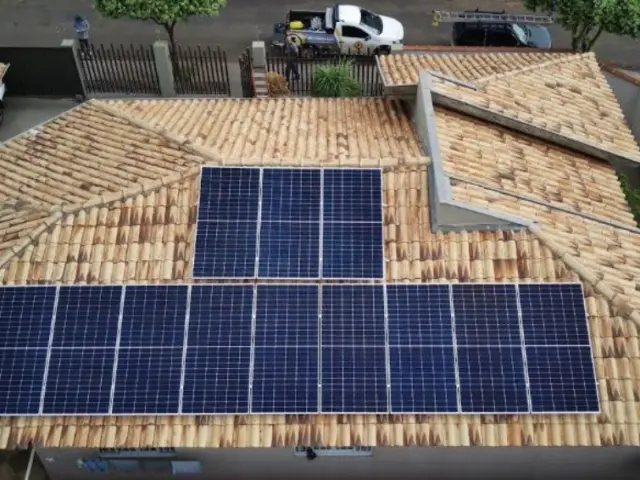
Whether due to the high cost of the project or aesthetic preferences, it is very common for the client to want the installation “their way”. An example is panels installed as if they were tiles, creating overlap and shading, which reduces performance. Thus, the customer may be happy at first, but complaints about the effectiveness of the panels will soon follow.
This is when the installation to the customer's taste (or budget) does not involve sizing errors in electrical components, imprecise connections or even improvised splices. It is only a matter of time before overloads occur, which could lead to very serious fires.
Therefore, technical inspection is essential before installation, and must be done by the engineer, without compromising good practices and safety standards. If the professional in your company does not come from the electrical field, or is a recent graduate, the ideal is for him to be accompanied by a qualified professional, at least at the beginning, until he gains experience and confidence. This is possible through partnerships.
And the seller, where does this come into play?
The project only becomes perfect with the combination of technical and commercial issues. The customer's greatest contact is with the seller, therefore, the commercial sector needs to be able to instruct them on the safety of the project's engineering, preferably right at the beginning of the negotiation.
When the customer is sensitive to price, it is the salesperson who has the mission to argue about the high risk of a project that compromises quality and safety. Even though the responsibility lies with the engineer, It will not be seen well for the commercial sector to promise something that will be invalidated during the technical visit.
Therefore, I do not mean to say that the seller is obliged to have a degree in electrical engineering to work in the solar energy sector. However, it will make all the difference if he understands the aspects of electrical energy, or at least technical standards such as NR 10 e NR 35, which are the main ones and also deal with the installer safety.
NR 10, for example, highlights the most common errors in electrical installation services:
- Hiring professionals without qualifications and/or certification;
- Overload of circuit breakers;
- Disconnected wires and cables;
- Lack of installation of the Residual Differential;
- Incompatibility of circuit breakers and electrical cables.
With the NR 10 course, the salesperson will be able to understand risk analysis techniques, Brazilian technical standards, individual and collective protective equipment, among others. This way, he will be able to anticipate risky aspects of the project and keep the client up to date with the situation.
Everyone benefits from well-done engineering
In conclusion, there needs to be a healthy balance between customer needs, engineering responsibility and sales. This balance is only possible when the seller has in-depth knowledge of the topic to mediate the dialogue.
Remembering that the project does not need to be extremely expensive to be safe and efficient. But without understanding the product and safety standards, there is no way to offer the best solution.
For example, if the client has a large roof, but with little usable area (either for shading or safety reasons), it is very useful to know how to identify this issue beforehand. After all, the customer may imagine that they need to cover the entire roof with large panels, believing that only then will they be able to generate enough energy. However, there are already smaller and lighter panels on the market, without giving up power.
Having knowledge of different products and considering what the engineer claims is viable is important to guide the customer. You need to make the customer understand that the cost-benefit of a project that complies with safety standards is greater than the economy of the famous gambiarra.
With everyone aligned, the customer will be guaranteed a powerful system according to their needs, the installers will have much more security during their work, and the salesperson will know that they have acted by offering the ideal solution to the customer's pain, without putting people or assets at risk. . The bonus is gaining customers who trust and promote your company during this journey. And you, have you seen a lot of gambiarra out there?

Comments (3)
Comments are moderated before publication.Comments should be respectful and contribute to a healthy debate. Offensive comments may be removed. The opinions expressed here are those of the authors and do not necessarily reflect the views of the author. Canal Solar.
The statements are relevant and should be followed, however the question remains: How will the sales sector be trained on this subject if the majority of resale owners do not have adequate technical information? In other words, how can you demand something if the business owner is unaware of the rules? if there is no supervision. All that remains is to inform interested parties that there is a consumer protection code and it is ruthless towards players in this sector as well.
Hello, Jefferson, how are you? Great question, I think that for this type of negotiation it is up to the sales sector to be technically trained, even to guide owners who do not have this knowledge in the future, about what can or cannot be done in a PV project, and that there are regulatory standards that govern the sector and which can invalidate the project, or even lose the warranty of the components if there is something outside the normative specifications.
Eng Gustavo, excellent article, which clearly shows the responsibility of the person responsible for the photovoltaic installation, something that should be emphasized to the customer, using the same level used for the equipment that is sold and installed, Hugo Malheiros, Abs