
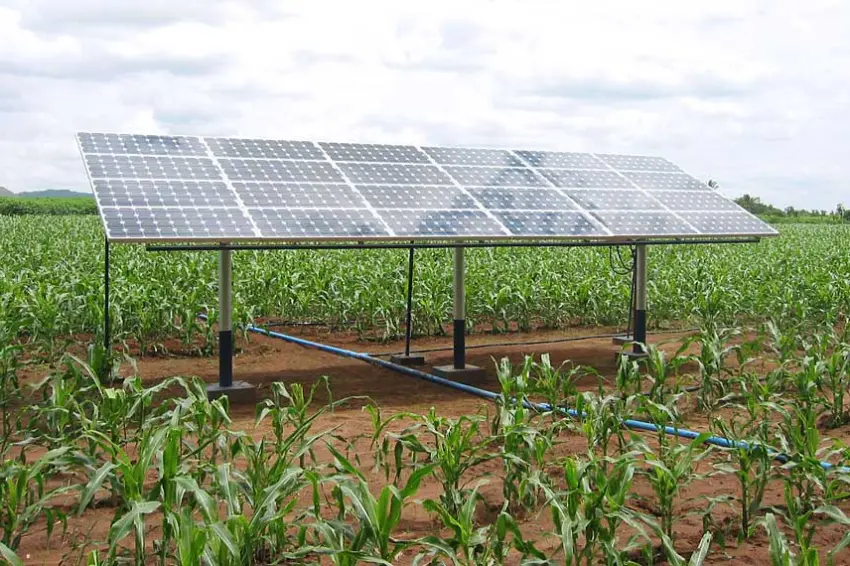
The expansion of irrigated agriculture in western Bahia opens up a range of opportunities for solar power generation companies, manufacturers and suppliers of photovoltaic equipment, and renewable energy traders.
The region faces a significant electricity supply deficit, which is already encouraging the use of private sources of supply and is likely to increase with the growth of agricultural activity.
In this scenario, solar energy emerges as an alternative to meet the demand of farms, pumping systems, and structures linked to agribusiness.
The diagnosis is part of the Study of Electricity Demand for Irrigated Agriculture in Western Bahia, which estimates that the energy needs for irrigation and associated activities in the 33 municipalities analyzed by AIBA (Association of Farmers and Irrigators of Bahia) will reach 1.826 Megawatts (MW) in 2035.
Currently, the electricity supply capacity allocated to these consumers is 443 MW, compared to an equivalent demand of 908 MW. The difference represents an immediate deficit of approximately 465 MW.
The gap does not mean a lack of energy in the Brazilian electrical system as a whole, but rather a difficulty in getting it to the points of consumption.
The study identifies limitations in regional distribution, with few supply points, long distances between substations and rural properties, and high costs for new connections.
Self-generation gains ground.
One of the findings of the survey is that part of the agricultural demand is already met by means alternative to conventional supply.
When calculating the equivalent energy needs of the region, the study also considers the portion supplied by self-generation, including photovoltaic systems, diesel generators, and small isolated hydroelectric plants.
Solar power generation, therefore, is not just a future possibility; it is already integrated into the energy supply of rural properties.
Inadequate grid infrastructure and connection costs may increase interest in self-generation projects, creating opportunities for suppliers of modules, inverters, structures, pumping systems, and electrical integration solutions.
The document also points to photovoltaic self-generation as a complementary alternative to enable productive activities in areas where the infrastructure cannot deliver energy in sufficient quantity or quality.
The need to evaluate solutions close to load centers is gaining importance given the large distances between farms and available connection points.
Market
In addition to installing their own systems, the growth in demand represents a potential opportunity for companies that trade in renewable energy.
Supply contracts in the free market, shared generation models, or other commercial structures can be evaluated by producers seeking to expand access to electricity and reduce exposure to local grid limitations.
However, the study does not compare hiring models nor does it measure the specific potential for migration to the ACL (Free Contracting Environment).
The opportunity arises from the identified volume of demand and the need for supply alternatives, with each project considering connection conditions, consumption profile, and economic viability.
Demand is expected to double by 2035.
The irrigated area considered in the survey increased from 217,6 hectares in 2020 to approximately 410 hectares in 2026. The projection used in the study indicates 692 hectares in 2035. With this, the equivalent electricity demand for irrigation is expected to increase to 1,826 GW in the 33 municipalities analyzed.
In the expanded area of 40 municipalities considered by Neoenergia Coelba, the estimate reaches approximately 2 GW. The study concludes that the expansion of the electrical infrastructure will be indispensable, but self-generation can also contribute to meeting the suppressed demand.
all the content of Canal Solar is protected by copyright law, and partial or total reproduction of this site in any medium is expressly prohibited. If you are interested in collaborating or reusing part of our material, please contact us by email: redacao@canalsolar.com.br.

Comments
Comments are moderated before publication.Comments should be respectful and contribute to a healthy debate. Offensive comments may be removed. The opinions expressed here are those of the authors and do not necessarily reflect the views of the author. Canal Solar.