
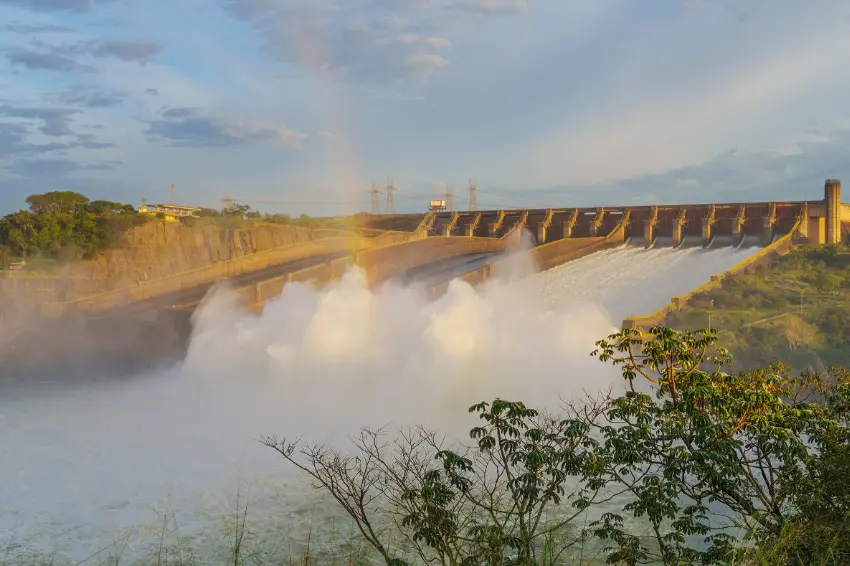
Hydropower reservoirs are expected to remain stable by the end of September, particularly in the South, where the ONS (National System Operator) estimates that the EAR (Stored Energy) will reach 91,4% of capacity.
The PMO (Monthly Operation Program) projections, referring to the week of September 12-18, also indicate levels considered high in the other subsystems: 73,5% in the North, 67,1% in the Northeast, and 55,8% in the Southeast/Central-West.
According to the ONS (National System Operator), storage indicators remain stable compared to previous projections, while the agency continues to monitor climate scenarios throughout the month with the aim of ensuring energy supply.
This picture is reinforced by the outlook for NFE (Natural Inflow Energy), which remains above the LTA (Long-Term Average) in two of the four regions.
The North and Northeast regions have a sensitive scenario.
In the South, projected inflow reaches 219% of the MLT (Long-Term Average), while in the Southeast/Central-West it reaches 119%. For the Northeast and North, however, the forecasts are below the historical average, at 68% and 50% of the MLT, respectively.
This scenario occurs even in the face of a projected increase in demand. For September, the ONS (National System Operator) estimates a 4,9% increase in load on the SIN (National Interconnected System), to 84.294 MWmed, compared to the same month in 2025.
The highest percentage growth is expected in the Northeast, at 10,7%, followed by the North, with 7,9%, the South, with 3,5%, and the Southeast/Central-West, with 3%.
The CMO (Marginal Operating Cost) also remains at R$ 68,52/MWh in the Southeast/Central-West, South, and Northeast regions. In the North, however, the estimate is considerably higher, at R$ 1.444,32/MWh.
Itaipu opens spillway
The favorable inflow situation also appears in the Itaipu reservoir, which had its spillway opened in a planned manner in the early hours of Sunday (13).
The measure was adopted to control the reservoir level in light of the rainfall recorded in the so-called incremental basin of the power plant, formed by the rivers that flow into the reservoir.
The operation began at 1:50 AM, with the opening of the left channel and a flow rate of 1.700 m³/s. A little less than an hour later, at 2:43 AM, the volume discharged was increased to 3.100 m³/s, with the possibility of reaching 3.800 m³/s during the afternoon, before decreasing throughout the day.
The spillway will remain closed as long as measures are needed to restore hydrological conditions to a level that allows the structure to be closed.
Itaipu operates on a run-of-river basis, with a reservoir of low storage capacity, a characteristic that also helps explain the need to control the water level when more intense rainfall occurs in the basin.
The drop is hitting the energy market.
The environment of greater water availability is occurring in parallel with a trend of lower energy prices in the market.
On the BBCE's (Brazilian Energy Trading Platform) EHUB platform, prices for products traded between September 7 and 11 ended the week down, with the largest declines concentrated in future delivery contracts for 2026.
Among conventional contracts with delivery in the Southeast region, the highlight was the product for October 2026, whose price fell by 15,44%, from R$ 193,35/MWh to R$ 163,50/MWh. The contract for November also showed a significant drop of 11,99%, going from R$ 245,44/MWh to R$ 216,00/MWh.
Reservoir movements, inflows, and prices thus present a picture of more favorable conditions for the electrical system at this time, although ONS projections show distinct behaviors among the subsystems and point to the continued monitoring of weather conditions throughout September.
all the content of Canal Solar is protected by copyright law, and partial or total reproduction of this site in any medium is expressly prohibited. If you are interested in collaborating or reusing part of our material, please contact us by email: redacao@canalsolar.com.br.



Comments
Comments are moderated before publication.Comments should be respectful and contribute to a healthy debate. Offensive comments may be removed. The opinions expressed here are those of the authors and do not necessarily reflect the views of the author. Canal Solar.