

The CNI (National Confederation of Industry) announced this Thursday (18) that it will present to the pre-candidates for the Presidency of the Republic a series of proposals for the electricity sector, highlighting the reduction of sector charges, subsidies and taxes that affect the electricity bill.
These measures are part of the document "Building Brazil 2050," which will be presented during the event "Industry on the Presidential Candidates' Agenda," scheduled for June 22nd in Brasília (DF). The proposal is justified by the growing weight of charges and taxes on energy tariffs.
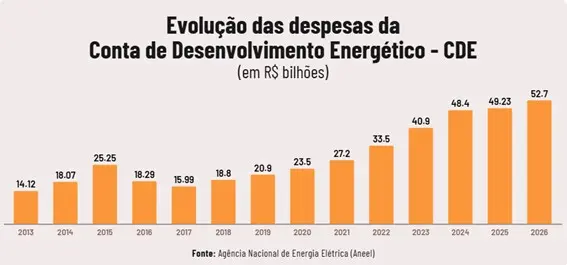
According to the Confederation, the so-called "add-ons" to the electricity tariff now represent 44% of the amount paid by consumers, with 18% related to sector charges and 26,4% to taxes. The main driver of this indicated growth is the CDE (Energy Development Account). According to the CNI, the account's budget increased from R$ 14 billion in 2013 to a projected R$ 52,7 billion for 2026.
During the same period, the combined weight of taxes and charges is expected to exceed R$ 72 billion, according to estimates from the confederation. "This burden directly affects the competitiveness of Brazilian industry, especially energy-intensive sectors, reducing investments and increasing production costs," stated Ricardo Alban, president of the CNI.
According to the CNI (National Confederation of Industry), reducing electricity costs should be a priority for the next government, given the impact of tariffs on the competitiveness of national industry. The organization believes that the current model for the sector needs adjustments to reduce the weight of electricity bills in production costs and to create more favorable conditions for the expansion of renewable energy sources.
"The industry advocates for a gradual reduction of incentives granted to generation sources that have already achieved economic competitiveness, as well as a review of subsidies for distributed generation and certain consumer segments," the Confederation added.
Reducing expenses on public policies and social programs.
The Confederation also advocates that expenses related to public policies and social programs should no longer be financed by electricity bills but rather by the National Treasury. Examples cited include the Social Electricity Tariff, the "Light for All" program, and subsidies allocated to the rural and sanitation sectors.
The CNI also advocates for the resumption of investments in hydroelectric power plants and the modernization of existing generating infrastructure to increase energy security and support the expansion of renewable energy sources.
Among the proposals are the regulation of the growth ceiling for the CDE (Energy Development Account), reduction of sector charges and cross-subsidies, as well as the modernization of the Brazilian electricity model.
The organization also proposes measures to mitigate the impacts of curtailment and prevent these costs from being passed on entirely to consumers.
Finally, the CNI highlights, however, that "there have been recent measures considered positive for the sector, such as the full opening of the free energy market to low-voltage consumers, which could benefit around 400 micro and small industries," the Confederation concluded.
all the content of Canal Solar is protected by copyright law, and partial or total reproduction of this site in any medium is expressly prohibited. If you are interested in collaborating or reusing part of our material, please contact us by email: redacao@canalsolar.com.br.



Comments
Comments are moderated before publication.Comments should be respectful and contribute to a healthy debate. Offensive comments may be removed. The opinions expressed here are those of the authors and do not necessarily reflect the views of the author. Canal Solar.