
The MEC (Ministry of Education) announced that it will eliminate the possibility of engineering courses being offered 100% online in Brazil.
The measure, which will be formalized by means of a decree scheduled for publication by May 9, meets a long-standing demand from the Confea/Crea System and which defends the importance of face-to-face hours in the training of new engineers.
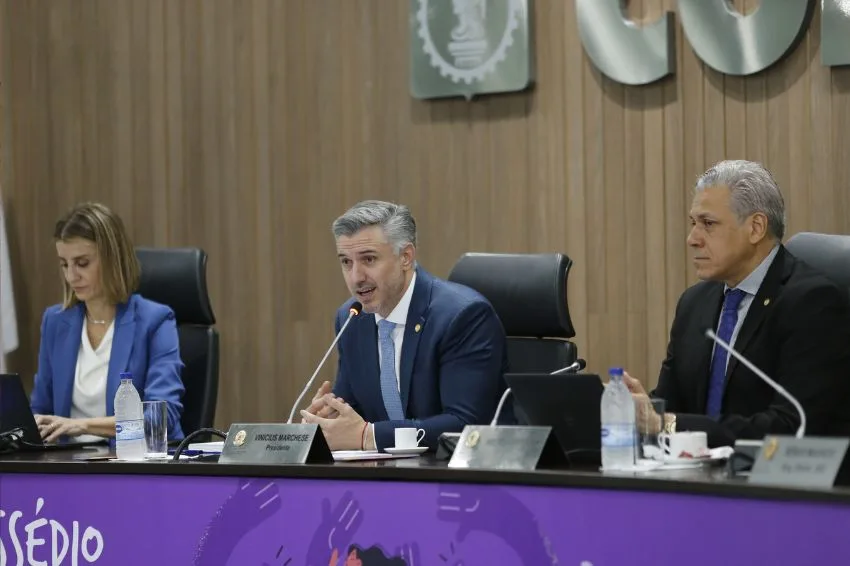
The position was officially announced by the Director of Regulation of Higher Education at the MEC, Daniel Ximenes, in an interview with the newspaper O Estado de S. Paulo, and confirmed by the president of Confea, Vinícius Marchese, during the plenary session of Confea on Friday (25).
Marchese highlighted that the decision is the result of a process of institutional and technical coordination, with the participation of Ceap (Education and Professional Attribution Commission), which provided technical support to the MEC for the decision.
With the new MEC regulations, the following will remain:
- Engineering courses with 100% of the workload in distance learning are prohibited;
- Institutions will have to comply with mandatory percentages of in-person classes, which will be defined in the decree to be published by May 9;
- Existing courses will need to adapt to the new requirements, as per MEC guidelines;
- New authorizations for distance learning courses in Engineering remain suspended.
all the content of Canal Solar is protected by copyright law, and partial or total reproduction of this site in any medium is expressly prohibited. If you are interested in collaborating or reusing part of our material, please contact us by email: redacao@canalsolar.com.br.
Comments (3)
Comments are moderated before publication.Comments should be respectful and contribute to a healthy debate. Offensive comments may be removed. The opinions expressed here are those of the authors and do not necessarily reflect the views of the author. Canal Solar.
Dear Sirs, I applaud the measure, since it makes no sense for a profession to require theory and practice to be combined. Imagine a civil or electrical engineer being designed by a professional who lacks a vision of practical reality. I remember when I was a newly graduated engineer, and the doubts and insecurity that often overwhelmed me. Anísio Teixeira used to say that those who do not know, only teach, and those who do, teach and tell how it is done in practice. Practicing engineer, professor, master in electrical engineering sciences, designer in solar generation, energy efficiency and electric vehicle charging stations, including a carport for solar generation.
I agree, and we urgently need to update the skills of several professionals who have become outdated when teaching in person. From what I've read, the main reason is the lack of laboratory classes, which are extremely important for students. However, with the methodology that many colleges apply, this ends up being meaningless, as it's all theory, something that can easily be conveyed through distance learning. Thus, most colleges offer this superficial knowledge that only students in in-person programs understand, even though most of them spent four years of their course watching slide presentations… Besides, many times the colleges don't even have well-equipped and modernized laboratories.
Dear Sirs, I applaud the measure, since I have no idea that a profession requires combining theory with practice. Imagine a civil or electrical engineer being designed by a professional who lacks a vision of practical reality. I remember when I was a newly graduated engineer, and the doubts and insecurity that often overwhelmed me. Anisisio Teixeira used to say that those who do not know, only teach, and those who do, teach and tell how it is done in practice. Practicing engineer, professor, master in electrical engineering sciences, designer in solar generation, energy efficiency and electric vehicle charging stations, including a carport for solar generation.