

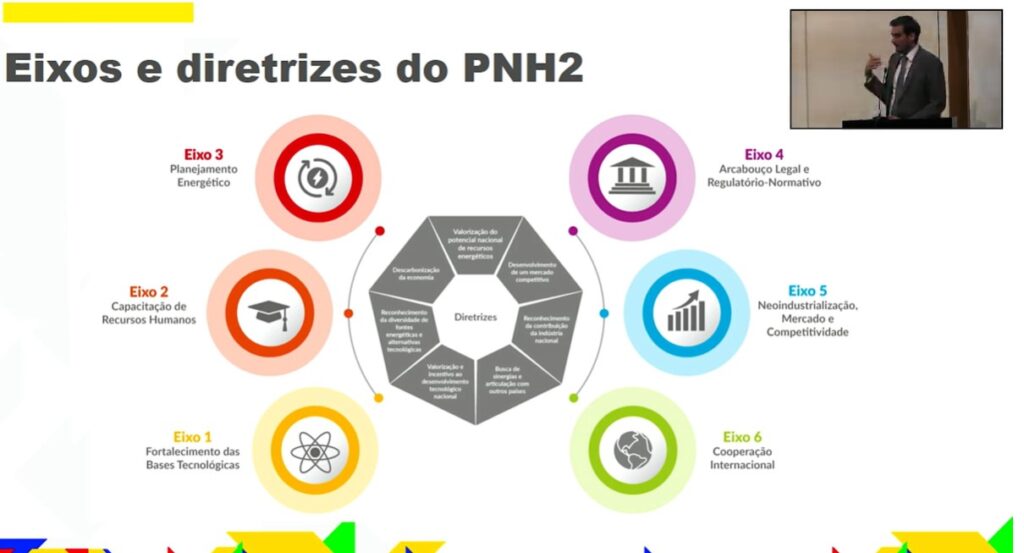
The secretary of MME Energy Planning and Transition (Ministry of Mines and Energy), Thiago Barral, presented this Wednesday (16), in a meeting with the private sector, the National Hydrogen Plan (PNH2) 2023-2025.
Among the priorities of the hydrogen economy plan include defining a national legal-regulatory framework, increase investments in R&D focusing on cost reduction and expand low-cost financing sources. The plan foresees a fivefold increase in public investments in research and development of low-carbon hydrogen.
The MME's expectation is to open a discussion, later this month, to begin the construction of a draft bill within the scope of the Federal Government. The full plan will be available to the public next week.
“The development of low-carbon hydrogen in Brazil brings more energy security, generates new jobs, will contribute to the decarbonization of industry and transport, and will help create an international market for this vector worth trillions of dollars,” said Minister Alexandre Silveira.
Barral was emphatic in stating that the construction of the PNH2 plan included the collaboration of more than 40 government institutions, more than 650 contributions registered in Public Consultation 147/22 and more than 20 private sector institutions that accompanied the thematic chambers.
O plan identified US$30 billion in hydrogen projects announced for Brazil, with the technical potential to produce 1,8 gigatons of hydrogen per year.
The plan is divided into three stages and will focus on technological routes to low carbon hydrogen production, which includes the production based on renewable sources (including biomass and biofuels), fossil fuels with carbon storage and capture, and waste.
Barral stated that the definition of the low-carbon hydrogen taxonomy is fundamental for establishing incentives, whether in the tax sphere or for the establishment of low-cost financing.
Low-carbon hydrogen appears as one of the technological solutions considered in the carbon neutrality scenarios proposed for Brazil by 2050, signaling some opportunities to create domestic demand for its use as an energy vector.
According to Barral, current projections position the Brazil as country with the lowest cost of producing low-carbon hydrogen and its derivatives until 2030.
Hydrogen has been seen as a relevant technological solution for the decarbonization of industry. In Brazil, the metallurgy and cement segments were responsible for 52% of GHG emissions from the industrial sector.
Of the 19 oil refineries authorized for operation in the country, 11 have hydrogen generation units. Currently, all are operating below the maximum installed capacity, indicating an idle capacity of around 200 thousand tons per year.
The use of low-carbon hydrogen to production of new fuels (ammonia, methanol and other synthetic liquid hydrocarbons) is a promising alternative for the decarbonization of the aviation and navigation sectors.
A fertilizer production as low associated carbon intensity brings the possibility of using ammonia as an energy carrier for hydrogen, bringing new opportunities and synergies to its exploration.
Read also
- Producing H2V will be 18% cheaper than producing gray hydrogen
- BNEF highlights the potential of green hydrogen and sustainable agriculture in Brazil
- Brazil will have a fertilizer factory using green hydrogen
In both cases, there is still a broad need for technological development, as there are high production costs, limited infrastructure and low production efficiency.
The plan aims to consolidate Brazil as the most competitive country for low-carbon hydrogen production by 2030. To get there, it will be essential to build partnerships with associations and companies in the private sector to discuss where the barriers and opportunities are.





Comments
Comments are moderated before publication.Comments should be respectful and contribute to a healthy debate. Offensive comments may be removed. The opinions expressed here are those of the authors and do not necessarily reflect the views of the author. Canal Solar.