

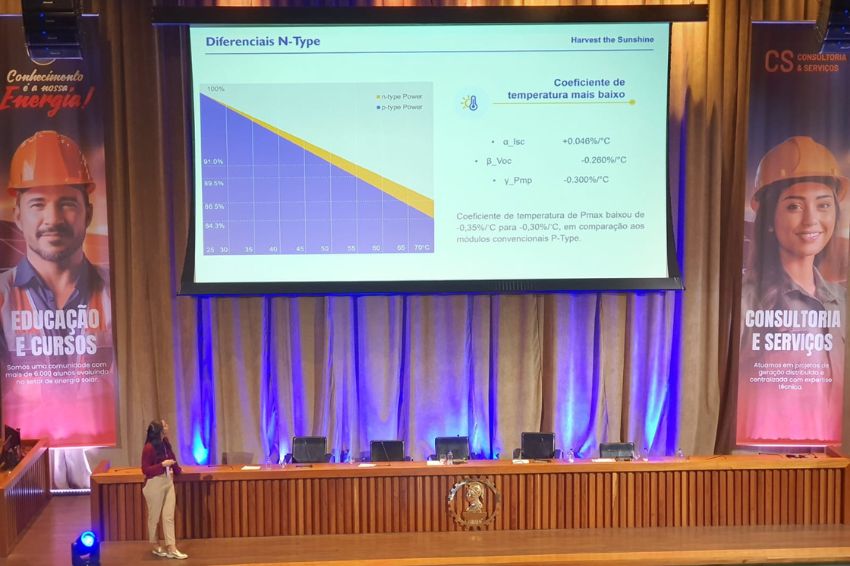
Installed power (MWp); available area; location; generated energy; and LCOE (levelized cost of energy). Second Marina Dias, technical support engineer at JA Solar, these are the points to consider when choosing between technologies P-Type ou N Type.
“It is important to always simulate projects to know the differences in energy generated between both technologies”, said the specialist, who was present as a speaker on the second day of the Canal Connect, congress held by Canal Solar in São Paulo (SP).
Furthermore, she stated that it is essential to analyze the cost available to spend on the installation. “N-Type panels are a little more expensive, in the order of 3% to 5%, but they bring benefits linked to more modern technology”.
If it is a rooftop system, for example, Marina commented that, in this type of project, there is a zero bifaciality factor, eliminating one of the biggest advantages of N-TYpe. “In this case, perhaps it would be more interesting to use the P-Type.”
“For ground-based plants, another important point to consider is the available area. If you have a small area, you will probably need a module with greater power, so it would be interesting to opt for an N-Type model. If you do not have area restrictions, you can use a panel with lower power and opt for a P-Type model”, he explained.
According to the engineer, JA Solar has a production capacity of 80 GW/year, and will continue producing both P-Type and N-type technologies, with the market and customers deciding which mix will prevail.
Differentials of the N-Type model
During the lecture, the specialist also discussed the differences between the N-Type models in relation to the P-Type, such as the reduction in BOS (system balance) from 2% to 4,5%. “This is because such modules have higher powers. Having higher power and better cell efficiency means we have less cost with the number of panels, structures and cabling.”
“There is also a reduction in LCOE from 2,5% to 6%, mainly due to gains linked to technology such as lower degradation and temperature rates, better performance at low irradiance and greater bifaciality factor”, he pointed out.
Below are the advantages and characteristics of N-Type photovoltaic modules, listed by the JA Solar engineer.
- Doping of wafers with Phosphorus and TOPCon cell technology. The P-Type features gallium doping of the wafers and PERC mono cell technology;
- Less degradation: maximum 1% in the first year and 0,4% annually over 30 years;
- Pmax temperature coefficient from -0,35%/°C to -0,30%/°C, compared to conventional P-Type panels, which leads to less thermal losses at high temperatures;
- Highest bifaciality factor: 80%. According to her, it is 10% larger than the P-Type. The bifacial gain – depending on the characteristics of the installation such as albedo (percentage of irradiation reflected by the surface. The higher the albedo, the greater the energy that can be absorbed by the rear face of the module), height of the modules and spacing between rows – can be 0,8 .1,2~10% (assuming XNUMX% back irradiation);
- Better performance at low irradiance: 0,2% extra energy gain at the beginning and end of the day, due to the better conductivity of the N-Type cell.
JA Solar launches
Marina Dias also presented at Canal Connects JA's launches for the coming months. Among the highlights is the P-Type JAM72D30/LB model, from the Deep Blue 3.0 series, which has an efficiency of up to 21,9% and a power of 580 W.
In addition, the manufacturer will make available the N-Type JAM66D45/LB model, from the Deep Blue 4.0 series, with efficiency of up to 22,8% and power of 615 W, and the N-Type JAM72D42/LB panel, also from the Deep series. Blue 4.0, with efficiency of up to 22,5% and power of 630 W.
Finally, it is worth mentioning that JA Solar has several 1-minute videos in Portuguese with simple language on its YouTube Brazil channel, which already have more than 130 thousand views.
The company also has a specific video about the differences between N-Type and P-Type, which can be accessed here.




An answer
I can't follow the lectures in person, but with these summaries I stay up to date with what's going on there.
Regarding the difference between P-type and N-type, this summary was very useful for me to understand and distinguish in terms of advantages and types of raw material for manufacturing the panels. Based on this distinction, it makes it easier to choose the most appropriate type of panels to choose for a given installation, without leaving aside the area where they will be mounted.