

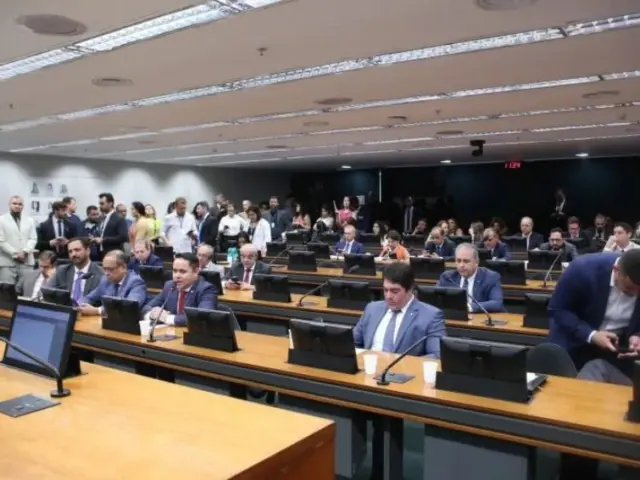
The Chamber of Deputies' Mines and Energy Committee held a public hearing this Tuesday (29) to discuss a bill that prohibits electricity distributors and their subsidiaries from operating in the micro and mini distributed generation segment.
The project in question, Bill 671/2024, authored by Deputy Delegado Marcelo Freitas (União Brasil-MG), received support from many representatives of institutions linked to the sector, invited to the public hearing.
Among the entities present were the National Confederation of Commerce, Goods, Services and Tourism, Sebrae, ABRADEE (Brazilian Association of Electric Energy Distributors), INEL (National Institute of Clean Energy), the MSL Association (Free Solar Movement), Revolusolar-Rio de Janeiro, FMGD (Minas Gerais Distributed Generation Front) and ABGD (Brazilian Distributed Generation Association).

“The electricity sector needs to be organized, but this requires focus and a broad and rich discussion. We just want things to work. The project addresses the risks associated with the creation of distributed generation subsidiaries by electricity distributors, which include conflicts of interest, monopoly, unfair competition, harm to free competition, disincentives for new market entrants and limitations on the diversification of energy sources. All this to ensure equal access to the grid for all generators and guarantee fair competition in the distributed generation market,” explained Heber Galarce, president of INEL.

Hewerton Martins, president of the Associação Movimento Solar Livre, highlighted in his speech that distribution companies are monopolizing the GD (distributed generation) sector, harming small generators.
He reported that electricity distributors have rejected solar energy projects, claiming technical problems with connection to the grid, but later they themselves offer this service to consumers.
Wedson dos Reis Alves da Silva, executive president of the Minas Gerais Distributed Generation Front, recently reported a case of unfair action by the energy distributor operating in Minas Gerais.
“The integrator had approached the university to do the installation, proposed the project, signed the contract with the university and, some time later, received a response from Cemig Distribuição saying that it was impossible, charging R$4 million to improve the network to include it in this system. Two months later, a system was already being installed by Cemig itself,” he said.
According to the rapporteur of Bill 671/2024, Congressman Lafayette de Andrada (Republicanos-MG), the current situation compromises equality among companies in the sector. “It does not seem equitable to me and, to me, it is an affront to the economic order, to free competition, for the same group that explores an economic activity to be the arbitrator who authorizes or not its competitor to exercise that same economic entity,” he said.
According to the parliamentarian, the law that deals with grants and concessions for energy distribution prohibits the same company from operating in distribution and electricity generation.
For Carlos Evangelista, president of ABGD, the approval of Bill 671/2024 is seen positively. He highlighted the “revolution caused in Brazil” by photovoltaic solar energy. “Almost R$200 billion in new investments, more than 1,2 million new jobs created and R$61 billion in revenue. In addition, 47,8 million tons of CO₂ were avoided. This project aims to consolidate this revolution,” he emphasized.
Integrators from SP and RS plan demonstrations against rejections due to flow reversal
Onslaught
At the end of the meeting, there was a disagreement between the project's rapporteur, deputy Andrada, and deputy Silvia Waiãpi (PL-AP), author of the request for the public hearing to be held and president of the session.
The congressman from Minas Gerais complained about having his speech cut off. Silvia argued that Lafayette had exceeded the three-minute speaking time stipulated for all the deputies present, while the other guests had ten minutes each. Lafayette claimed that, because he had signed the document, he was entitled to more time, and left the public hearing.
Watch the public hearing
Don't miss any news from the electricity sector! Sign up to our Community by clicking here and get exclusive access to our content!
all the content of Canal Solar is protected by copyright law, and partial or total reproduction of this site in any medium is expressly prohibited. If you are interested in collaborating or reusing part of our material, please contact us by email: redacao@canalsolar.com.br.


Comments
Comments are moderated before publication.Comments should be respectful and contribute to a healthy debate. Offensive comments may be removed. The opinions expressed here are those of the authors and do not necessarily reflect the views of the author. Canal Solar.