
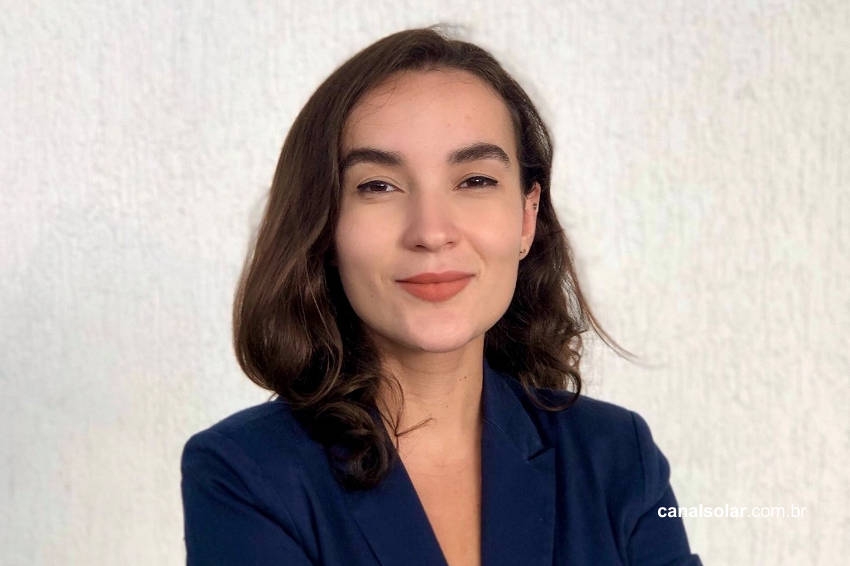
Today is the debut day of the Papo Solar podcast and our guest is distributed generation specialist Bárbara Rubim. A leader in the renewable energy sector for years, the vice-president of the Board of Directors of ABSOLAR (Brazilian Photovoltaic Solar Energy Association) She told how she started her career in the sector and analyzed what is to come this year with the update of REN 482. In addition, Bárbara commented on her expectations regarding the creation of the legal framework for distributed generation in Brazil through a bill.
Bárbara, tell us what your start in the electricity sector was like here in Brazil?
Well, I started my career in the electricity sector about eight years ago and it was through the third sector, through Greenpeace. Before that, I already had experience as a parliamentary advisor and then I was invited to work at the Greenpeace office in São Paulo. When I started at the office, I started working directly on the energy campaign with the theme of renewable energy, which is one of Greenpeace's focuses: promoting energy production.
I studied possible developments and developments in the Brazilian electrical matrix to understand what type of public policies we should encourage to achieve the energy transition. This is how I became increasingly close to the renewable sector and also the solar energy sector. This was, more or less, at the time of the arrival of 482 and the options about what distributed generation would look like and how distributors would adapt to it. After this entry, I never left the sector.
You followed the entire transition, from the establishment in 2012, when the resolution was reached, until now. How is your view of solar energy here in the country compared to countries abroad?
We had two moments in the regulation of solar energy: when 482 came, when we talked about distributed solar generation, and another when we had the review of 482, in 2015. When we had the review in 2015, we usually say that this placed Brazil among the reference countries in the world in the subject of regulation for distributed generation. An extremely advanced regulation that stimulated the development of this in the country.
I think that much of what we have seen in the development of the sector since then is somewhat the result of that, but it is also the result of a slightly broader public policy that also began in October 2014, when we had the first dedicated federal auction for solar energy. Brazil is a reference country in terms of solar energy because of the potential we have here, but, without a doubt, we leave a lot to be desired when we think about how much we can grow as a country in this source and how little we take advantage of the potential we have today. .
Bárbara, you were at the presentation of the draft of the bill that aims to create the legal framework for distributed generation in Brazil. What is your perspective on this bill or others that are also being processed in the Chamber of Deputies?
Well, the first thing we need to say is that there is a draft that has been prepared by Representative Lafayette and we are not quite sure how it will be formally presented to Congress. It is not yet a bill per se. We have more than seven bills under consideration in Congress. Congress related to the issue of distributed generation. These projects have, in several aspects, sought to bring a more balanced solution to the sector, with regard to the way in which the compensation system operates than the solution presented by ANEEL, in October of last year.
you expect the ANEEL present this update that is being discussed a lot in this first semester?
Absolutely. At the end of last year, the ANEEL published its regulatory agenda for 2020 and 2021 and, in that agenda, updated the topic of review 482, saying that this process would be concluded by the end of the first half of the year. So, I no longer believe that we will have a conclusion of it in the first quarter, which was the initial forecast given even by the director/rapporteur.
However, I believe that in the first half of the year, maybe by the end of June, we will have some formal progress on this by the agency. What we have to fight for and hope for as a sector is that we can have a resolution, a change coming through a bill before we have the administrative review process concluded by the agency itself. ANEEL.
Talking about this month, which is women's month. How do you see female participation in the solar energy sector?
First, it is important to say that the electrical sector is extremely marked by the presence of men. The entry of women more massively into the electrical sector has occurred more recently and it is great to see this. I remember that when I started in the sector, eight years ago, it was very difficult to see women debating the electrical sector, the energy matrix, especially raising and talking about solar energy at events. So it is a very welcome and much needed change.
A super important fact to keep in mind in this very important month is that the renewable energy sector is one of the sectors that employs the most women in the world in recent years, in terms of job growth. This shows a few things: the first is how much women have become interested in the topic and how much it is a sector that has opened up worldwide to bring more opportunities. In Brazil, this is no different, we have seen more and more female leaders emerging.
I think what we need now is to be able, in our sector, to build more and more space for equality between genders. And, not just between genders, but a space that is truly diverse, whether for gender or minorities, valuing everyone's voice and what each person has to add in terms of their knowledge, expertise, beliefs and its capabilities for the sector.

Comments
Comments are moderated before publication.Comments should be respectful and contribute to a healthy debate. Offensive comments may be removed. The opinions expressed here are those of the authors and do not necessarily reflect the views of the author. Canal Solar.