

According to the MME (Ministry of Mines and Energy), MMGD (micro and mini-distributed generation) dates back to 2008. In this context, a working group was created, culminating in Normative Resolution 482/2012.
With the exponential growth of the distributed electricity generation model through the SCEE (Electricity Compensation System), several discussions began regarding changes to the existing rules at the time, leading to the need for a new legislative framework for the sector, which was consolidated with Federal Law No. 14.300 of 2022, later regulated by Normative Resolution 1.000/2021, amended by Normative Resolution 1.059/2023.
With this new regulatory framework, ANEEL (The National Electric Energy Agency) intended to resolve previously existing legislative omissions, bringing more legal certainty regarding the use of the SCEE.
Distributed magnetic resonance (DMR) became popular through so-called "Solar Communities" or "Solar Farms," a model that allows a group of people to maintain a DMR plant and share the benefits among themselves.
This model of electricity production appeals to consumers who, despite their high electricity consumption, are not included in the concept of free consumers, who can define who their electricity suppliers will be.
They are called captive consumers, that is, they are consumers without the freedom to decide who to buy their energy from, being linked to the local energy distributor.
In this sense, the consumer-generators connected to the electricity distribution network are small generators, and fall within the definition of captive consumers.
In other words, given the impossibility of choosing who to buy the energy consumed from, the consumer-generators included in the MMGD produce electrical energy for their own consumption.
According to the Federal Prosecutor's Office at the ANEELHowever, "[t]he fact that the captive consumer has generation capacity, as permitted by Resolution No. 482/2012, does not violate this premise. By installing, maintaining, and operating its asset, using the energy it generates, the consumer acts as a generator, not a generator holding a concession, permit, or even authorization, but a unique generator, with characteristics of a registered holder and others outlined by Resolution No. 482/2012."
The Federal Prosecutor's Office continues, "[t]he commercialization of the input, moreover, is absent from the scope of activities of this 'consumer'. In fact, not even when he makes use of the electricity compensation system inaugurated by Resolution No. 482/2012 and injects the surplus of unconsumed energy into the distribution network, appropriating corresponding credits, is the commercialization of the input characterized. Moreover, Opinion No. 108/2012 already addressed the issue, concluding, after analyzing the nature of several contracts, that the electricity compensation operation constitutes a loan, (...)".
Despite Resolution 482/2012 having been superseded by the publication of Resolution 1.059/2023, the precepts present therein remain, so that the understanding adopted by the Federal Prosecutor's Office with the ANEEL remains current, with regard to the validity of the MMGD model for captive consumers.
And this is evidenced by ANEEL, which asserts that “(…) it is imperative to recognize that the new and recent provision in the Law, by explicitly making eligible 'consortium, cooperative, voluntary or building civil condominium or any other form of civil association, established for this purpose, composed of natural or legal persons who own a microgeneration or distributed minigeneration consumer unit', among others, has enabled the creation of new business models that use the shared generation modality, making the characterization and prevention of possible distortions of distributed minigeneration as generation for own consumption more complex.”
It is in the context of high tariffs and the lack of freedom to choose the electricity supplier, that Solar Communities, supported by current legislation, take advantage of the possibility of uniting a group of people, sharing the costs arising from the generation of electricity. to share the benefits resulting from joint investment in the system.
Starting from this premise, several questions arise, including:
- Legality of Solar Communities;
- Delegation of supervision to distributors; It is
- Lack of clear penalties for irregularities highlighted by distributors.
Legality of Solar Communities
Given the growth of Solar Farms implemented in recent years, the distributors claim that they subverted the objective of the association permission for the purpose of self-generation of electrical energy, to, in practice, sell electrical energy, using the free market model for consumers. captives.
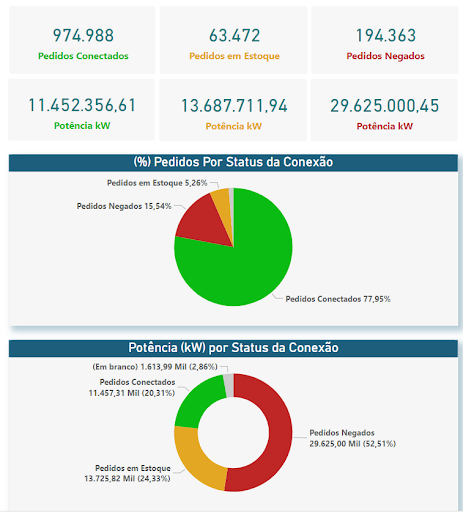
Even though we are dealing with a fraction of the distributors' captive consumers, the distributors' real concern is with the continued possibility of losing this consumer market, which was guaranteed to them by an old model of the electrical system, of structural monopoly, without the existence of current technologies.

Currently, distributors serve 90 million consumer units. Of this total, 2,09 million customers have adopted distributed generation. However, solar communities do not move to the free market because, to date, there is no possibility of choosing an electricity supplier for low-voltage consumers, who remain linked to the local distributor.
In fact, even if the legislation authorizes remote energy generation, it is not possible for them to be that remote, as distributed generation requires that the consumer-generator be within the same concession area as the consumer unit that will receive the energy credits.
In other words, energy consumption and generation must be covered by the same local distributor, there being, therefore, no interchangeability between distributors, and in this sense, there is no freedom of choice, an essential characteristic of the captive consumer model.
Delving deeper into the issue, while not exhausting the topic, it is observed that one of the points of discussion regarding the existing model is that the costs incurred by distributors would be borne by other consumers, those unable to participate in solar communities or install their own systems. However, we do not believe this conclusion to be true.
First, because the distortions are covered by current legislation, which seeks to compensate for any potential loss by the distributor. What we don't see being taken into account when analyzing the issue is that solar communities bear part of the cost of expanding the system, which is used by other consumers who are not generators.
According to article 108 of Resolution 1000/2021, the generating consumer must financially contribute to the works necessary to increase demand, as requested in the connection application. It is also important to highlight the obligation of the generating consumer in group A to pay the minimum contracted demand.
It is clear that the increase in load and its costs are not fully borne by the distributor, which will pass it on to its captive consumers, but there is clearly a division of costs with the solar communities, so that the claim that Solar communities would result in an increase in the cost of energy for other captive consumers.
The discussion then turns to the legal prohibition on the sale of electricity under the MMGD model. Again, what is observed is a discourse from distributors that solar communities would, in fact, sell the energy generated, which violates current legislation.
The legislation is expressed:
"It is forbidden to include in the SCEE (Brazilian Electricity Regulatory System) a consumer unit with distributed microgeneration or minigeneration that does not qualify as electricity production for its own consumption."
E, "The sale of energy credits and surpluses is prohibited, as is obtaining any benefit from the allocation of energy credits and surpluses to other holders, and the provisions of article 655-F shall apply if this is found to be the case.".
The fact is that solar communities don't sell energy; the system is built on the possibility of offsetting the energy generated by the consumer-generator, which has as members various owners of consumer units. Obviously, this is a private enterprise that must be maintained through financial contributions with a periodicity agreed upon by the parties.
At this point, the Director-Rapporteur of the review of REN no. 482/2012 presented his understanding that “(…) there is no such regulatory restriction for captive consumers to carry out the activity of self-production of electricity (or self-consumption, according to the nomenclature of Resolution No. 482/2012, of 2012, which seeks to emphasize the consumer characteristic of those who have chosen to install micro and mini-distributed generation), and they may possess the land and generation equipment through rental and lease agreements whose consideration is not, fundamentally, the payment for the energy produced. In other words, equipment contracts may have clauses defining the payment of variable installments associated with the yield and performance of the equipment, but the value of the principal installment must be fixed so as not to characterize the commercialization of electricity.”
This contradicts what the Specialized Audit Unit for Electrical and Nuclear Energy of the TCU (Federal Court of Accounts) would like to suggest, which asserts that there is an irregular commercial arrangement in the organization of solar farms.
It is worth clarifying that, although the understanding was adopted under REN No. 482/2012, the core of the issue is the same under Resolution 1000/2021, the legal impossibility of selling electricity within MMGD.
In fact, corroborating this conclusion, the response from ANEEL to the TCU: “(…) Nevertheless, unless the commercialization of electricity between associations/consortia/cooperatives/voluntary or building civil condominiums and their respective beneficiary consumers is identified within the scope of the SCEE, or irregularity in the constitution of these associative forms, it is not seen a priori that the distributors have sufficient legal support to remove or not allow the participation of these consumers in the SCEE. This is because the law itself explicitly provides for the right of consumers to join together in one of these associative forms to participate in the SCEE in the shared generation modality.
And finally, the distributors themselves use the solar community model, which would be contrary to their own interests, if, truly, this model were harmful to the captive consumer system.
We could extend the debate and delve deeper into all the points discussed; however, it seems clear to us that solar farms are in perfect accordance with the legislation on the subject. Therefore, we move on to the next point: the problem of delegating the oversight of compliance with the legislation to local distributors.
Delegating oversight to distributors
Chapter – distributor – carry out the inspection and install or adapt the measurement system.
According to article 655-F, in the event of evidence of irregular receipt of benefits associated with the SCEE (Special System for Energy Efficiency), the distributor must take steps to accurately characterize this, compiling a set of evidence that proves the irregular receipt of the benefit. It is evident that the distributor is responsible for overseeing compliance with the legislation and regulations of MMGD (Minimum Guaranteed Distribution), under Resolution 1000/2021, which clearly presents a conflict of interest.
Local distributors through ABRADEE (Brazilian Association of Electric Energy Distributors) question the validity of solar communities, essentially alleging that they violate the captive market, generating losses for distributors due to the reduction – allegedly – of their effective consumer market, and these same companies are those responsible for monitoring the validity of the energy compensation system.
The oversight should be carried out by an independent body whose purpose is to guarantee the faithful compliance with the law. We question, at this point, how to ensure that the oversight body will, in fact, impartially analyze whether the situation is indeed in accordance with the law, if the body responsible for doing so has an interest in the outcome of the oversight.
We do not stop at this point, but expand to the issue relating to the granting of connection budgets, which are also often denied in a discretionary manner by the distributors, who use arguments, sometimes without any factual support, to deny the connection.
It is of utmost importance to emphasize that it is not only the responsibility of the local distributor to assess whether the project requesting the connection quote complies with the legislation during the use of the compensation system, but also at the time the connection quote is granted. To reiterate, local distributors are clearly not impartial entities in the role of overseeing the electricity compensation system, and this function should not be delegated to them.
Furthermore, distributors – notwithstanding the social function of companies – are guided by profitability, not by social well-being and the well-being of the electricity system, which definitely benefits from the growth of distributed generation (DG), an essential part of the energy transition that has been so much in vogue in recent times. Finally, we move on to the issue of legal uncertainty arising from the lack of a clear definition of penalties and their extent in the electricity compensation system.
Lack of clear penalties for irregularities highlighted by distributors.
In addition to the impartiality of the agent to whom the inspection was delegated, there is no clarity as to what the penalty would be if the solar communities were, in fact, irregular. Solar farms, as seen throughout this explanation, are in perfect harmony with the electricity compensation system, including in the understanding of... ANEEL.
The creation of associative groups in order to reduce their costs for using the compensation system in no way violates the norm, however, if irregularities were identified, the question we must ask is: how will the solar farm be penalized?
We could try to answer the question by analyzing article 655-F, of REN no. 1000/2021, which says:
"Article 655-F. In the event of evidence of irregular receipt of benefits associated with the SCEE (Special System for Electricity Distribution), the distributor must take steps to accurately characterize this, compiling a set of evidence that proves the irregular receipt of the benefit. (Included by REN)" ANEEL 1.059, of 07.02.2023/XNUMX/XNUMX)” (no emphasis in the original).
Or still in continuity with what was said above, we must analyze article 655-D, § 3, which reads, as transcribed below:
Art. 655-D. The consumer responsible for a consumer unit can participate in the SCEE:
§ 3º The inclusion of consumers in the SCEE is prohibited in cases where it is detected, in the document proving possession or ownership of the property where the distributed microgeneration or minigeneration is installed or will be installed, that the consumer has rented or leased land, lots, and properties under conditions in which the rental or lease value is given in reais per unit of electrical energy.
And, further, we look at article 325:
“Art. 325. The distributor must compensate the billing when there is a difference to be charged or returned resulting from the following situations: I – measurement defect, as referred to in Section V of Chapter VIII; II – proof of irregular procedures, as referred to in Chapter VII of Title II; or
§ 1 The distributor must notify the consumer in writing, using a method that allows proof of receipt, containing the following:
III-A – in the case of irregular receipt of benefits associated with the SCEE, a description of the irregularity and associated evidence, as well as the amounts to be recalculated; and (Included by REN) ANEEL 1.059, of 07.02.2023/XNUMX/XNUMX)” (no emphasis in the original).
The above regulation is entirely based on the terms of Resolution 1.000/2021. Although we have the articles above addressing the topic, none of these articles fully answers the question posed.
Assuming that the distributors will in fact act impartially, once the irregularity has been corrected, could the consumer-generator be reinserted into the electricity compensation system? How long?
By paying the differences determined by the distributors in any irregularity found, and correcting the identified irregularity, should the compensation system be reinstated for that consumer unit? When?
The insecurity caused by the lack of answers to the questions above is evident, since, even though solar communities are not profit-making ventures in essence, as they are not about the sale of electrical energy, as we have made clear, they are of investments, the results of which are harvested through compensation for the energy generated, and which in the current system are at the mercy of the distributors.
We consider it unfeasible to apply the penalty of exclusion from the SCEE indefinitely, however, with the distributors as agents of supervision and application of the penalty, due to a clear conflict of interests.
In our view, there should be a period of cure for the irregularity, allowing the inclusion of the consumer-generator in the SCEE, and furthermore, it should necessarily be ANEEL be part of this procedure in order to ensure the appropriate penalty.
References
- Consumers covered by articles 15 and 16 of Law no. ° 9.074/1995 and by §5 of article 26 of Law no. 9.427/1996
- Opinion no. 00542/2015/PFANEEL/PGF/AGU
- Official Letter No. 20/2024 -AIN-ANEEL, of 18/04/2024
- https://app.powerbi.com/view?r=eyJrIjoiZTZhYWU4ZTItNGVjYy00NWIwLTg3ZjMtNGIwMzBiZGNhMDAwIiwidCI6IjQwZDZmOWI4LWVjYTctNDZhMi05MmQ0LWVhNGU5YzAxNzBlMSIsImMiOjR9 (acessado em 12/04/2024)
- https://abrapch.org.br/2023/08/geracao-distribuida-ja-representa-11-de-toda-energia-gerada-no-pais/
- Art. 108. The consumer's financial participation is the positive difference between the budget for the minimum overall cost work, proportionalized under the terms of this article, and the burden for which the distributor is responsible. § 1º The distributor must proportionalize the budget for the minimum overall cost work considering the relationship between the greatest demand for load or generation to be met or increased and the maximum demand made available by the budget at the connection point, with mandatory application of art. 100. (Text given by REN ANEEL 1.059, of 07.02.2023/2/4) § 98º The budget cannot contain the items set out in § XNUMXº of art. XNUMX
- Art. 2°. (…) the consumption of active electrical energy or accounted for as energy credit by consumer units participating in the system. (…) – REN 1.000/2022
- § 5 of article 655-D, of REN 1000/2021
- § 5 of article 655-M, of REN 1000/2021
- Circular Letter No. 0010/2017-SR/ANEEL, of 22/03/20217
- Official Letter No. 20/2024 – AIN/ANEEL
- Cemig SIM- company linked to a distributor


Comments
Comments are moderated before publication.Comments should be respectful and contribute to a healthy debate. Offensive comments may be removed. The opinions expressed here are those of the authors and do not necessarily reflect the views of the author. Canal Solar.