
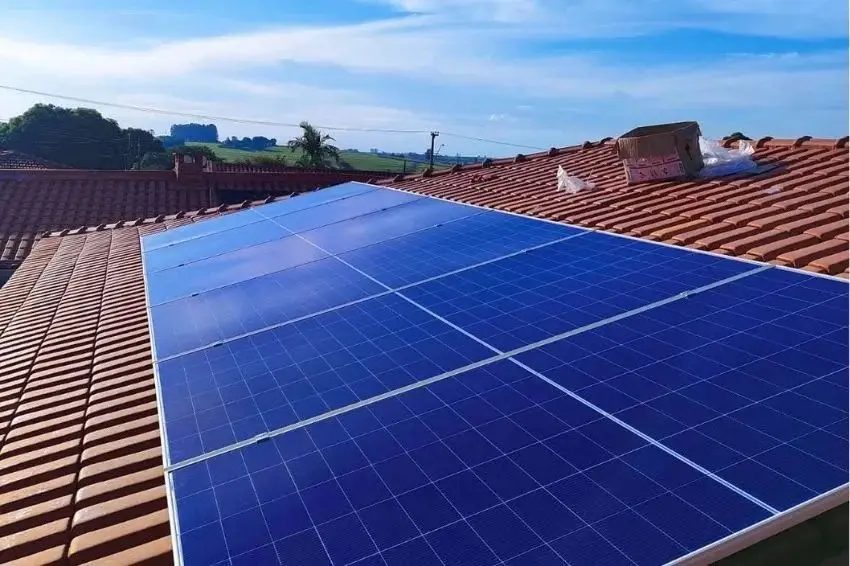
For those who look at distributed generation (DG) through a CFO's spreadsheet, the indicators that usually enter the analysis are the obvious ones: installed capacity, monthly generation, projected savings on the electricity bill. What almost never enters is allocation efficiency, that is, how much of the energy injected into the grid is actually converted into credit deducted from the bill. It is this omission that leaves real money on the table, percentage point after percentage point.
First, the correct definition.
The basis of calculation matters. Energy consumed at the moment of generation (instantaneous self-consumption) directly reduces the bill and never becomes a credit, therefore it should not be included in the denominator.
Allocation efficiency is measured by the energy injected and the credits available: it is the relationship between the energy compensated and the energy compensable (which, according to the rules of the Electric Energy Compensation System, should have offset the consumption of the beneficiary units during the period).
It is also necessary to distinguish between what is not inefficiency. The progressive charging of part of the Fio B component on compensated energy, foreseen in Law 14.300/2022 for systems that filed the access request after January 7, 2023, reduces the value in reais of each kWh compensated, but it is a legal and predictable rule.
It's factored into the investment projection, not the inefficiency calculation. What matters here are the kWh that should have been compensated for but weren't.
The scale that makes 1 percentage point relevant.
Brazilian distributed generation increased from 36,2 GW in 2024 to 45 GW in 2025, according to EPE, and already exceeded 50 GW in September 2026, above the projections made at the beginning of the year. On a base of this magnitude, distributed across millions of consumer units, any percentage of inefficiency in the allocation of credits ceases to be an operational detail and becomes a systemic cost line, silently diluted among the bills.[RV2]
For a company or fund with a distributed generation (DG) portfolio, whether as a generator, as a consumer with multiple units in remote self-consumption, or as a manager of third-party assets, the same logic applies on a smaller scale: 1 percentage point of compensable energy that does not become applied credit, month after month, has the same effect as a hidden tariff that no one contracted.
Why the effect is greater than it seems
The 1 pp weight is cumulative, not a one-time event. Energy credits are valid for 60 months, and a misallocated credit in one month does not generate an alert: it is added to the credit of the following month, and the next, resulting in a loss that only becomes visible when someone compares, period by period, the energy actually compensated with the energy that could be compensated.
Consider an illustrative example, with round numbers: a distributed generation (DG) portfolio with potential credits equivalent to R$ 1 million per month (net of the Fio B portion stipulated by law), operating with 96% allocation efficiency.
The 4% lost due to claim denials, incorrect allocation, and expired credits represents R$40 per month, or R$480 per year. Increasing efficiency to 97% doesn't seem ambitious, but it reduces the annual loss by R$120. In larger portfolios, the same 1 percentage point increases proportionally to the asset.
This reduces allocation efficiency in practice.
The factors are not exotic. They are operational and, therefore, correctable: outdated or poorly configured allocation percentages between units in remote self-consumption; beneficiary units with incorrect registration; credits that reach the end of the 60-month window without being applied; and distributor deductions that are not identified and contested.
What does the regulatory agenda add to the bill?
Up to this point, the CFO equation had one known regulatory variable: the Fio B schedule, which reaches 60% in 2026, 75% in 2027, and 90% in 2028 for systems included in the general transition. The next variables are less predictable, and all affect the value of each kWh compensated.
The first is the post-2029 regime. Law 14.300 stipulates that, once the transition is complete, the rules will reflect the valuation of the costs and benefits of distributed generation. This issue has accumulated delays: the ANEEL The Public Consultation Process No. 23/2025 was opened, which ended in March 2026, and the 2026-2027 Regulatory Agenda postponed the calculation to 2027.
The second is the discussion about hourly rates: the Federal Attorney's Office together with ANEEL The government issued an opinion admitting its application to consumer-generators, preserving the legal benefits of the transition. If this goes ahead, the time of generation and consumption will change the discount on the bill, even without a change in physical production.
The third is the ECR (Resource Supplement Charge) created by Law 15.269/2025, which provides, starting with the 2027 budget, for a proportional reduction in benefits funded by the CDE that exceed legal limits, with an effect on the GD that still depends on the classification of each project.[RV3]
Why this should be on a CFO's radar, not just the technical team's.
The argument for investing in distributed generation (DG) is usually presented in terms of return on generation: system payback, project IRR. But the real return depends on a second factor.
A less discussed variable: the efficiency with which the injected energy is converted into credit deducted from the bill. An asset with impeccable generation and 90% allocation efficiency delivers 10% less value in the portion of the benefit that depends on credits, and this extends the payback period without any equipment failure.
With the regulatory agenda making the value of each kWh compensated more variable, the question on the decision-making table changes. It's not just "how much does this plant generate," but "how much of that generation do I actually get back, how consistently is that number audited, and how does it behave in each regulatory scenario?" Treating allocation efficiency as a permanent financial metric, and not as a one-off check, is the way to answer this question.
References: Law 14.300/2022 (art. 17, art. 26 and art. 27); Law 15.269/2025; EPE, data on installed capacity of MMGD 2024-2025, via Canal Solar (10/09/2026); Canal Solar, installed capacity survey (September 2026); ANEELPublic Consultation 23/2025 and Regulatory Agenda 2026-2027. The numerical example values are illustrative, constructed for educational purposes, and do not represent audited market data. Regulatory situation with a cutoff date of September 2026.
The price of opacity: how much does it cost not to track GD credits[RV4]
"Traceability" is one of those words that sounds good in sustainability reports but means nothing in a financial spreadsheet, until someone does the math. Once the math is done, what is currently treated as good governance practice in distributed generation reveals itself to be something more concrete: a cost line that a large portion of consumers using distributed generation pay without knowing they are paying it.
Two concepts, one difference.
In the market, the term "compensable energy" refers to the portion of injected energy and accumulated credits that, according to the rules of the SCEE (Electric Energy Compensation System), should offset the consumption of beneficiary units in a cycle.
Compensated energy is what effectively reduced the bill. These terms are not defined in regulations (the regulations refer to injected energy, surplus energy, and energy credit), but they are the most direct way to see where the value is lost.
From concept to number
Transforming traceability into monetary value does not require proprietary methodology. It does require one precaution: separating what is a legally mandated deduction from what is an avoidable loss. For systems that submitted their access request after January 7, 2023, Law 14.300/2022 stipulates that part of the Fio B component be billed based on compensated energy (60% in 2026, 75% in 2027, 90% in 2028). This reduces the value in reais of
Each kWh is offset, but it's not opacity. Therefore, the difference must be measured in kWh and valued at the net credit value:
Avoidable loss (R$) = (Compensable energy – Effectively compensated energy, in kWh) × Net value of kWh compensated in the period
The net value is the tariff applicable to the compensated consumption minus the portion of the B Wire that the transition rule mandates be billed. With this separation, what the formula reveals is not statistical noise: it is energy that existed, was injected, was eligible, and did not return.
In period-by-period monitoring, this difference becomes invisible. It doesn't appear as an error anywhere on the bill because it doesn't trigger an automatic alert: it's a process gap that only becomes apparent when someone compares the two numbers side-by-side.
Where opacity is born
None of the causes are hypothetical. They all stem from how the current rules work in practice: credits with a 60-month validity that expire without being applied when no one monitors the balance; incorrectly configured or outdated percentage allocations between units in remote self-consumption; beneficiary units with inconsistent registration; and distributor deductions not identified in time for contestation.
In each of these situations, energy that was compensable ceases to become compensated energy, silently, bill after bill.
The scale of the problem
Brazilian distributed generation already exceeded 50 GW of installed capacity in September 2026, distributed across millions of consumer units.
On this basis, even a small opacity rate, of a few percentage points of compensable energy that does not translate into credit, represents a significant volume of uncaptured value, dispersed among individual accounts and therefore invisible in the aggregate until someone specifically searches for it.[RV5]
There is currently no official, consolidated figure for how much this represents in reais for the sector. No agency publishes this metric because it is only visible to those who monitor individual portfolios. It is precisely this absence of public statistics that supports the argument: the cost of opacity is real, but remains invisible due to the lack of traceability that would expose it.
Opacity will gain new sources.
Until now, the gap between generated and compensated energy had known causes. The 2026 regulatory agenda adds another: energy that is not injected due to grid constraints. Public Consultation No. 009/2026, opened by ANEEL In April, it addresses the treatment of surplus energy in distribution and acknowledges that, in critical system security situations, generation cuts may be necessary. In September, Public Consultation No. 033/2026 began discussing monitoring and communication requirements.
and response to commands for resources connected to the distribution, with different requirements depending on size and impact.[RV6]
A limitation on injection reduces the energy reaching the compensation system without the plant having any defect and without the bill explaining why.
For those who only monitor generation and compensation, this effect is easily confused with low irradiance or equipment failure. Therefore, traceability tends to require a fourth number: the energy not injected due to restrictions, estimated from the expected generation.
What changes with traceability?
In practice, tracking means keeping the numbers (energy generated, compensable and compensated, and increasingly the energy not injected due to restrictions) comparable period by period and per consumer unit, with alerts when the ratio between compensated and compensable energy falls below an expected margin. This does not eliminate the B Wire, which is a legitimate and growing deduction, but it separates what is a legally foreseen cost from what is an avoidable loss.
The difference is relevant for those making investment or audit decisions. It's one thing to accept that Fio B reduces the expected return on a distributed generation asset, because that's mandated by law and is predictable. It's quite another to lose additional value by not knowing which credits have expired or that an allocation has been incorrectly configured for eight months.
The first is regulatory cost. The second is opacity, and it has a price, even if it doesn't yet have an official name in any industry statistics.
The opinions and information expressed are the sole responsibility of the author and do not necessarily represent the official position of the author. Canal Solar.


Comments
Comments are moderated before publication.Comments should be respectful and contribute to a healthy debate. Offensive comments may be removed. The opinions expressed here are those of the authors and do not necessarily reflect the views of the author. Canal Solar.