
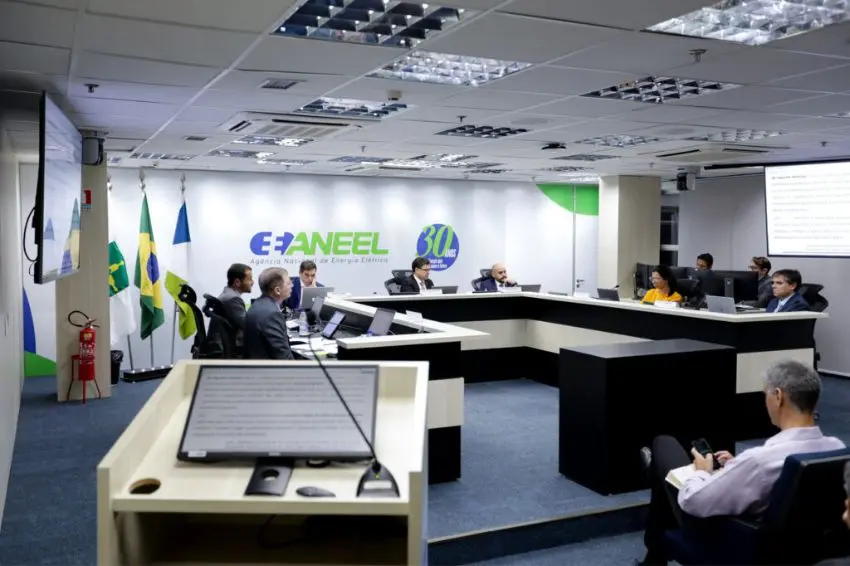
The proposed budget for the CDE (Energy Development Account) for 2027 marks a new stage in the financing of subsidies for the electricity sector.
With the entry into force of the spending cap foreseen in Law No. 15.269/2025, part of the costs that exceed the legal limits will no longer be covered by the quotas paid by consumers in general and will be attributed to the beneficiaries of the incentives themselves, through the ECR (Resource Supplement Charge).
A ANEEL The Brazilian National Electric Energy Agency (ANEEL) estimates that the gross budget of the CDE (Energy Development Fund) will reach R$ 55,1 billion in 2027. Of this total, R$ 6,369 billion corresponds to the excess of expenses subject to the spending cap, an amount that will be covered by the new charge.
The proposal is in a preliminary phase and has been submitted for a 30-day public consultation period before the final version is prepared for deliberation by the agency's board of directors.
CDE finances public policies in the electricity sector, including tariff benefits, programs to universalize access to energy, and subsidies for certain generation and consumption segments.
Its main revenues come from annual fees charged to agents that serve end consumers, with costs incorporated into the usage fees for the distribution and transmission systems.
The new rule, however, limits the revenue allocated to certain expense categories. The ceiling is calculated based on the values considered in the 2025 budget, adjusted for inflation.
When the projected expenditure exceeds this limit, the difference is allocated to the beneficiaries of that category, without the possibility of offsetting it with any surplus funds from other subsidies.
Distributed generation will see a greater reduction.
The most significant impact falls on subsidies for distributed micro and mini-generation (DMM), a category that includes small-scale generation systems, such as solar panels installed on rooftops.
The projected expenditure for this benefit rises from approximately R$ 6,9 billion in 2026 to R$ 8,455 billion in 2027. The inflation-adjusted ceiling, however, remains at R$ 4,028 billion.
The estimated difference of R$ 4,426 billion will be covered by the ECR. ANEEL It calculates a charge factor of 52,4% on the projected expense for this item. The reduction does not mean that the electricity bill for all consumers with solar panels will increase by 52%. The percentage applies to the benefit, not to the total bill amount.
Furthermore, the application of the charge will depend on specific regulations. The proposal under discussion aims to cover systems classified as GD2 and GD3, as well as GD1 systems served by small distributors, respecting the provisions of the legal framework for distributed generation.
The second group affected is that of incentivized sources, which benefit from discounts on network usage fees. The projected expenditure for 2027 is R$ 18,809 billion, compared to an updated ceiling of R$ 16,866 billion. The surplus of R$ 1,943 billion corresponds to an ECR factor of 10,3%.
Combined, these two categories account for the R$ 6,369 billion of the new charge. There is no projected surplus for supply discounts or for coal in 2027.
Expenses that fall outside the spending cap, such as the CCC (Fuel Consumption Account), the Social Tariff, and universal access programs, continue to be financed by the CDE's ordinary budget.
Regional apportionment is moving towards equalization.
Another change affects the distribution of CDE quotas among Brazilian regions. The legislation provides for a gradual reduction in the historical difference between the costs charged in the North and Northeast and those applied to the South, Southeast, and Midwest.
The process should be completed in 2030, when the reference unit costs will be equalized between the regions.
By 2027, the ratio between the reference costs of the South, Southeast, and Midwest and those of the North and Northeast will be 1,38. This means that the unit charge in the first three regions will remain higher, but the difference will be smaller than what is currently observed.
The transition gradually transfers a larger share of the revenue sharing to the North and Northeast regions, while reducing the relative share of the other regions.
Aneel's proposal estimates that, in 2027, the unit cost of the CDE (Energy Development Fund) will increase by 7,3% in the North and Northeast regions and decrease by 3,8% in the South, Southeast, and Midwest regions. For low-voltage consumers, the estimated average tariff impact is an increase of 0,77% in the first two regions and a reduction of 0,62% in the others.
These variations stem from the regional criteria for allocating quotas, and not just the total size of the budget. The proposal also maintains differentiated factors by voltage level. Medium-voltage consumers have a factor of 0,80 in relation to low-voltage consumers, while high-voltage consumers have a factor of 0,50.
Budget almost stable in quotas
Despite a gross budget of R$ 55,1 billion, the portion financed by the annual CDE quotas is estimated at R$ 47,842 billion in 2027, a growth of only 0,1%, or R$ 49 million, compared to the R$ 47,793 billion considered for 2026.
Stability results from the application of the spending cap and the ECR (Economic Compensation Rate), which reduce the portion covered by ordinary revenues, offset in part by the decrease in other sources of funds and the increase in financial adjustments.
The values may still change after the subsidies are gathered. Aneel (Brazilian Electricity Regulatory Agency) will also have to finalize the ECR (Energy Recovery Code) regulations, including the billing method and the updating of factors according to the expenses actually incurred. The expectation presented in the supporting document is that the new rule will be implemented starting in January 2027.
all the content of Canal Solar is protected by copyright law, and partial or total reproduction of this site in any medium is expressly prohibited. If you are interested in collaborating or reusing part of our material, please contact us by email: redacao@canalsolar.com.br.

Comments
Comments are moderated before publication.Comments should be respectful and contribute to a healthy debate. Offensive comments may be removed. The opinions expressed here are those of the authors and do not necessarily reflect the views of the author. Canal Solar.