
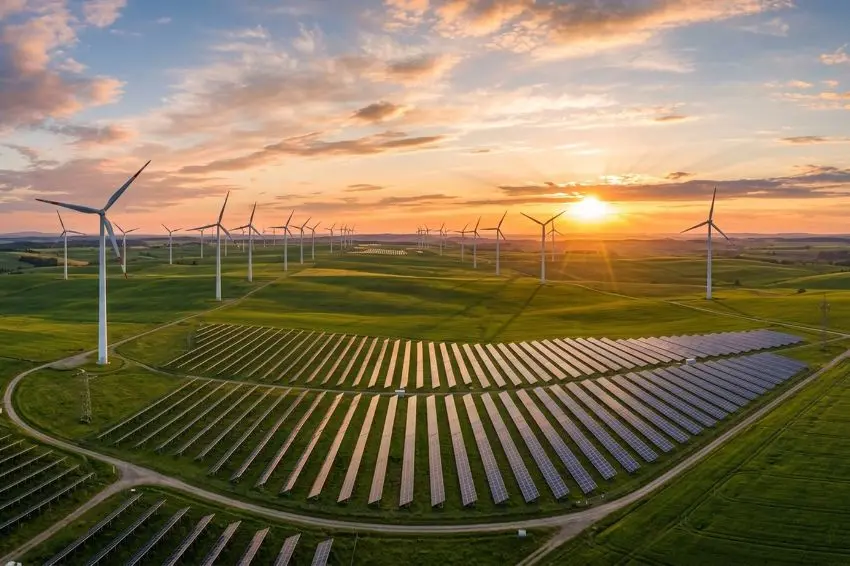
More than 2,5 TW of installed capacity in wind and solar power plants worldwide will face decisions regarding decommissioning, life extension, or repowering by the 2040s.
The estimate comes from the consulting firm Wood Mackenzie, which points to the aging of equipment as one of the main factors that should influence investments and the expansion of renewable energy sources in the coming decades.
This volume represents more than 70% of the 3,5 TW of wind and solar capacity that were in operation worldwide at the end of 2025.
According to the study “Renewing renewables: The next chapter in the energy transition”Replacing old equipment with more efficient technologies could expand electricity generation, reduce costs, and create new opportunities for manufacturers and investors.
The movement has already begun in the wind power sector. By the end of 2026, more than 30 GW of capacity are expected to have been decommissioned worldwide, with approximately two-thirds of that volume taken out of operation between 2022 and 2026.
Currently, nearly 50 GW of wind farms have been in operation for more than 20 years, a period that corresponds to the originally projected lifespan of many of the turbines installed in the early stages of the technology's expansion.
Wood Mackenzie expects wind power capacity with more than two decades of operation to exceed 230 GW by 2040, potentially reaching 440 GW by 2050. In the solar photovoltaic segment, although expansion has occurred more recently, the volume of installations over 20 years old is expected to surpass that of wind power before 2040.
According to the consultancy, repowering existing power lines could represent a more economically attractive alternative than constructing new developments, especially in regions with limited access to the electricity grid and limited land availability.
This is because existing power plants already have connection infrastructure, operational history, and, in many cases, licenses and permits that can facilitate the modernization of projects.
Although capital and operating costs are similar to those of new ventures, the efficiency gains from the equipment can provide greater electricity production and reduce the levelized cost of energy (LCOE).
In Germany, for example, wind farms decommissioned this decade are located in regions with average wind speeds 4% higher than those of new projects. According to Wood Mackenzie, this difference can result in capacity factors approximately 7% higher and an equivalent reduction in LCOE.
Technological progress
The evolution of equipment is another factor that should stimulate the modernization of wind farms. In the last 20 years, the average power of wind turbines has increased from 1,5 MW in 2006 to 6 MW in 2026. The projection is that it will reach 7,5 MW by 2036, allowing for increased generation capacity with a smaller number of wind turbines.
In solar photovoltaic energy, the average efficiency of modules increased by 69% between 2005 and 2025. As a result, current projects can occupy up to 30% less area to deliver the same installed capacity as projects built in 2010.
In addition to productivity gains, the equipment has also become more durable. The design lifespan of wind turbines has increased from 20 years to over 30 years, while warranties for photovoltaic modules have increased from 25 to 30 years.
According to Wood Mackenzie, these advances can make replacing equipment economically viable even before the end of its useful life, especially when increased production offsets the necessary investments.
Renovation can reduce prices.
The consultancy also draws attention to the impacts of repowering on the electricity market. In Germany, the modernization of existing wind farms could increase generation from this source by 16% by 2050, considering efficiency gains and the reduction of losses associated with generation cuts.
The additional volume is equivalent to almost a third of the country's current annual wind energy production. According to projections, the increased supply could lead to a 12% to 19% reduction in electricity prices in the German market during the 2040s, all other conditions remaining the same.
This scenario, while favorable to consumers, could also represent a challenge for power generators. This is because many projects will have terminated their long-term contracts and will be more exposed to price fluctuations in the wholesale market or to the conditions negotiated in bilateral power purchase agreements.
Wood Mackenzie believes that plant owners will need to consider the effects of repowering on future revenues, especially when deciding whether to extend equipment operation, replace assets, or permanently shut down operations.
The aging of wind farms could also hinder the achievement of renewable energy expansion targets. In the European Union, for example, the goal of reaching 500 GW of wind power capacity by 2030 requires the installation of approximately 37 GW per year between 2023 and 2030.
However, the projected decommissioning of 17 GW during the same period will increase the need for new installations by approximately 2 GW annually just to compensate for the removal of old equipment.
Manufacturers should increase sales.
The renovation of wind and solar farms is also expected to drive the global supply chain. Even with the prospect of a slowdown in net additions of installed capacity, Wood Mackenzie estimates that equipment sales could be more than 60% higher in 2050 compared to 2026, driven by the need to replace aging assets.
By the 2040s, equipment replacement is expected to account for 44% of wind power installations and 23% of solar power installations worldwide. In more mature European markets, where a significant portion of plants were built in the early stages of renewable energy expansion, the share of replacements could exceed 70%.
The study also identifies a shift in investor behavior, with companies acquiring operating power plants not only for their current generation capacity but also for their potential for modernization. In these cases, location, the quality of natural resources, and connectivity infrastructure can represent competitive advantages for the new owners.
all the content of Canal Solar is protected by copyright law, and partial or total reproduction of this site in any medium is expressly prohibited. If you are interested in collaborating or reusing part of our material, please contact us by email: redacao@canalsolar.com.br.




Comments
Comments are moderated before publication.Comments should be respectful and contribute to a healthy debate. Offensive comments may be removed. The opinions expressed here are those of the authors and do not necessarily reflect the views of the author. Canal Solar.