

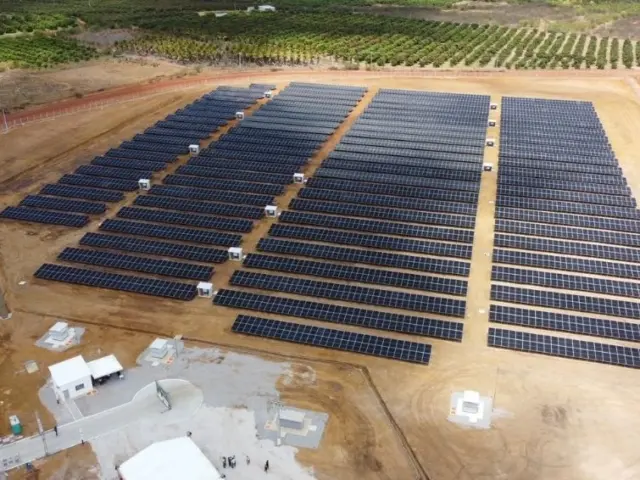
A supermarket in Arapiraca (AL) received a 1,2 MWp photovoltaic solar system, with 2.182 modules and 8 100 kW inverters, designed to meet the increased load of air conditioning without the need to expand the substation or change the contracted demand with the utility company.
The project was developed by LR Soluções Elétricas, a company owned by Laerte Ramon with over 17 years of experience in distributed generation (DG) and large-scale electrical projects. The system was designed to enable air conditioning for the supermarket without waiting for the approximately one-year period required to expand the substation from 500 kVA to 1.000 kVA, as demanded by Equatorial Alagoas.
“We submitted the project to the utility company and received approval, but with a one-year deadline to energize the customer. Since he had already purchased the equipment and was installing the air conditioning, we conducted a study and identified that the best solution would be to opt for the Grid Zero system,” explained Laerte Ramon, the electrical engineer responsible for the project.
System that operates alongside the load.
The Grid Zero model works in such a way that the photovoltaic generation does not inject energy into the grid, acting only to offset the client's internal demand. In this way, the supermarket was able to put the air conditioning into operation immediately, without increasing the contracted demand.
“When the air conditioning units come online, the solar system will also start operating in parallel, compensating for this. Therefore, it wouldn't be necessary to change the contracted demand,” Laerte stated.

Technical details of the project
The system includes:
- 2.182 photovoltaic modules;
- 8 SUW500 WEG inverters of 100 kW each;
- Dry-type transformer of 1.000 kVA and main circuit breaker of 1.500 A;
- Detailed single-line diagrams, measurement with current transformers (CTs), protection with relays and knife switches.
All equipment was installed on the supermarket roof, fully integrated with the existing load, ensuring operation within the contracted demand limit.
Results
With Grid Zero active, the demand recorded by the utility company showed a significant reduction, for example: 70 kW at 5 am and 480 kW at 17:30 pm, even with the air conditioning fully operational.
Laerte highlighted that the solution allowed the supermarket to operate with air conditioning without the need to expand the substation or delay the operation of the equipment. "We managed to implement a logistical system within the supermarket so that there would be no alteration in the contracted demand," he concluded.
The project demonstrates how large-scale photovoltaic systems can be strategically integrated to control demand without relying on capacity increases from utility companies.
Furthermore, the project was designed with a safety margin in relation to the supermarket's electricity demand. Although the client has a contracted demand of 500 kW, the maximum historical consumption recorded before the air conditioning was around 230 kW, with an average below 300 kW. This difference creates an operational reserve that allows the system to remain stable even in the event of failures in some of the photovoltaic inverters.
According to Laerte, the system is also undergoing an automation process to reinforce this safety. If one or more inverters malfunction, a mechanism can automatically activate a trip coil connected to the circuit breakers of the air conditioning units, shutting down part of the load to prevent exceeding the contracted demand.
In an extreme scenario where the fault is not immediately noticed, the substation still has the electrical capacity to support the full load, since the transformer has been replaced with a 1.000 kVA model, and the only possible impact would be the punctual payment of excess demand to the utility company.
all the content of Canal Solar is protected by copyright law, and partial or total reproduction of this site in any medium is expressly prohibited. If you are interested in collaborating or reusing part of our material, please contact us by email: redacao@canalsolar.com.br.
Comments
Comments are moderated before publication.Comments should be respectful and contribute to a healthy debate. Offensive comments may be removed. The opinions expressed here are those of the authors and do not necessarily reflect the views of the author. Canal Solar.