
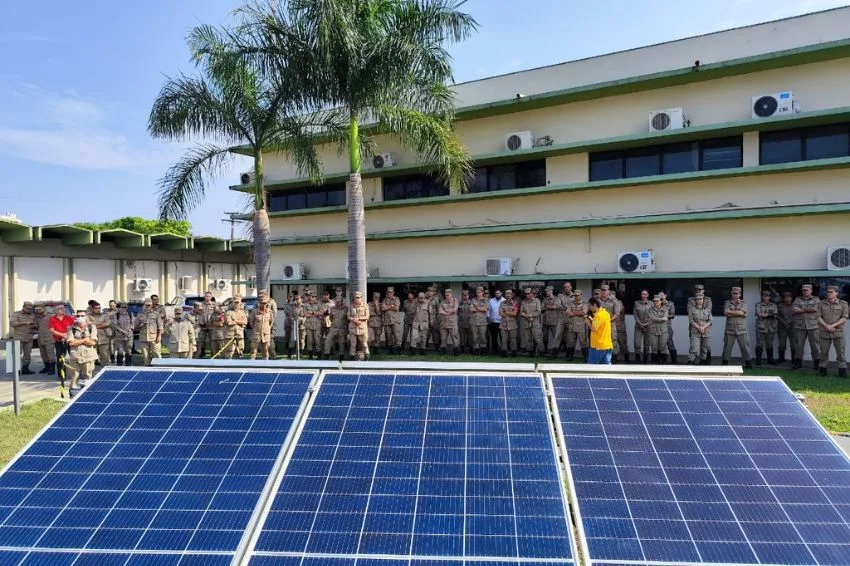
ABNT (Brazilian Association of Technical Standards) published, this Tuesday (4), the NBR 17193:2025 – Fire safety in photovoltaic installations — Project requirements and specifications — Use in buildings. The technical standard establishes the mandatory AFCI (arc fault interruption system) and the FDR (rapid shutdown function) in buildings, their envelopes and associated risk areas, whatever their use (residential, commercial, industrial, whether public or private).
Another new feature introduced by the text is that solar panels cannot be installed continuously on roofs, and must be spaced at least 2 m apart every 16 linear meters, or be interspersed with a fire-resistant barrier, classified as EI-60 or EW-60, according to ABNT NBR 16945, which rises at least 1 m above the upper plane of the plant installation.
Standard creation process
The project was developed in just one year, between January and December 2023, within the scope of CB-024 of ABNT, the Brazilian Fire Safety Committee, based on a technical report by IEC and other national and international standards.
The initiative arose from a request by Conaci (National Firefighting Committee), in response to the concerns of state fire departments about the fact that photovoltaic systems installed on roofs continue to generate energy, even with the alternating current input switches turned off.
Importance and impacts on the sector
For engineer João Souza, technical manager at Ecori Energia Solar and current secretary of the study committee that drafted the text of the standard, the publication represents a significant advance in the safety of photovoltaic installations in Brazil. “NBR 17193:2025 is an important step towards ensuring the safety of firefighters and consumers, both in relation to electric shocks and fires,” he stated.
He emphasized that the document is already in force and must be followed in new installations. “This standard will serve as a reference so that all fire departments in Brazil can update their regulations or, in states that do not yet have specific standards, use it as a basis for new guidelines.”
Souza also revealed that a new standard for large ground-based solar plants is already underway. “The one that was published applies to installations in (or inside) buildings. We are now working on a similar text, but specific to ground-based plants, which also require safety regulations,” he explained.
Lessons from the floods in Rio Grande do Sul
In addition to the regulations, the engineer cited a practical example of the importance of the new requirement for the rapid shutdown function. He recalled the recent floods in Rio Grande do Sul, when several photovoltaic installations remained energized even when submerged, posing a risk to professionals and rescue teams.
“Manufacturers and distributors had to be very careful when decommissioning and disassembling systems. Even when submerged, the modules could remain energized if they were receiving light, which could cause accidents. With the quick shutdown function, this type of situation would be avoided. This was a real problem debated by the market and now there is a standard that helps mitigate this risk,” he concluded.
Want to turn knowledge into opportunity? Discover the next solar energy events and stay up to date with the latest news in the sector in Brazil and around the world.
all the content of Canal Solar is protected by copyright law, and partial or total reproduction of this site in any medium is expressly prohibited. If you are interested in collaborating or reusing part of our material, please contact us by email: redacao@canalsolar.com.br.

Comments (5)
Comments are moderated before publication.Comments should be respectful and contribute to a healthy debate. Offensive comments may be removed. The opinions expressed here are those of the authors and do not necessarily reflect the views of the author. Canal Solar.
What happens to an inverter purchased without an AFCI and that has not yet been installed? Do I have to take legal action to avoid throwing the equipment away? Brazil changes its rules all the time. This is what is called legal instability, where the rules change at the whim of the wind, harming those who purchased the equipment without an AFCI and now have to install it. This harms companies and customers who purchased the equipment without an AFCI. A real treat for dealers who have no interest in installing solar energy. What a shame.
This new text of NBR 17193:2025 will indeed bring an important advance in the safety of professionals who deal with these installations, but it has also brought a huge challenge to adapt and meet this requirement in projects that use String systems, since these devices that will bring more safety, if implemented, must be under the modules and on the roof, which would only be practically possible, except with MLPE systems. Ideally, these DC sectioning and protection components would already be added to the photovoltaic modules themselves.
Bom Dia.
I just hope this isn't another cost imposition,
financial or excessively technical, and limitations due to roofs, too many coverings of a Brazil and the rest of the World, who did not dream that this gift would one day come to pass, and thank God,
in continental dimensions, especially in our Brazil, today in the Group of the 10 largest wind generators and especially solar PV in the world,
and look, there was no shortage of powerful “bought” ones to disrupt this extraordinary innovation, originating from the King star, the Sun, which, thank God, cannot be covered, in addition to being the author of life on Earth, which by 2050 will become the largest generator of clean energy on the Globe,
Yes, we started with the extraordinary solar/CSP thermo system with storage in Brazil, with 4 types of generation systems, the most used being the parabolic trough and the tower with thousands of heliostats around it, with steam storage tanks at a minimum temperature of 500 degrees, with the use of molten salt, resulting in this gift, generating solar energy day and night.
Go to Google and search for Parque Solar Cerro Dominador, Chile.
And look, we have the Maremotris generation source waking up!!
Finally, human beings are making the biggest impact on Planet Earth in history, with solar PV generation projects already underway in Space.
Is it soft or what?
Oops… and the GHG, greenhouse gases, falling their emissions, in an extraordinary way on Earth,
safeguarding the power of Life, in the same way that it celebrates, every day, the miracle of human existence, and especially the protection of future generations.
Hugs,
Emerson,
Mt.
Please ban string inverters.
The people who were so careful not to set a deadline can only live in Disney and think that this will not have a brutal impact on integrators. It even seems that the end customer will stop getting the cheapest quotes with these string inverters without RDS.
Thank you very much, gentlemen, for putting another nail in the coffin of our sector.
Good luck ecori.
In practice, we know how difficult it is to implement, but what reassures us is the fact that we have generation but at a very low voltage level and in the DC system. I don't see much risk.
But Standards and Regulations are always important… for large plants.