

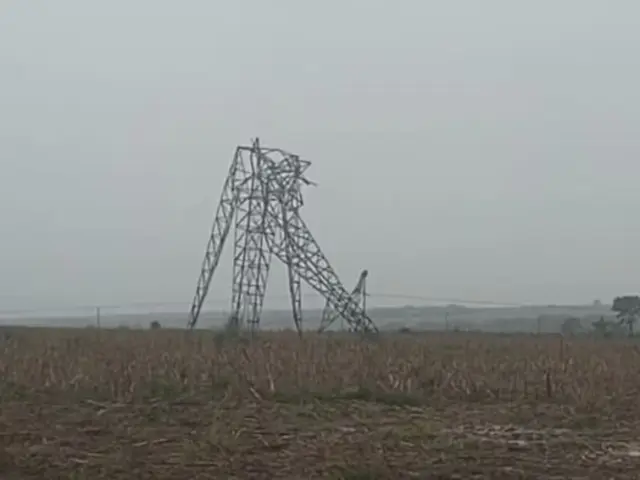
After identifying actions of vandalism at three transmission towers and having created a special office to monitor the situation, a ANEEL (National Electric Energy Agency) shot um alert to the sector for generators, transmitters and distributors to activate contingency plans to minimize the effects of possible new attacks.
Even though the prevention measure is an important point taken by the Agency, energy sector professionals highlight that other initiatives also can be applied to minimize not only possible impacts caused by vandalism, but also by more intense weather events on transmission lines.
One of them, for example, is the use of battery banks in regions close to power towers, as explained by Rogério Costa, an energy consultant with experience in storage systems.
According to him, the use of technology can, among other benefits, avoid interruption of electricity in services considered essential – such as hospitals and industries – for a period in which technical authorities can make the necessary corrections to the transmission line.
“Today, we have towers transmitting energy from point A to point B and, if you have a storage system at the end point of this line, you have a contingency of three to four hours to solve the problem and not let an entire city will be without power during this period,” he explains.
In addition to helping to minimize the problems of a possible lack of supply, Costa comments that the use of technology also reduces the risk of overloading transmission lines, since when you have a battery bank you can have a constant flow of energy throughout the day instead of recording peaks on the transmission line.
“Today, if there is a line in the North or Northeast, where there is a lot of renewable energy, we can use the battery to regulate the voltage, frequency and use it as a capacity system – avoiding the dispatch of thermoelectric plants when there is little rain. Furthermore, it can serve as a contingency system in case of a line outage”, he pointed out.
The use of technology in projects related to energy transmission is not new in Brazil. Recently, in December this year, the country's first large-scale battery system went into operation in the interior of São Paulo.
The system was installed at the Registro Substation (SP) and occupies an area of approximately 5 thousand square meters – the equivalent of half of a football field.
The system architecture, the result of an innovation project by ISA CTEEP and with support from the R&D Program of ANEEL, acts during peak consumption periods, as a reinforcement to the electrical grid, thus avoiding interruptions in the energy supply on the South Coast of São Paulo.


Comments
Comments are moderated before publication.Comments should be respectful and contribute to a healthy debate. Offensive comments may be removed. The opinions expressed here are those of the authors and do not necessarily reflect the views of the author. Canal Solar.