
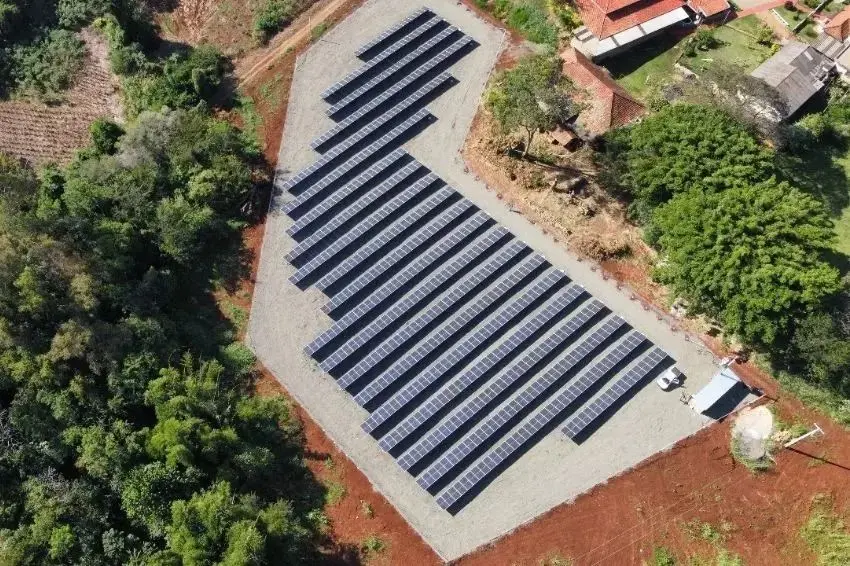
Law No. 14.300/2022 established the legal framework for MMGD (micro and mini-distributed generation) and regulated the transition of tariff components applicable to compensated energy.
Law No. 15.269/2025 introduced a new economic variable by establishing limits for certain expenses of the CDE (Energy Development Account) starting in 2027, with repercussions on the benefits covered by the ECR (Complementary Resource Charge).1
REN ANEEL Decree No. 1.176/2026, published on November 23, 2026, regulates the application of the charge in invoicing, without approving the definitive factor.2
The problem investigated consists of determining the monetary magnitude on which the factor affects and how this effect can modify the economy of a consumer participating in shared generation.
The hypothesis is that the impact depends on the share of the eligible benefit in the total economy, as well as the form of remuneration for private agents. The methodology combines normative examination, arithmetic reconstruction of the invoice, and counterfactual simulation, keeping other billing conditions constant. The intention is not to generalize the results from a single unit to the entire market.
Normative foundations and basis of incidence
Article 13 of Law No. 10.438/2002, as amended by Law No. 15.269/2025, establishes the mechanism for limiting the expenses covered by the CDE (Environmental Development Fund). The ECR (Environmental Compensation Rate) seeks to cover the surplus by reducing the corresponding benefit, shifting part of the cost to the beneficiaries of the item.
REN No. 1.176/2026 distinguishes between gross tariff benefit, charge, and net benefit. Article 310-A of REN No. 1.000/2021, introduced by the new regulation, covers distributed generation (GD) II and GD III, in addition to the specific case of GD I served by a distributor with a market of less than 700 GWh per year.2

The CDE's budget proposal for 2027 estimated, for MMGD subsidies, an expenditure of R$ 8.454,52 million, a limit of R$ 4.028,38 million, and a surplus of R$ 4.426,14 million. Dividing the surplus by the projected expenditure results in approximately 52,4%. This is an estimate subject to methodological definition and approval, not a definitive percentage.
Case study: identifying the rubrics
The excerpt from the invoice shows consumption of 1.451,001 kWh and compensation of 1.264,340 kWh. Negative entries for TE, TUSD, and flag charges total R$ 881,14. Items 6U and 73, for gross and net tariff benefits for GD II, show symmetrical values of R$ 472,33, with a net effect of zero in the analyzed document.4
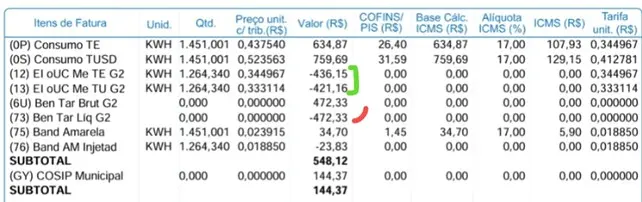
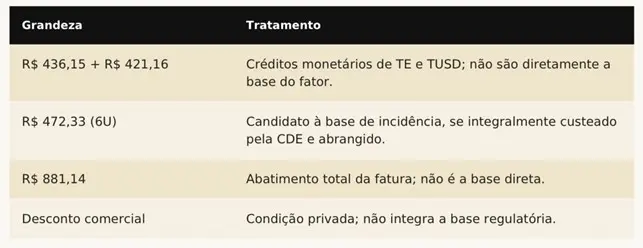
Item 6U is a candidate for the tax base, conditional upon confirmation of its composition and the amount actually covered by the ECR. The monetary credits for TE and TUSD, by themselves, do not constitute the direct basis of the factor.
Economic simulation of the charge.
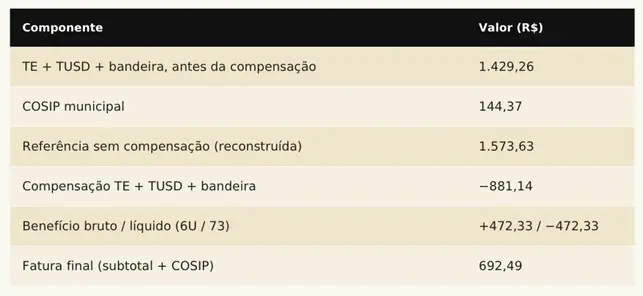
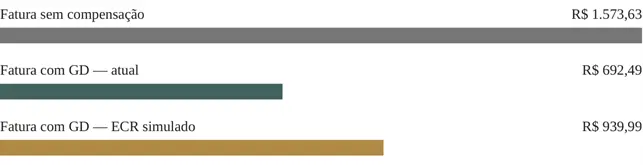
The invoice reconstruction without compensation results in R$ 1.573,63 (R$ 634,87 for TE, R$ 759,69 for TUSD, R$ 34,70 for flag fees, and R$ 144,37 for COSIP). The value with compensation is R$ 692,49, including COSIP. The difference is R$ 881,14. Assuming that the entire 6U item is eligible, the hypothetical ECR is calculated by the expression E = B × f, where B represents the gross benefit covered and f, the applicable factor:
E = R$472,33 × 0,524 = R$247,50.
The net benefit increases to R$ 224,83;
The simulated bill rises to R$ 939,99
The remaining discount is R$ 633,64.
The result equates to a 28,09% reduction from the original discount (247,50 ÷ 881,14), and not a 52,4% reduction in the total savings.
Interaction with the scaling of Wire B
The 2027 projection requires distinguishing the ECR from the transition foreseen in article 27 of Law No. 14.300/2022. In the general regime of GD II, the incidence of the distribution components specified in the law increases from 60% in 2026 to 75% in 2027.5 The ECR factor, in turn, applies to the monetary benefit covered.
It is not methodologically appropriate to sum the percentages or automatically apply the 25/40 ratio to item 6U, as its composition may be broader. The invoice must first be reconstructed according to the rules and tariffs in effect in 2027, and then the eligible base must be identified and the approved factor applied. Adjustments, taxes, tariff flags, and changes in consumption can also modify the result.
Contractual repercussions in shared generation
The regulatory effect impacts the beneficiary unit's bill, but its economic absorption depends on the conditions agreed upon between the consumer, the manager, and the owner of the generating plant. The commercial discount should not be confused with the benefit funded by the CDE (Energy Development Fund). Billing regulations do not establish an obligation to declare the private discount to the distributor for the purpose of calculating the ECR (Energy Recovery Code), without prejudice to information duties in specific audits.2
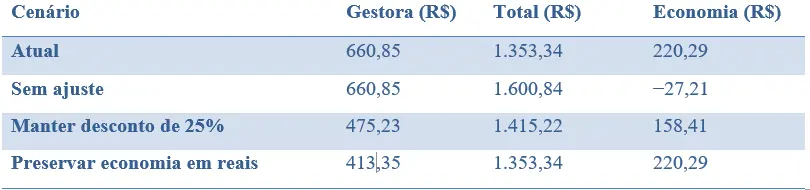
To evaluate this distinction, a completely fictitious commercial scenario is adopted, with a 25% discount on the abatement, without reproducing the contracts or private data of the operation. The consumer would save R$ 220,29 and the manager's charge would be R$ 660,85. The application of the simulated charge allows for three distinct commercial responses.
Maintaining the original charge would result in negative savings. If the discount percentage on the new reduction is preserved, the manager's gross revenue would decrease by R$ 185,62; if the nominal savings are preserved, it would decrease by R$ 247,50. These differences do not necessarily represent a loss of margin, as the margin also depends on costs, taxes, and the plant's remuneration.
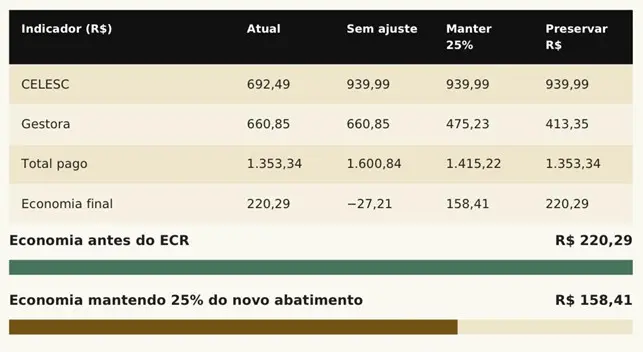
The full allocation of the impact to the owner of the generating plant may be subject to contractual negotiation, but it is not an automatic consequence of the regulation. The review must observe the existing clauses, objective good faith, and the legal limits of the SCEE (Brazilian Electricity Regulatory System).
It is recommended to establish verifiable adjustment criteria, prohibit duplicate payments, require prior notification, implement renegotiation mechanisms, and set exit rules. Remuneration should respect the legal nature of the operation, without altering the shared generation model.
Conclusion
The ECR introduces a budgetary dimension to the evaluation of the savings obtained by the MMGD. In the case analyzed, the simulation shows that a factor of 52,4% on the hypothetically eligible gross benefit of R$ 472,33 produces a reduction of R$ 247,50, equivalent to 28,09% of the total reconstructed discount.
Compensated energy may remain nominally constant, while its economic value decreases. This decoupling requires that project evaluations consider not only physical generation, but also tariff and contractual conditions.
Billing transparency is essential to distinguish the charge from other tariff effects. REN No. 1.176/2026 allows for a transitional presentation due to a reduction in the benefit in the first half of 2027; subsequently, the identification of the calculation elements and the availability of individualized records facilitate auditing.2
The discussion regarding the financing of benefits should also be accompanied by an assessment of the costs and benefits of MMGD as provided for in Article 17 of Law No. 14.300/2022.5
The main limitation of the study is the lack, in the examined material, of an individualized calculation record from CELESC confirming the full eligibility of item 6U, in addition to the absence of a definitively approved factor.
The results are illustrative, do not constitute a forecast of the 2027 bill, and do not allow for statistical inferences about the sector. Validation of the data with the distributor and updating of the scenarios after the factor is approved are recommended.
Sources
1 BRAZIL. Law No. 10.438, of April 26, 2002, art. 13, as amended by Law No. 15.269/2025. Legal text.
2 ANEELNormative Resolution No. 1.176, of November 17, 2026. Official Gazette of the Union, November 23, 2026. Published text (reproduction). ANEEL. Communication Official announcement of November 17, 2026.
3 ANEELTechnical Note No. 192/2026-STR/ANEEL, dated October 19, 2026, SEI 0486059. CDE's budget proposal for 2027. Technical document (reproduction).
4 CELESC. Invoice excerpt from beneficiary unit GD II provided for the study; Oliveira & Rohr Consultoria. Newsletter 003/2026, Nov. 25, 2026, pp. 4–10. Fictitious commercial data; own calculations.
5 BRAZIL. Law No. 14.300, of January 6, 2022, articles 17 and 27. Legal text.
Regulatory framework and source consultation: November 25, 2026.
The opinions and information expressed are the sole responsibility of the author and do not necessarily represent the official position of the author. Canal Solar.

Comments
Comments are moderated before publication.Comments should be respectful and contribute to a healthy debate. Offensive comments may be removed. The opinions expressed here are those of the authors and do not necessarily reflect the views of the author. Canal Solar.