
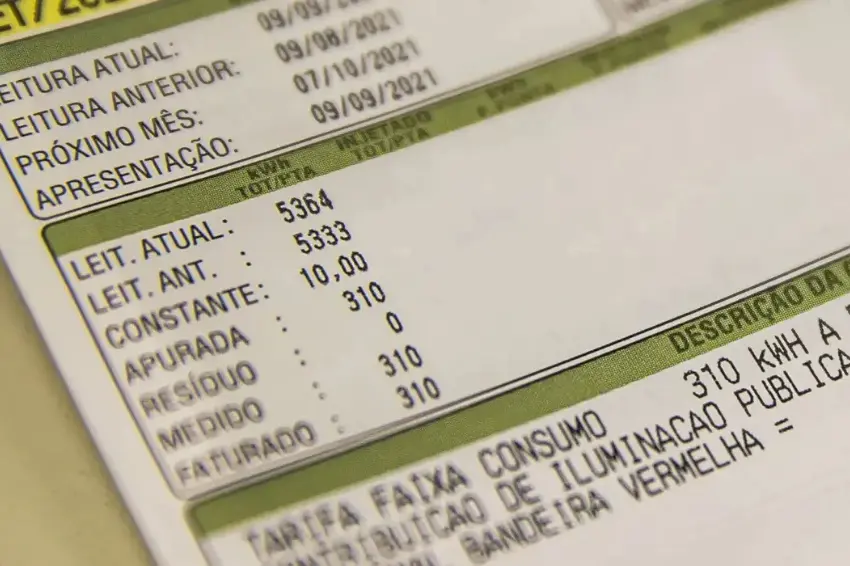
Retirees and pensioners of the INSS (National Institute of Social Security) who receive up to one minimum wage may be automatically included in the TSEE (Social Electricity Tariff) without the need for prior registration in the CadÚnico (Single Registry for Social Programs).
The change is foreseen in Bill 1.876/2026, currently under analysis in the Chamber of Deputies. According to the proposal, automatic enrollment will be for beneficiaries of the RGPS (General Social Security Regime) who fall within this income limit.
To receive the benefit, the retiree or pensioner must be the account holder for the electricity bill or be part of the family unit responsible for the bill, in addition to meeting the consumption limits established by the regulations of the electricity sector.
However, the text changes the Law No. 12.212 / 2010, which deals with the Social Tariff, and seeks to remove one of the steps currently required for access to the benefit by this public: prior registration in the CadÚnico (Single Registry for Social Programs).
Data from the INSS (Brazilian National Social Security Institute) may be cross-referenced with information from distributors.
To enable automatic approval, the project foresees the integration of INSS (Brazilian National Social Security Institute) information systems with the databases of electricity distribution companies.
By cross-referencing the information, it would be possible to identify retirees and pensioners who meet the established criteria and link them to their respective consumer units. The sharing of data must respect the rules for the protection of personal data.
The author of the proposal, Representative Pompeo de Mattos (PDT-RS), argues that the government already has information on retirees and pensioners of the RGPS (General Social Security Regime) who receive up to one minimum wage.
"If the State is aware of the universe of retirees and pensioners whose monthly income does not exceed a minimum wage, there is no reasonable basis for imposing an additional bureaucratic step on them as a condition for accessing a public policy of tariff relief," he stated.
The proposal still needs to make progress in Congress.
The change is not yet in effect. Bill 1.876/2026 will be analyzed, in a conclusive manner, by the committees on Mines and Energy; Social Security, Welfare, Childhood, Adolescence and Family; Finance and Taxation; and Constitution and Justice and Citizenship.
To become law, the proposal still needs to complete its passage through the Chamber of Deputies and be approved by the Federal Senate. Until then, the current rules for accessing the Social Tariff remain in effect.
all the content of Canal Solar is protected by copyright law, and partial or total reproduction of this site in any medium is expressly prohibited. If you are interested in collaborating or reusing part of our material, please contact us by email: redacao@canalsolar.com.br.

Comments (1)
Comments are moderated before publication.Comments should be respectful and contribute to a healthy debate. Offensive comments may be removed. The opinions expressed here are those of the authors and do not necessarily reflect the views of the author. Canal Solar.
I am retired, I earn minimum wage, I am 70 years old, and I haven't been able to get a discount from Enel or Sabesp. What can I do? I already have a CRAS (Social Assistance Reference Center).