
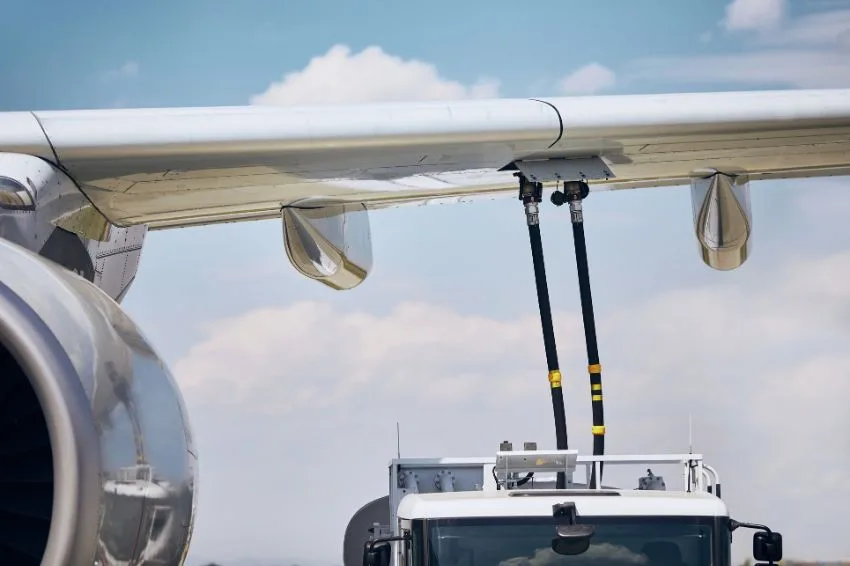
Brazil will have to produce at least 1,1 billion liters of sustainable aviation fuel by 2037 if it wants to meet its target of a 10% reduction in SAF (Sustainable Aviation Fuel).
The estimate is part of a new study prepared by Firjan (Federation of Industries of the State of Rio de Janeiro), which was launched this Wednesday (13), at the Fenabio Congress, during Fenasucro & Agrocana, the main world fair for the sugar-energy sector, in Sertãozinho (SP).
The survey was carried out based on projections from EPE (Energy Research Company) and includes targets established in Law No. 14.993/24, known as the “Fuel of the Future Law”.
Second this legislation, SAF will be progressively incorporated into traditional aviation kerosene, derived from petroleum, from 2027.
Despite its potential, Brazil still lacks the installed capacity to produce SAF on a large scale. Currently, only six projects are underway, mostly using vegetable oils as raw materials.
Among these, two are in Rio de Janeiro, under the leadership of PetroTwo projects are underway in Brazil: one in Itaboraí, with the creation of a biorefining complex, and another at the Duque de Caxias Refinery, where tests are already being conducted with mixtures of up to 1% renewable content.
Gradual goals and challenges
In 2027 and 2028, a 1% reduction in emissions is expected, which will require the production of 83 million and 153 million liters of SAF, respectively. Starting in 2029, this requirement will gradually increase until reaching a 10% reduction in 2037.
The process runs parallel to international commitments made by the country within the scope of LANE (Carbon Offsetting and Reduction Scheme for International Aviation), a program coordinated by ICAO (International Civil Aviation Organization).
In the current phase of CORSIA, airlines operating international routes from Brazil must monitor, report, and verify their CO₂ emissions. This step is crucial to creating a reliable database and preparing the industry for the next phases of the program.
Starting in 2027, the mandatory phase of CORSIA begins, when companies will have to offset any emissions that exceed the average recorded in 2019 and 2020, a requirement already regulated in Brazil by ANAC (National Civil Aviation Agency).
Even with relatively low initial targets, the challenges are significant. Currently, Brazil lacks a consolidated production structure for SAF, and the biofuel's share in the aviation mix is expected to be only 1,7% in 2027, according to Firjan estimates, considering current jet fuel consumption volumes.
This index may vary, depending on the efficiency of the production routes adopted and the quality of the raw materials used.
In addition to progressive targets, the sector also faces the challenge of expanding investments, developing industrial infrastructure, and ensuring a sustainable supply of renewable raw materials.
The need for coordinated action between government, companies, and research centers is seen as essential to avoid bottlenecks and consolidate Brazil as a protagonist in the transition to low-carbon aviation.
Below is the minimum annual percentage of emission reduction and projected SAF consumption:

Brazil's potential and leading role
For Firjan, Brazil has all the conditions to lead this new market, thanks to its extensive experience in biofuels and the vast supply of renewable raw materials.
Luiz Césio Caetano, president of the entity, also highlights the strategic role of the state of Rio de Janeiro as a logistics and airport hub, which makes it a key point in the future SAF production and distribution chain.
However, some initiatives are already pointing the way. This year, operations began to supply imported SAF from Galeão Airport in Rio de Janeiro (RJ).
The action is already seen as a symbolic and practical step towards decarbonisation of Brazilian aviation and reinforces the possibility of the state of Rio de Janeiro becoming a production and distribution hub sustainable fuels.
Projects submitted
1 – Boaventura Energy Complex – investment in a biorefining plant in Itaboraí, in a contiguous area where the Rota 3 integrated project is already operating, for the production of sustainable fuels;
2 – Expansion of REDUC – at the Duque de Caxias refinery, tests are being conducted on the co-processing of QAV (aviation kerosene) with 1% renewable content, with commercial introduction expected in 2025.
3 – Manaus Free Trade Zone (AM) – BBF (Brasil BioFuels) is developing a biorefinery with an annual production capacity of 500 million liters of SAF and green diesel (from palm, soybean and corn oils as raw materials). Operations are scheduled to begin in 2026;
4 – Mataripe Refinery (BA) – Acelen Renováveis plans to build a biorefinery attached to the Mataripe Refinery, with operations expected to begin in 2028. The project has the capacity to produce 1 billion liters of green diesel and SAF per year. The company is investing in diversifying its raw materials, with a special focus on macauba, a palm tree native to Brazil that could be a sustainable alternative to soybean oil.
5 – Presidente Bernardes Refinery (SP) – a PetroBrazil is studying the production of SAF (Sustainable Agricultural Fuel) and green diesel in a new unit to be installed in Cubatão (SP). Scheduled for 2029, the plant will have an estimated production capacity of 350 million liters of sustainable fuel per year. The main raw material will be a mixture of 70% soybean oil and 30% beef tallow;
6 – Paulínia Refinery (SP) – a PetroBrazil is preparing a SAF (Steel Alcohol Production) plant using ethanol, a route from alcohol to jet, with a projected capacity to produce 10 barrels of SAF per day, consuming 3 to 4 million liters of alcohol per day.
all the content of Canal Solar is protected by copyright law, and partial or total reproduction of this site in any medium is expressly prohibited. If you are interested in collaborating or reusing part of our material, please contact us by email: redacao@canalsolar.com.br.

Comments
Comments are moderated before publication.Comments should be respectful and contribute to a healthy debate. Offensive comments may be removed. The opinions expressed here are those of the authors and do not necessarily reflect the views of the author. Canal Solar.