
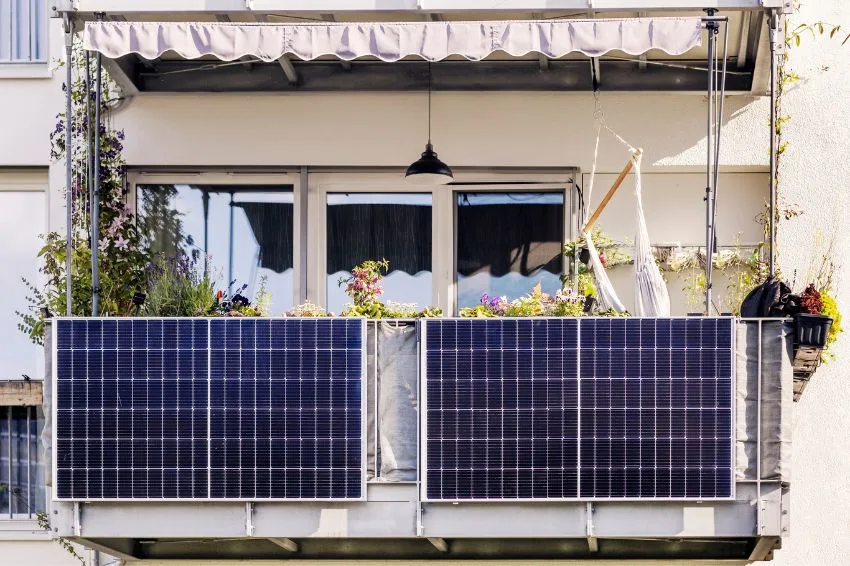
Plug-in systems, or balcony power plants as they are also known, have been gaining more and more fans in Germany. The low cost of the device and the cost-benefit advantages have heated up the market. The BSW (German Solar Industry Association) recently published that, according to the Federal Network Agency (BNetzA), Germany should reach the mark of one million plug-in devices installed by the end of July 2025.
However, BSW claims that this milestone may already have been reached, since many registrations are made late with the BNetzA, which may cause fluctuations in the numbers. Expectations for the Plug-in market are high and the sector is expected to continue growing. In a survey conducted by YouGov, commissioned by the German Solar Industry Association, the approval of the system was positive among those interviewed.
The survey was conducted at the end of 2024 and shows, through its data, that 8% of respondents intended to purchase a Plug-in system by the end of 2025, while 9% showed interest, but with plans to install it later. In 2025 alone, between January and April, around 135 thousand new devices came into operation.
The figures show a 36% increase compared to the same period last year. This growth resulted in 75% more installed solar plants on balconies. “Now that solar rooftops have become standard in residential areas, the boom in solar on balconies will increasingly shape the image of urban centers. Increasingly larger parts of the population are benefiting from the transition to solar energy,” he says. Carsten Körnig, CEO of the German Solar Industry Association.
For a country like Germany, where buildings known as “Familien Haus” are common, balcony plants are a practical and low-cost solution that brings great efficiency to consumers, significantly reducing the cost of energy bills.
Regulation of the use of plug-in devices in Germany
In recent years, the government has eased regulations regarding the use of plants on balconies. Among the measures is the relaxation of rules involving authorization by landlords and co-owners.
Unlike conventional photovoltaic installations, these devices have technical limitations that guarantee greater safety: the modules must not exceed 2.000 W of power, while the inverter, responsible for converting the energy generated, must operate with a maximum of 800 W in alternating current, according to technical guidelines.
To regularize the situation, it is mandatory to register the equipment in the national system of the Federal Network Agency within 30 days after installation. It is worth remembering that only equipment without a battery falls into this simplified category; solutions with energy storage still require professional installation and direct communication with the power grid operator.
all the content of Canal Solar is protected by copyright law, and partial or total reproduction of this site in any medium is expressly prohibited. If you are interested in collaborating or reusing part of our material, please contact us by email: redacao@canalsolar.com.br.




Comments
Comments are moderated before publication.Comments should be respectful and contribute to a healthy debate. Offensive comments may be removed. The opinions expressed here are those of the authors and do not necessarily reflect the views of the author. Canal Solar.