
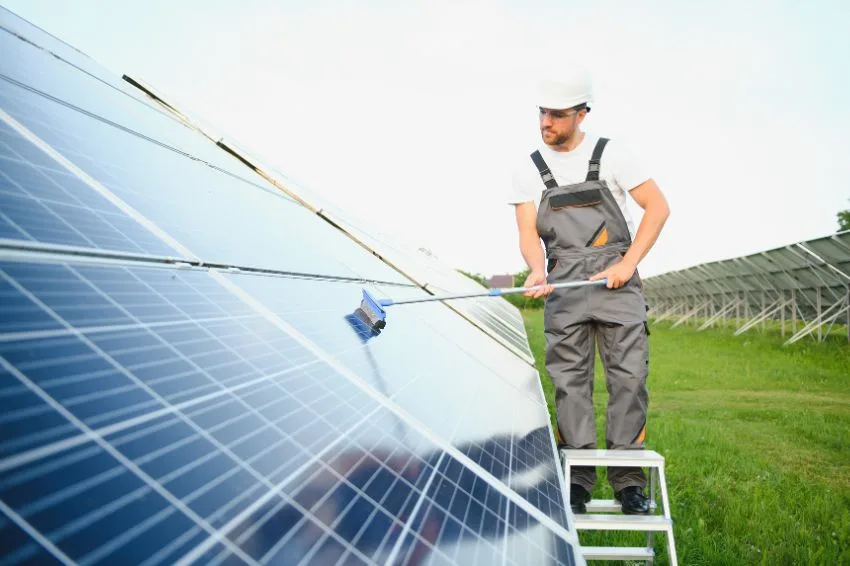
Lavee Solar announced that its solution, specifically developed for dry cleaning of photovoltaic modules, has received approval from major global manufacturers, including Trina, LONGi, JA Solar, Jinko Solar, TW Solar, DAH Solar, DAS Solar, Sunova, QCells, ZNShine and Boviet Solar.
According to Leandro Capucho, CEO and founder of BioForcis, the company responsible for creating Lavee, the process goes beyond replacing detergents or water with a new product. “It is necessary to change the concept of the 'cleaning operation'”.
“In addition to being environmentally friendly, Lavee brings simplicity and savings to the panel cleaning process, minimizing resources and maximizing generation. The incremental revenue generated by cleaning with Lavee is much higher than the cost of operation. We have developed simulation models that clearly demonstrate these results,” said the executive, highlighting the innovative nature of the solution, which has certifications from national and international laboratories and is registered with Anvisa.
Manufacturers' approvals came after a series of tests were carried out to validate the product's effectiveness. Initially conducted at the Unicamp laboratory, the studies were followed by international validations, such as that of TÜV Süd, including the HF10 test, which puts the panel cleaned with Lavee through energy efficiency tests in extreme temperature conditions.
One of the main objectives of the research, according to Ricardo Valle, partner and responsible for the commercial area of the business, was to ensure that the use of the solution would not negatively impact the energy generation of the panels, much less damage the materials that make up the module.
“Our biggest concern was to ensure that the solution cleaned the plate without leaving residue that could affect the capture of solar energy by the photocell, validated by accredited laboratories and providing total security to customers,” said Valle.
With the process approved and accepted by major companies in the photovoltaic sector, Valle stated that the solution stands out as a significant advance in the market. “In addition to contributing to the efficiency of photovoltaic systems, the method reinforces the commitment to sustainability and the protection of energy generation assets,” he concluded.
all the content of Canal Solar is protected by copyright law, and partial or total reproduction of this site in any medium is expressly prohibited. If you are interested in collaborating or reusing part of our material, please contact us by email: redacao@canalsolar.com.br.




Comments
Comments are moderated before publication.Comments should be respectful and contribute to a healthy debate. Offensive comments may be removed. The opinions expressed here are those of the authors and do not necessarily reflect the views of the author. Canal Solar.