
Every week someone asks me if the solar energy market isn't already saturated. The question makes sense for those who see solar panels on every rooftop in the neighborhood, receive three different proposals from integrators in the same month, and hear about price wars at every industry event.
But feelings aren't a given. And the numbers for 2026 tell a different story. What we've already achieved is significant, without a doubt. What remains to be achieved is far greater. And the business that will capture that space isn't exactly the same one that brought us this far.
A base that grows every year.
Brazil had more than 94 million electricity consumer units in December 2024, according to EPE (Energy Research Company). The vast majority are residential. In 2025, residential units reached 84,5 million and commercial units 6,2 million. Rural properties totaled approximately 3,9 million in 2024, and the remainder is divided between industry, public sector, and other sectors.
And this base continues to grow. In 2024, the regulated market gained more than 1,4 million consumers, according to EPE. In 2025, the number of units grew by 1,9%, even with companies migrating to the free market.
In September 2026, the number of captive consumers continued to grow by 1,5% year-on-year, driven by the Central-West region, with an increase of 3,4%. In practice, this represents more than 1,4 million new electricity bills per year.
And it's not just that there are more consumers. Each one of them is consuming more. In September 2026, national electricity consumption grew 4% compared to the same month of the previous year, the sixth consecutive increase, according to EPE. Commercial consumption rose 8,3%, residential consumption 7,7%. In the Central-West region, consumption advanced 10,5%.
Every new house, every store that opens, every warehouse that connects to the power supply represents a customer who hasn't yet decided where their energy comes from. And every additional kilowatt-hour on the bill of an existing customer is another reason for them to make that decision.
The bill that keeps going up.
The second driver of this market is price. Until the beginning of July, the ANEEL (The National Electric Energy Agency) had already approved 22 tariff revisions and adjustments in 2026, affecting more than 70 million consumer units. There were double-digit adjustments in several concession areas, such as Copel, with 20,51%, and CPFL Santa Cruz, with 18,89%. Aneel itself projected an average increase of 8,6% in tariffs for the year, above inflation.
Behind this lie structural costs that are not dependent on rainfall and that no government can dismantle overnight. The Energy Development Account, which finances subsidies embedded in the tariff, has a proposed gross budget of R$ 55,1 billion for 2027, compared to R$ 32,09 billion in 2022.
Of that total, approximately R$ 47,8 billion comes from the quotas paid by consumers in the tariff. The remainder comes from a new charge levied on the subsidy beneficiaries themselves. When the bill goes up every year, the customer doesn't need to be convinced that they have a problem. They need someone to present the solution.
Where has solar power already arrived?
Distributed solar generation responded to this scenario with impressive speed. The first million consumer units benefiting from solar power were reached in September 2021. The sixth million was expected in March 2025.
In January 2026, the country surpassed 7 million. In July, it exceeded 8 million. And the Aneel registry from October 3rd already showed 8,95 million units receiving distributed generation credits, almost all of them solar.
The number of systems followed the same trend. It was 1 million in May 2022, 2 million in June 2023, and 4 million in February 2026.
In October, there were 4,66 million systems, and the difference from the number of units benefiting is explained by the modalities in which the same power plant serves multiple accounts, such as remote self-consumption and shared generation.
Residential use dominates in terms of quantity, but it's not alone. In October, residences accounted for 28,07 GW of power, commercial establishments 14,39 GW, rural properties 6,72 GW, and industries 3,77 GW. By state, in July, Minas Gerais led in units benefiting from the system, with 1,92 million, followed by São Paulo, with 1,05 million, and Rio Grande do Sul, with 565.
The reverse account
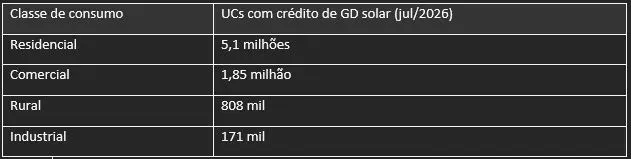
Almost 9 million seems like a lot, and it is. But do the math the other way around. Of every ten electricity bills in Brazil, less than one receives solar energy credit. In the residential sector, there were 5,1 million units with credit in July, out of a base of 84,5 million, about 6%. In the commercial sector, it's about 30%. In the agricultural sector, close to 20%. Since these figures are from the end of 2025 (2024 in rural areas) and have only grown since then, the actual percentages are somewhat lower.
This means that more than 85 million consumer units still do not receive any solar energy credits. And this backlog grows by more than 1,4 million new accounts per year.
The map reinforces the argument. São Paulo, the country's largest consumer market, has just over half the number of units benefiting from solar energy compared to Minas Gerais. This is not a sign that people in São Paulo don't want solar energy. It's a sign that a large portion of them haven't yet received the right proposal, in the right format, from the right person. The same applies to millions of apartment dwellers, small business owners, and service companies scattered throughout the capital cities.
A saturated market doesn't have that pattern. That's the pattern of a market that has barely begun.
The product isn't the panel, it's the energy management system.
The mistake is looking at these more than 85 million accounts and only seeing the roof. A huge portion of this audience lives in apartments, rents the property, has a bad roof, or simply doesn't want to do any renovations. Another part consists of companies that need cost predictability more than module predictability. What's at stake is energy management, and it has a different format for each client.
In the house
For families, the conversation begins with rooftop generation, but it doesn't end there. Those without a rooftop can participate in shared generation or energy subscriptions. Those who already have a system are natural candidates for energy storage, expansion, and recharging their electric car.
Brazil has already surpassed 1 million registered electrified light vehicles, with projections of around 450 units in 2026 alone, and more than 25 electrophores Public and semi-public. The garage has become part of the electricity bill, and whoever sells energy to the house needs to know how to talk about it.
In commerce and services
Retail is currently the sector experiencing the fastest growth in consumption, with an 8,3% increase in September. There are already 1,85 million commercial establishments with solar energy credits, representing approximately 30% of the country's 6,2 million commercial establishments. Even so, seven out of ten bakeries, pharmacies, clinics, gyms, and stores still do not receive solar energy credits.
For this client, the conversation will change significantly starting next year. According to Decree 13.097/2026, commercial and industrial low-voltage consumers will be able to choose their supplier in the free market from November 25, 2027, through a retail marketer. The winning proposal will combine self-generation, energy contracting, and demand management.
in the industry
The industry and high-voltage companies are already experiencing this reality. The free market accounts for approximately 45% of national electricity consumption, according to EPE. After all high voltage was liberalized in January 2024, around 25 consumers migrated that year and another 22 in 2025, according to the EPE Yearbook. The number of free market consumers grew by 16,5% in September compared to the previous year.
Here, energy management means contracting well, generating some of your own energy when it makes sense, controlling demand, and reducing exposure to charges. There are 171 industrial units with solar credits, and a huge opportunity for those who know how to put these pieces together.
In the field
Farmers have already understood the message: 808 rural units are benefiting, about one in five of the nearly 4 million rural units in the country, and rural properties already totaled 6,72 GW of installed capacity in October. Energy in the countryside is a production cost, whether for irrigation, refrigeration, milking, or grain drying. Predictability is as valuable as savings, and whoever comes up with a complete solution gains a customer for many years.
The thread that ties everything together
I see many people treating distributed generation, the free market, energy storage, and electric mobility as separate, sometimes rival, markets. The customer doesn't see it that way. They want to know how much they will pay, how much they can save, and what they can predict. Whoever answers these three questions for the home, the store, the factory, and the farm will occupy the position of energy advisor. Whoever only offers price per kilowatt peak will be competing for pennies.
Energy management also requires honesty about the rules. According to Aneel's preliminary proposal, still under public consultation, a new charge should reduce, starting in 2027, part of the benefit of GD2 and GD3 systems, in addition to GD1 systems served by small distributors. The proposal that already considers this change in the simulation is the one that wins the customer's trust and survives the second billing cycle.
What separates those who will grow?
If the market is this size, why do so many companies in the sector feel it's harder to sell? Because a large portion of them continue to compete for the same customer, with the same offer, through the same channel. The homeowner with a good roof in a middle-class neighborhood receives several quotes. The building manager, the clinic owner, and the manager of a medium-sized industry receive none.
To get out of this fight, I see four moves. The first is to look at your own portfolio and territory and separate residential, commercial, rural, or industrial areas, with the right solution for each. The second is to prepare the sales team to talk about energy management, and not just modules and inverters, which includes understanding the free market, storage, and recharging.
The third is to build partnerships with those who complete the offering, from retail distributors to storage and charging infrastructure companies, before they reach their customers on their own. The fourth is to return to the installed base: the millions of customers who already have a system are the shortest path to selling expansion, batteries, chargers and, soon, energy in the free market.
The customer of the future is more informed, compares offers, and is wary of easy promises. They don't want to buy a solar panel; they want to solve their electricity bill for the next 25 years. This requires less equipment salesmanship and more energy consulting.
Nine out of ten
In just over a decade, the Brazilian solar sector has built one of the most dynamic distributed generation markets in the world. This is a source of pride, but it cannot become a reason for complacency.
So, the next time someone says the solar market is saturated, remember that nine out of ten electricity bills are still waiting for someone to offer a solution. That more than 1,4 million new bills arrive every year. That businesses and homes are consuming more.
The tariff continues to rise. And, starting in November 2027, low-voltage customers will begin to gain the right to choose. The question isn't whether there's a market. It's who will arrive first, with the right offer, for each type of customer.
The opinions and information expressed are the sole responsibility of the author and do not necessarily represent the official position of the author. Canal Solar.

Comments
Comments are moderated before publication.Comments should be respectful and contribute to a healthy debate. Offensive comments may be removed. The opinions expressed here are those of the authors and do not necessarily reflect the views of the author. Canal Solar.