
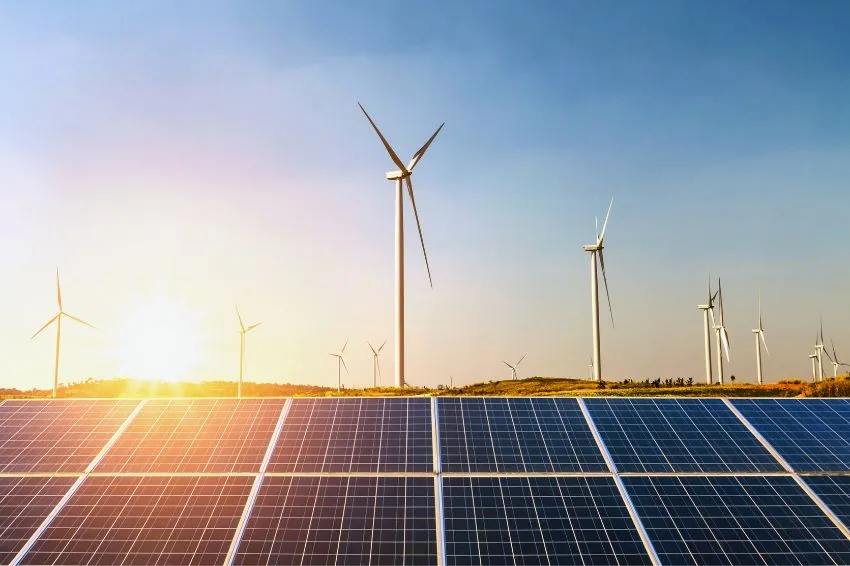
Renewable sources are poised to take the lead in global electricity generation, overtaking coal as early as 2025 – or, at the latest, by 2026. This is the projection from the IEA (International Energy Agency), which also predicts one of the fastest and most sustained growths in electricity demand in over a decade.
Despite economic uncertainty, global electricity consumption is expected to increase by 3,3% in 2025 and 3,7% in 2026—more than double the growth rate of total energy demand over the same period. This growth will be driven primarily by factors such as the growing use of energy in industries, air-conditioned buildings, data centers, and electric vehicles.
Although the percentages are slightly lower than the 4,4% jump recorded in 2024, they remain well above the average of 2,6% observed between 2015 and 2023.
The report also points out that, in addition to renewables, nuclear energy production is expected to reach record levels, driven by reactor restarts in Japan, operational stability in the US and France, and new additions in Asia. Natural gas is expected to continue gaining ground, gradually replacing coal and oil in several regions.
With this transition, the IEA projects that CO₂ emissions from electricity generation will stabilize in 2025, with a possible decline in 2026 – although climate and economic factors may influence this trajectory.
“Global electricity demand growth is expected to remain robust through 2026, despite the uncertain economic outlook,” said Keisuke Sadamori, Director of Energy Markets and Security at the IEA.
"The strong expansion of renewable and nuclear sources is reshaping energy markets. However, investing in networks, storage, and sources of flexibility will be essential to ensure a secure and affordable supply," he added.
Regional highlights
The growth in demand will be led by emerging Asian economies. Together, China and India are expected to account for 60% of the global increase in electricity consumption in 2025 and 2026. In China, growth is projected to jump from 5% in 2025 to 5,7% in 2026; in India, from 4% to 6,6%.
In the United States, the rapid expansion of data centers is expected to sustain annual growth of over 2%, more than double the average of the last decade.
The European Union will see a more moderate pace, with an estimated increase of just 1% in 2025 and a modest acceleration in 2026. Despite this, wholesale prices rose between 30% and 40% in the first half of 2025 compared to the same period in 2024, influenced by the rise in natural gas in a tighter global market.
Although average prices are below 2023 levels, they remain higher than in 2019. At the same time, the incidence of negative wholesale prices is growing in several regions, signaling the urgency for greater flexibility in electrical systems.
The IEA emphasizes that effective regulatory policies, combined with investment in storage and demand response, will be essential to address this scenario.
Competitiveness at risk
According to the Agency, price disparities between regions continue to impact the industrial sector. Average electricity rates for energy-intensive industries in the European Union are still double those in the United States—and well above those in China. This cost difference jeopardizes the competitiveness of European industry in the face of changes in the global energy landscape.
Click here and check out the full study.
all the content of Canal Solar is protected by copyright law, and partial or total reproduction of this site in any medium is expressly prohibited. If you are interested in collaborating or reusing part of our material, please contact us by email: redacao@canalsolar.com.br.





Comments
Comments are moderated before publication.Comments should be respectful and contribute to a healthy debate. Offensive comments may be removed. The opinions expressed here are those of the authors and do not necessarily reflect the views of the author. Canal Solar.