
Exports of solar equipment from the United States to Cuba registered significant growth in 2026, at a time when the Caribbean country is facing a severe energy crisis, marked by frequent blackouts and difficulties in electricity supply.
In the first seven months of the year, American shipments of photovoltaic cells and modules to the island totaled US$6,3 million, a 1.070% increase compared to the entire year of 2025, when sales reached US$538. The data comes from the United States Census and was published in a report by [source name missing]. Bloomberg.
The advance occurs while Cuba seeks to expand the share of solar energy in its electricity mix. and reduce the impacts of supply disruptions. Up to the period depicted in the report, Cuba had recorded seven national blackouts, a situation that has led consumers and companies to invest in their own generation and storage systems.
Although China remains the main supplier of photovoltaic equipment to the country, the growth of American exports represents an additional source of supply for Cuban entrepreneurs and consumers.
These operations are made possible through commercial permits that authorize the shipment of certain goods to the island's private sector.
In a country with approximately 9,4 million inhabitants, the availability of solar equipment has become important not only for diversifying electricity generation, but also for the continuity of economic activities and essential services.
Solar systems and batteries enable businesses to operate during blackouts.
The combination of photovoltaic generation and storage has been gaining ground among commercial establishments that need to maintain their operations even during prolonged power outages.
In Havana, La Campana, an event space managed by entrepreneur Ramiro Llovet, is an example of this application. The establishment operates out of the businessman's residence and hosts weddings, birthdays, and corporate events for groups of 15 to 350 people.
During one of the national blackouts recorded this year, the facility managed to maintain its operations thanks to the use of solar panels and backup batteries. While the power supply was interrupted in other areas, the equipment installed at the establishment allowed the schedule to continue normally.
Experience demonstrates the importance of systems capable of operating during grid failures, especially in regions where unstable supply compromises commercial activities.
For residential consumers, solar power generation can also represent an alternative to meet basic needs, such as charging cell phones and powering small appliances.
Cuba has already installed 1.418 MW in photovoltaic parks.
The expansion of solar energy in Cuba is also reflected in the figures presented by President Miguel Díaz-Canel during an interview with Cuban state radio.
According to the president, the country has already installed 1.418 MW of capacity in 144 photovoltaic parks and is working towards a forecast of ending 2026 with more than 1.500 MW.
Díaz-Canel also reported that renewable sources already account for 21,4% of national electricity generation, a percentage that considers all these technologies combined, and not just solar power.
In addition to photovoltaic parks, generation installed directly at consumer sites has also been advancing. According to the president, entities from the state and private sectors already account for more than 563 MW of installed capacity.
The private sector is showing the strongest growth in the adoption of photovoltaic panels among consumers and, according to the data presented, already produces approximately 20% of the electricity it uses in its activities.
This self-generation helps reduce demand on the national electricity system, especially in a scenario of supply restrictions.
Storage is gaining ground in energy strategy.
The expansion of photovoltaic generation is also accompanied by investments in energy storage. In the interview, Díaz-Canel stated that Cuba had already installed 50 MW of storage capacity and planned to incorporate another 100 MW in October. If the expansion is completed as planned, the country will have 150 MW of storage capacity.
Technology is particularly important in the face of recurring blackouts, as it allows the use of previously stored energy to power loads during periods of grid unavailability, provided that the systems are designed to operate under these conditions.
Unlike conventional grid-connected photovoltaic systems, which typically interrupt generation during power outages for safety reasons, solutions with batteries and backup capabilities can keep essential equipment running.
This operational capability represents an advantage for companies that depend on the continuity of electricity supply and for services that cannot suffer prolonged interruptions.
Renewable energy reaches hospitals, banks, and healthcare facilities.
Another statistic presented by the Cuban government shows that the expansion of renewable energy sources is reaching different public services. According to Díaz-Canel, 99% of the country's polyclinics already have renewable energy sources. Among hospitals, the reported coverage is 47%.
Presence of renewable energy sources in essential establishments and services in Cuba, according to data presented by the Cuban government.
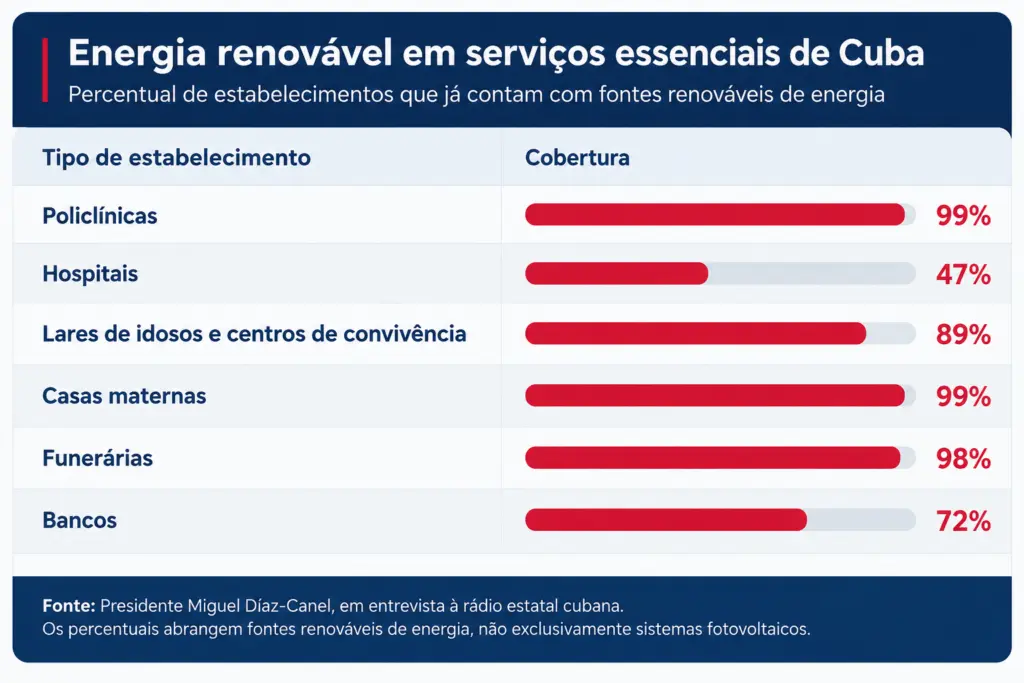
In the case of banking institutions, Díaz-Canel stated that the government intends to expand coverage to reduce the dependence of public services on the national electricity grid. The use of renewable energy sources in these facilities demonstrates an attempt to reduce the vulnerability of activities considered essential in the face of recurring supply failures.
However, these percentages do not necessarily mean that all of these establishments have complete autonomy during blackouts. This capacity depends on the characteristics of the installed systems, including the availability of storage and resources for isolated operation.
Solar energy will also be used for water supply.
The application of photovoltaic generation in essential services also includes water supply. During the interview, the president reported that Cuba had already installed 646 solar pumps to serve the population, in addition to more than a thousand pieces of equipment used in livestock farming and irrigation.
The government also plans to expand the use of generation systems to reduce dependence on pumped water from the electricity grid. One of the initiatives involves Havana, where 200 MW of photovoltaic generation is planned to be allocated exclusively to pumping systems.
According to Díaz-Canel, the expectation is to advance in the energy independence of this operation in the first months of 2027, with the possibility of extending the experience to other provinces. The initiative seeks to address two problems that simultaneously affect the Cuban population: interruptions in the electricity supply and difficulties in water supply.
Electricity crisis puts pressure on the expansion of renewable energy sources.
Despite investments in solar power generation, Cuba continues to face significant difficulties in meeting electricity demand. In an interview with state radio, Díaz-Canel mentioned a projected deficit exceeding 2.020 MW in the electrical system for that day, although he stated that the figures recorded on previous days had been below 2.000 MW.
The president also highlighted the difficulties in obtaining fuels for economic activities and energy generation. Given this scenario, he stated that the country's strategy involves expanding domestic oil production and accelerating the transition to renewable energy sources.
The Cuban government also announced measures to encourage the adoption of these technologies by consumers and businesses, including bank credit lines for the installation of renewable systems, tax incentives, and mechanisms for remuneration for electricity supplied to the grid. These initiatives aim to expand the participation of decentralized generation and reduce pressure on existing electrical infrastructure.
China remains the main supplier of solar equipment.
Although American exports have registered strong growth, China continues to hold the position of main supplier of photovoltaic equipment to Cuba. In September, the Caribbean country received a new Chinese donation of 5 solar systems, reinforcing the Asian partner's participation in the expansion of the technology.
Shipments from the United States, in turn, have contributed to expanding access to equipment, especially among consumers and private entrepreneurs. This movement highlights the diversification of sources of supply for photovoltaic technology at a time of growing demand for self-generation.
Despite the advancements, the installation of solar panels and batteries alone does not solve the structural problems of the Cuban electrical system. These technologies, however, offer consumers the possibility of reducing their dependence on the grid and maintaining certain activities during outages.
In a country marked by recurring blackouts, solar energy is no longer just an alternative source of power generation, but is playing an important role in the continuity of essential businesses and services.
all the content of Canal Solar is protected by copyright law, and partial or total reproduction of this site in any medium is expressly prohibited. If you are interested in collaborating or reusing part of our material, please contact us by email: redacao@canalsolar.com.br.


Comments
Comments are moderated before publication.Comments should be respectful and contribute to a healthy debate. Offensive comments may be removed. The opinions expressed here are those of the authors and do not necessarily reflect the views of the author. Canal Solar.