
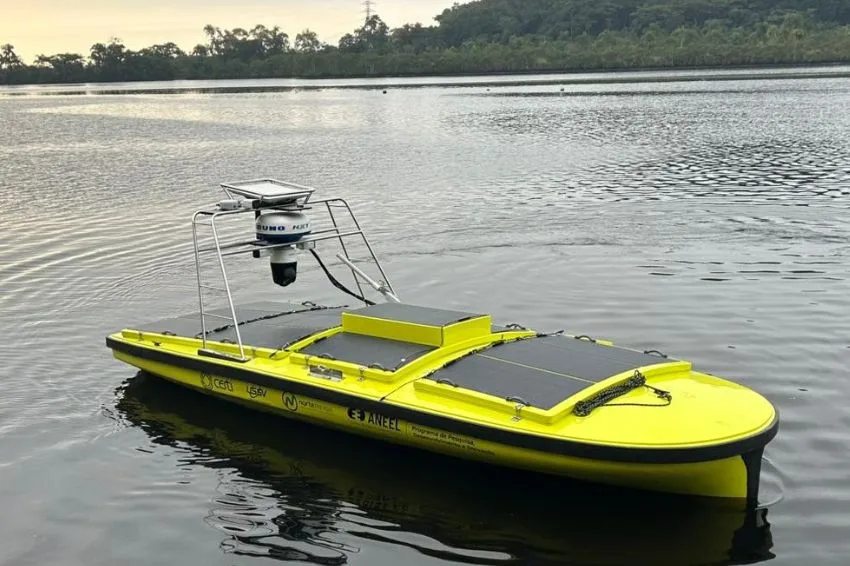
An autonomous solar-powered boat is about to revolutionize environmental monitoring in the region of the Belo Monte Hydroelectric Power Plant, in Pará. The equipment, which is already in the testing phase, will monitor in real time the water quality of the Xingu River, an area of difficult access and of great environmental importance in the Amazon.
The prototype is powered by solar energy, consisting of three lithium batteries recharged by 12 modules of 100 W each, completely eliminating the use of fossil fuels, which are quite common in vessels in the region. The boat has autonomy for up to 20 hours of navigation, covering a monitoring area of approximately 500 km².
The project is the result of a partnership between Norte Energia, the plant's concessionaire, and technology and research institutions such as CERTI Foundation, USSV Autonomous Technology and the CERTI Amazon Institute (ICA).
The investment cost around R$4 million in the development of the innovation, which could be applied in the future in other hydroelectric plants located on large rivers in the Amazon.
Technologies used
Regulated by ANEEL (National Electric Energy Agency), the boat uses cutting-edge technology to make the process of collecting and analyzing environmental data more efficient and safer.
UFPA and Norte Energia inaugurate the first electric boat in the Amazon
Equipped with a multiparametric probe (equipment that allows the simultaneous measurement of several physical-chemical parameters of the water), the vessel navigates autonomously following routes pre-defined by the operators.
During the journey, it monitors several strategic points on the river, collecting data that is transmitted in real time via satellite to a system with artificial intelligence capable of predicting water quality, eliminating the need for additional laboratory analyses.
Among the advantages of the new technology is the possibility of carrying out frequent monitoring in remote areas, without the need to move technical teams, which reduces risks for professionals and lowers operating costs.
“The use of an autonomous vessel allows difficult-to-access areas to be monitored frequently, regardless of weather conditions, protecting technicians from exposure to risks and reducing operating costs,” highlights Lorenzo Cardoso de Souza, CEO of USSV Tecnologia Autônoma, the company responsible for developing the boat.
In addition to data collection, the project has cloud modules that store and process the information captured by the vessel. Using artificial intelligence, it is possible to generate predictive indicators of water quality from data obtained by the multiparametric probe, which analyzes parameters such as temperature, turbidity, pH and dissolved oxygen.
“With a probe capable of analyzing multiple parameters, the system monitors important variables such as temperature, turbidity, pH and dissolved oxygen, providing more precise, safe and real-time information about water quality”, explains Marcelo Pedroso Curtarelli, project coordinator at CERTI’s Green Economy Center and developer of the data processing system.
all the content of Canal Solar is protected by copyright law, and partial or total reproduction of this site in any medium is expressly prohibited. If you are interested in collaborating or reusing part of our material, please contact us by email: redacao@canalsolar.com.br.



Comments
Comments are moderated before publication.Comments should be respectful and contribute to a healthy debate. Offensive comments may be removed. The opinions expressed here are those of the authors and do not necessarily reflect the views of the author. Canal Solar.