
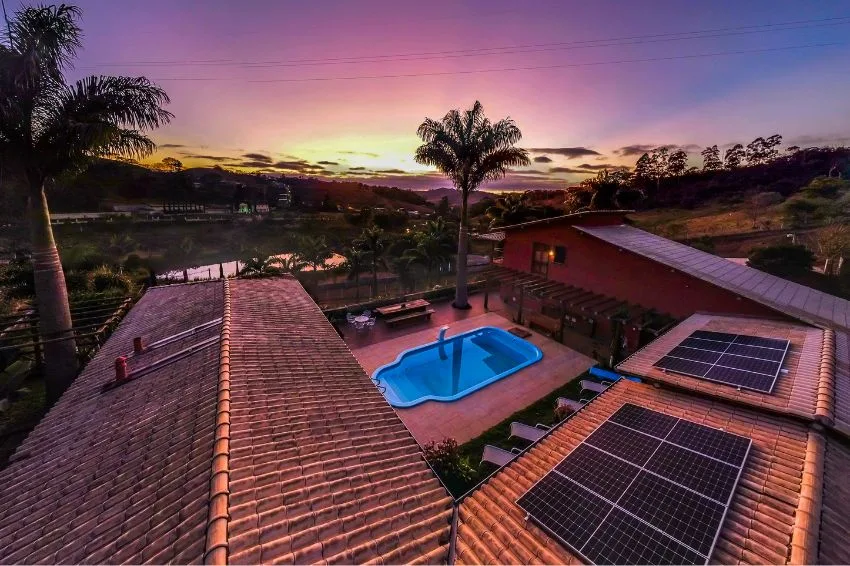
With activation of the red flag on the electricity bill, which raises the price of electricity throughout Brazil, consumers who have solar energy at home or plan to install are seeing an even greater financial advantage.
O The time for the photovoltaic system to “pay for itself” has fallen by 5% in Brazil, being that in in some states the reduction reaches 9%, the equivalent of three months of extra savings. This is what a new study by Solfácil shows.
In practice, this means that with more expensive energy, Those who have solar energy can save even more on their electricity bill, or that accelerates the moment in which the savings generated offset the value invested in the system, reducing the time to recover the amount spent, the so-called payback, which varies according to the home's energy consumption and the rates charged in the state.
The states of Roraima, Paraíba and Acre lead the ranking with the largest reductions. According to Solfácil, before the red flag, a consumer who installed solar energy under the green flag took about three years to recover the amount invested. With the higher tariff, this time dropped to 2,75 years — a savings of three months. In other states, such as São Paulo, Goiás and Bahia, the reduction was 2 months.
The data used for the research were extracted from public information from each concessionaire, while the calculation of the return on investment was based on the “Solfácil Radar” study, which measures the price of solar energy in Brazil. For this analysis, an energy bill worth R$300 was considered, in addition to the price per kWh of the concessionaire with the largest number of consumer units in each state, according to data extracted from ANEEL and the dealerships themselves.
“Solar energy is the most efficient way to avoid the volatility of electricity rates and ensure predictability in energy costs. Consumers who invest today are protected against these fluctuations and can generate their own energy for at least 25 years, with significant savings,” explained Fabio Carrara, CEO and founder of Solfácil.
States with reduced turnaround time
The study data shows that this reduction in payback varies from state to state, but is felt significantly in all cases where there was an increase in rates. See the ranking below:
1st- Paraiba (PB)
- Payback Time – Green Flag: 2,75 years;
- Return Time – Red Flag: 2,50 years;
- % Reduction in Return Time: 9%;
- Years in advance: 0,25 years (3 months).
2nd- Roraima (RR)
- Payback Time – Green Flag: 2,92 years;
- Return Time – Red Flag: 2,67 years;
- % Reduction in Return Time: 9%;
- Years in advance: 0,25 years (3 months).
3rd- Acre (AC), Bahia (BA), Mato Grosso (MT), Maranhao (MA)
- Return Time – Green Flag: 2,17 to 3,00 years;
- Return Time – Red Flag: 2,00 to 2,75 years;
- % Reduction in Return Time: 8%;
- Years in advance: 0,17 years (2 months).
4th- Ceara (CE), Mato Grosso do Sul (MS), Espirito Santo (ES), Goiás (GO), Pernambuco (PE)
- Return Time – Green Flag: 2,33 to 2,58 years;
- Return Time – Red Flag: 2,17 to 2,75 years;
- % Reduction in Return Time: 7%;
- Years in advance: 0,17 years (2 months).
5th- Alagoas (AL), Federal District (DF), Sao Paulo (SP), Sergipe (SE)
- Return Time – Green Flag: 1,92 to 3,25 years;
- Return Time – Red Flag: 1,83 to 3,08 years;
- % Reduction in Return Time: 4% to 6%;
- Early years: 0,08 to 0,17 years (1 to 2 months).
6th- Rio Grande do Norte (RN), Rio Grande do Norte (RN).
- Return Time – Green Flag: 2,17 to 2,25 years;
- Return Time – Red Flag: 2,25 years;
- % Reduction in Return Time: 0%;
- Early years: –
With the water crisis scenario, the red flag is expected to remain for a few more months, which means that Brazilians may continue to face higher electricity bills. However, the growth of solar photovoltaic energy offers a long-term solution.
For Brazilians, investing in solar energy is becoming increasingly advantageous and accessible. In addition to reducing electricity bills, adopting photovoltaic systems contributes to a cleaner energy matrix, helping Brazil meet its environmental goals.
“With increasingly easy financing and government incentives, solar energy is on its way to becoming one of the main solutions to the energy crisis in Brazil. For those who have already installed the system, the coming months represent significant savings, and for those who have not yet invested, the scenario indicates that this may be the best time,” concluded the executive.
Don't miss any news from the electricity sector! Sign up to our Community by clicking here and get exclusive access to our content!
all the content of Canal Solar is protected by copyright law, and partial or total reproduction of this site in any medium is expressly prohibited. If you are interested in collaborating or reusing part of our material, please contact us by email: redacao@canalsolar.com.br.



Comments
Comments are moderated before publication.Comments should be respectful and contribute to a healthy debate. Offensive comments may be removed. The opinions expressed here are those of the authors and do not necessarily reflect the views of the author. Canal Solar.