
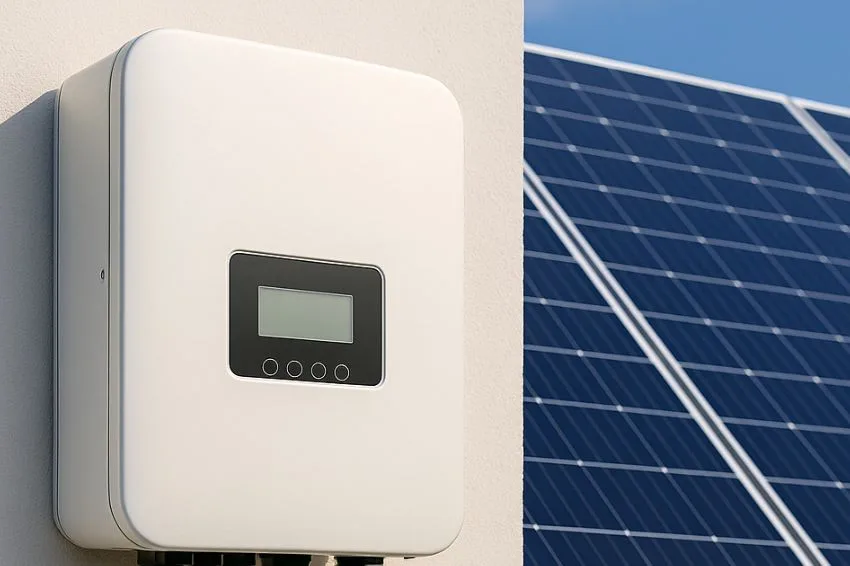
In recent days, the national solar energy sector has been closely monitoring the movement by distributors and importers regarding the review of warranty policies for inverters and microinverters.
Unlike other past changes, this is not a single mandatory regulatory guideline, but rather a spontaneous initiative, where each distributor/importer is adopting their own practices based on internal and operational criteria.
The discussion gained momentum after two distributors — Soollar and BelEnergy — announced changes: the former started to adopt a one-year warranty, while the latter established a five-year term for equipment.
Both proposals contrast with the standard traditionally offered by manufacturers of photovoltaic inverters and microinverters, which usually varies between 10 and 15 years.
According to the companies, the proposal seeks to align expectations between manufacturers, distributors, integrators and end consumers, promoting greater transparency and realism regarding equipment warranties.
According to distributors, many of these guarantees are offered by local representatives with no formal ties to foreign parent companies, operating through companies with low share capital and limited structure in Brazil.
In an interview with Canal Solar, Sergio Lucas, CEO of BelEnergy, highlighted that there is no unified movement among companies in the sector to change guarantees.
According to him, although some distributors share similar views, each company is making decisions independently, based on its technical and legal circumstances. "BelEnergy is responsible only for its own decisions," he stated.
He emphasizes that the change adopted seeks to protect all links in the chain: consumer, integrator, and distributor. By avoiding unrealistic guarantee promises, the company believes it can reduce future frustrations and preserve the industry's credibility.
"It's easy to promise a 10- or 15-year warranty when the manufacturer making the promise doesn't even have a CNPJ (Brazilian corporate tax ID) in Brazil or has a share capital of R$10. But the person who imports the equipment and issues the invoice is the one legally responsible for this promise," he said.
A Soollar, in turn, highlighted that today Brazil is one of the few countries in the world with 10 and 15-year warranties on inverters, unlike, for example, the European market – where the standard warranty is five years.
"The company is committed to importing and supplying quality products, but it doesn't see any point in a microinverter, for example, having a 15-year warranty when the equipment's payback period is currently between three and five years, including financing," the distributor noted in a statement.
Later, other companies began to position themselves. WEG confirmed that integrators approved by the company will continue to have 10-year coverage, provided they meet specific technical criteria.
For the others, the standard five-year warranty will be adopted. "We've noticed a significant increase in technical assistance calls, especially for installations performed by non-approved professionals. This measure aims to protect the customer and recognize the technical expertise of those who represent the brand," said Harry Neto, WEG's director of Solar, BESS & Building, in an interview with Canal Solar.
A I'm Energy also reinforced the importance of promoting a more in-depth debate on the topic. According to the company, over the past 10 years, the Brazilian market has seen several cases of manufacturers leaving the country, abandoning a liability that ultimately fell entirely on importers and distributors.
"This creates a scenario in which it's easy for foreign manufacturers to promise extensive warranties—after all, the real cost of this promise isn't theirs. I understand that, in the recent past, when photovoltaic systems were expensive, the argument of a long warranty helped drive sales," said Carlos Kleber Pinho, CEO of Sou Energy.
However, he emphasized that the current scenario is quite different. "Today, an inverter can cost less than a refrigerator, which leads us to question the real need for such long warranties," he stated.
Kleber also highlighted the high costs faced by integrators in after-sales support, often caused by consumers' lack of understanding of the difference between equipment warranties and service warranties. "A possible reduction in warranty periods could contribute to reducing these operating costs," he emphasized.
Another point of emphasis, according to him, is the recurring confusion between the concepts of warranty and equipment lifespan. "A shorter warranty period doesn't necessarily mean the product will last less," he stated.
"Given all of this, I don't see how reducing equipment warranty periods could be detrimental to the market—neither to integrators nor to the end customer. The biggest problems consumers face, in practice, are much more related to installation errors than to the equipment warranty itself," concluded Kleber.
Do you need help with the process of solar energy approvalLearn all about this topic on our blog!
Other positions
Other companies, however, have decided to maintain their current policies. Canadian Solar Inverters announced that it will continue to offer a 10-year warranty across all its channels. "Canadian Solar now also distributes products in the Brazilian market and maintains a 10-year warranty across both businesses," said Karlla Nunes, commercial manager at Canadian Inversores LATAM.
A Fortlev Solar also stated that it has not made any changes to its commercial conditions and reinforced that all information is described on the sales platform. "The company continues to operate normally, maintaining its service standards and commitment to customers and partners," the company said in a statement sent to the press.
Other companies, such as Fotus, for example, reported that they are in a wait-and-see mode, observing the developments and real impacts of the movement before deciding whether to adhere to the new policies.
What does the Consumer Protection Code say?
To understand the legal provisions on the subject, the Canal Solar interviewed consumer law specialist Lilian Novakoski. According to her, a distributor can define a different contractual warranty than the manufacturer.
However, the minimum legal guarantee of 90 days is mandatory and must be maintained, as provided for in Art. 26 of the CDC (Consumer Defense Code).
"It is not permitted to exempt the distributor/importer from the 90-day legal warranty, but they can establish a contractual warranty with different terms and conditions than those offered by the manufacturer — as long as this is in line with what they believe they can fulfill," explains Lilian.
The lawyer emphasizes, however, that the reduction in the contractual term is only valid if it is formally described in a clear and transparent manner. Otherwise, the distributor may be held legally liable.
"If the distributor chooses to offer a five-year warranty, it's crucial that the contract specifies exactly what's being covered: is it just one component? What type of failure is covered? All of this needs to be very detailed to avoid future liability," he warns.
Lilian further clarifies that if the equipment presents a defect after the five-year period stipulated by the distributor, the responsibility falls on the manufacturer.
“In the case of the manufacturer — whether national or foreign — they are only released from liability if they can prove that they did not place the product on the market, that the defect does not exist, or that the fault was solely that of the consumer or third parties,” he highlights.
The expert cites an international manufacturer as an example. "Imagine that a foreign manufacturer advertises an extended 15-year warranty in a global campaign. In other words, it commits to providing a warranty for its product anywhere on the planet," she said.
"In general, we do not apply the Brazilian guarantee to goods acquired abroad, however, in this case we could still apply it, if the company has a presence in the country — whether through a branch, agency or subsidiary — liability can, in fact, be required based on this local operation in business deals concluded at a national level," he added.
Integrator may be held liable
Although the manufacturer is primarily responsible for the equipment's warranty, the lawyer emphasizes that everyone involved in the chain — manufacturer, distributor, and integrator — may end up being held liable.
For example: if an integrator sells equipment with a promised 15-year warranty, he may be obliged to comply with this period with his customer if the manufacturer and distributor cease to operate in the market.
In this situation, the integrator becomes, in practice, the main person responsible for the product's warranty to the consumer, being directly responsible for any defects that may arise.
Learn more: Warranty of photovoltaic equipment: who is responsible?
How can the integrator protect itself?
No last episode of the Papo Solar podcast, held on Tuesday (29), Leonardo Cyrino, CEO of HDT Energy, spoke precisely about this subject.
The professional recommended that integrators should always pay extra attention when closing deals — not only with regard to the distributors operating in the market, but also with regard to the manufacturers with whom these distributors work.
"Would you invest in a car whose manufacturer isn't present in Brazil? Would you buy a product knowing you'll need to rely on it for five years or more, without any local support? This needs to be considered more carefully," he warned.
According to him, before closing a purchase, the integrator needs to evaluate aspects such as the companies' share capital, their presence and operations in the country, and the solidity of the distributor, and especially the manufacturer. "These are important indicators and say a lot about the future of the operation," he added.
Cyrino emphasizes that this analysis needs to be performed at every link in the chain, because, ultimately, the integrator is also jointly responsible for delivery to the customer. "You're lending your credibility. It's not just about selling a kit and installing it. You'll continue to have this customer for years to come," he concluded.
What do integrators think about this?
In addition to hearing from some of the top distributors on the topic, the Canal Solar also interviewed integrators from different regions of the country on the topic.
For engineer Ivo Araújo, partner at Nossolar Engineering, The current 10-year warranty model for solar inverters in Brazil may be hindering the market more than helping it.
According to him, the coverage period, although it seems advantageous for the consumer, represents a misalignment with the economic reality of photovoltaic systems in the country, whose average payback is between two and three years.
The professional believes that this extended period increases the costs embedded in the products, puts pressure on integrators with unforeseen expenses—such as uninstallation and logistics shipments—and also increases legal risks, especially in cases of power surges or failures caused by external factors.
Araújo's suggestion is that the industry adopt a new standard: a three-year free warranty, with the option of a paid extension up to the fifth year. He believes this change would bring more balance, reduce prices, and make the market more competitive and sustainable in the long term.
"The ten-year warranty, which sounds attractive, actually inflates costs, creates uncertainty, and overloads the production chain. A leaner model aligned with the product's economic reality would be a strategic step toward the maturation and expansion of the solar market in Brazil," he said.
Douglas Teixeira, owner of MP Integrated Solutions, also argues that reducing the warranty period of inverters would bring a healthier scenario to the solar market.
In his assessment, the current model — with terms of up to 10 years — no longer provides security for either the consumer or the integrator.
"Today, warranties have become more of a problem than an advantage. Most brands can't even comply with the Consumer Protection Code, which requires them to resolve the issue within 30 days," the businessman comments.
“In practice, when you send an inverter for service, this deadline is almost always exceeded — with the exception of one or two manufacturers,” he highlighted.
According to Teixeira, this situation ultimately falls on the integrator, who is the one responsible for maintaining a good relationship with the customer. "We offer a one-year installation warranty, but if the inverter burns out in the second or third year, we end up paying for travel and support. This generates losses," he explains.
He points out that many of the brands currently on the market could disappear or be acquired, making it even more difficult to honor the promised warranties. "There are already manufacturers that have left the market or been acquired, and now no one knows who will assume these warranties."
For the integrator, it is better to offer a shorter warranty that actually works than to sell an illusion that only causes headaches.
“I prefer a short, efficient guarantee that works, rather than this false promise of a long guarantee that only works on paper,” Teixeira emphasized.
Confusing? Learn all about solar energy with courses of Canal Solar. Access and stay informed!
Communication could have been done differently
Integrator Flávio Abreu, CEO of the company i9 Solar, believes that there was a failure in the way some distributors communicated the reduction of warranty periods.
For him, although there are economic and operational arguments that justify the shortening of coverage, the way in which this decision was announced ended up generating noise in the market.
The professional argues that the topic does need to be debated, but in a coordinated and transparent manner, involving all links in the chain.
"This discussion, on the one hand, highlighted something that was already happening: the mass introduction of low-cost products, more susceptible to failure, which were putting pressure on distributors' warranty costs. I understand their strategic perspective, but I think the way this was communicated ended up working against them," he assessed.
all the content of Canal Solar is protected by copyright law, and partial or total reproduction of this site in any medium is expressly prohibited. If you are interested in collaborating or reusing part of our material, please contact us by email: redacao@canalsolar.com.br.


Comments (2)
Comments are moderated before publication.Comments should be respectful and contribute to a healthy debate. Offensive comments may be removed. The opinions expressed here are those of the authors and do not necessarily reflect the views of the author. Canal Solar.
What a nest of crooks... to reduce the guarantee and get rid of responsibilities, they justify everything, until the guarantees fail to fulfill their duties.
The only reasonable comment is that the number of maintenance requests has increased. There are several factors at play, mainly noncompliance with REGULATIONS, unregistered technicians, companies without responsible technicians, etc. It's also true that the manufacturers' maintenance companies are not providing adequate services.
From a legal perspective, none of this supports the reduction of guarantees, but I emphasize that our legislation in these cases of guarantees would need to be improved.
There was a meeting in China with several Brazilian distributors and we already knew that this subject was going around and would soon explode.
Regarding the warranty, the equipment must support at least 10.000 hours of use. Reducing the warranty to less than 5 years may be a way for manufacturers to keep their poor equipment on the market and this should be checked with the brands that fight so hard for this forced reduction.