
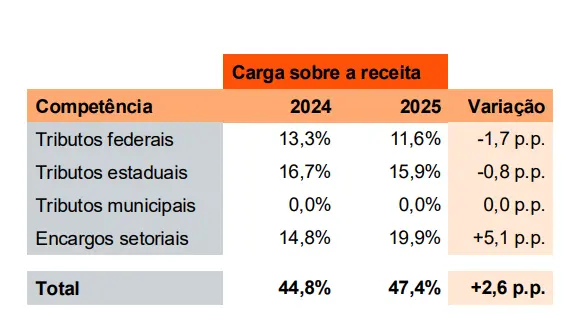
The tax and fee burden levied on the Brazilian electricity sector reached 47,4% of companies' gross operating revenue in 2025, an increase of 2,6 pp (percentage points) compared to the 44,8% recorded in 2024.
The data comes from a study conducted by the consulting firm PwC in partnership with the Acende Brasil Institute, which analyzed 43 companies in the generation, transmission, and distribution sectors.
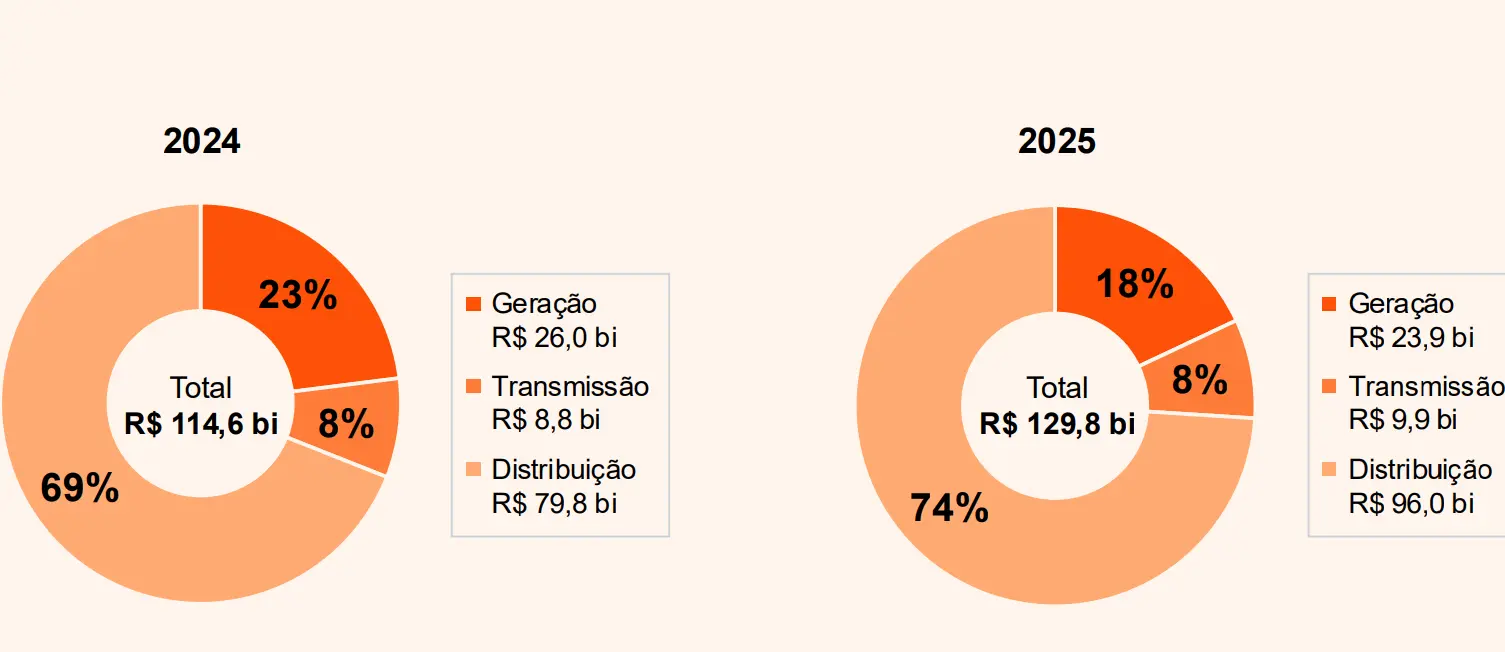
Together, these companies, which represent about two-thirds of the Brazilian market, collected R$ 129,8 billion in sector taxes last year. This amount is 13,2% higher than the R$ 114,6 billion of 2024, which corresponds to a nominal increase of R$ 15,2 billion.
The increase in the share of these charges in revenue was driven by sector-specific charges, which rose 5,1 percentage points during the period, exceeding the reductions recorded in federal (-1,7 percentage points) and state (-0,8 percentage points) taxes.
What is the difference between taxes and charges?
Taxes are levies established by law and intended to finance the activities of the public sector, such as ICMS, PIS, and Cofins.
Sectoral charges, on the other hand, are amounts allocated to finance public policies and specific activities of the electricity sector, such as tariff subsidies, incentive programs, and costs related to system operation, such as the CDE (Energy Development Account) and ESS (System Services Charges).
Distributors account for 74% of tax and fee collection.
In the segment analysis, electricity distribution companies recorded the largest growth in the collection of taxes and sector charges between 2024 and 2025.
The amount increased from R$ 79,8 billion to R$ 96 billion, an increase of R$ 16,2 billion. As a result, the share of total revenue rose from 69% to 74%.
In the transmission segment, collection increased from R$ 8,8 billion to R$ 9,9 billion, an increase of R$ 1,1 billion. Generation, on the other hand, registered a reduction from R$ 26 billion to R$ 23,9 billion between the years, a decrease of R$ 2,1 billion.
Which taxes and charges were taken into consideration?
For the preparation of the study, PwC and the Acende Brasil Institute used information extracted from the companies' financial statements, available on their websites. ANEEL (National Electric Energy Agency), the CVM (Securities and Exchange Commission) and the sector's own agents.
Among the federal taxes considered are IRPJ (Corporate Income Tax), PIS/Pasep, Cofins (Contribution to Social Security Financing), and CSLL (Social Contribution on Net Profit).
The study also took into account the ICMS (Tax on the Circulation of Goods and Services), a state tax, the ISS (Tax on Services), a municipal tax, and labor costs, including employer contributions to INSS (National Institute of Social Security) and FGTS (Guarantee Fund for Length of Service).
Among the sector-specific charges, the following were also analyzed: CDE (Energy Development Account), CFURH (Financial Compensation for the Use of Water Resources), RGR (Global Reversion Reserve), TFSEE (Electricity Services Inspection Fee), and ESS (System Services Charges).
Finally, the survey also included in the calculation the Proinfa (Program for Incentives for Alternative Sources of Electrical Energy), the PDI (Research, Development and Innovation Program) of ANEEL, the PEE (Energy Efficiency Program), in addition to the resources allocated to EPE (Energy Research Company) and FNDCT (National Fund for Scientific and Technological Development).
all the content of Canal Solar is protected by copyright law, and partial or total reproduction of this site in any medium is expressly prohibited. If you are interested in collaborating or reusing part of our material, please contact us by email: redacao@canalsolar.com.br.

Comments
Comments are moderated before publication.Comments should be respectful and contribute to a healthy debate. Offensive comments may be removed. The opinions expressed here are those of the authors and do not necessarily reflect the views of the author. Canal Solar.