
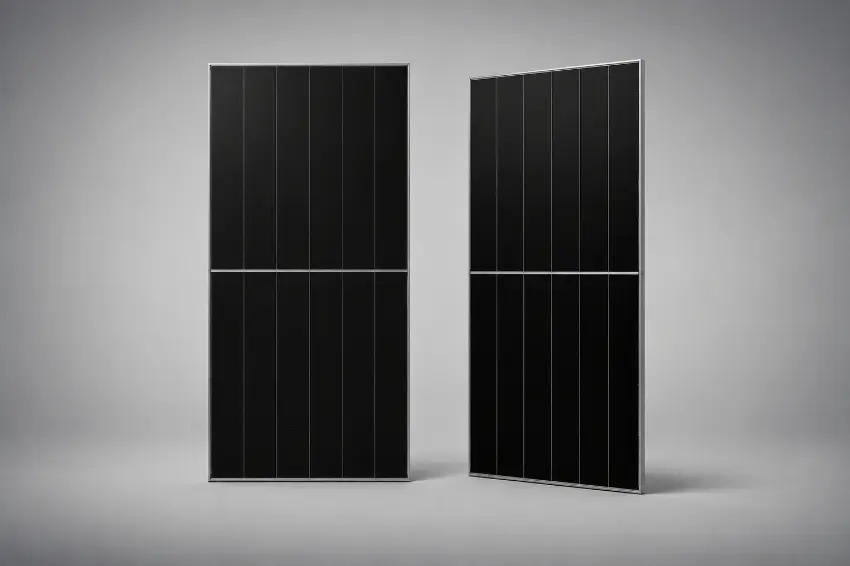
Given the changes in how photovoltaic module performance is evaluated, new technologies have also begun to be analyzed using different indicators that go beyond nominal power.
Throughout this text, studies and data released by Gokin on BC (Back Contact) technology will be presented, considering aspects such as generation, thermal behavior, degradation, shading, and economic impacts. The results reflect the conditions and methodologies adopted by the manufacturer in its evaluations.
The photovoltaic industry is changing its evaluation criteria.
For many years, the photovoltaic market focused its analysis on two main factors: nominal power and price per watt.
This strategy was sufficient during the consolidation period of solar energy. However, the sector's maturity has brought new challenges.
Currently, developers, EPC contractors, distributors, and investors have begun to consider more complex variables, such as cumulative generation, LCOE (levelized cost of energy), degradation, thermal behavior, and utilization of available land.
At the same time, the expansion of distributed generation has intensified a problem that has become increasingly common: the physical limitations of installation areas.
Commercial rooftops have begun to limit the expansion of installed capacity. In solar power plants, the cost of land has started to exert an increasingly significant influence on the financial viability of the projects.
The question is no longer "which module has the highest power output?" but rather "how much energy can be generated using the same available area?"
For the manufacturer, one of the answers to this challenge is BC technology. In this architecture, by transferring the electrical contacts to the back of the cells, this model eliminates the shading caused by the front busbars, increases the active area for capturing solar radiation, and reduces electrical losses.
From PERC to BC technology: the evolution of solar cell architecture.
The photovoltaic industry has gone through different cell architectures throughout its technological evolution.
PERC technology incorporated passivation of the rear face of the cells with the aim of reducing losses and improving efficiency. Subsequently, TOPCon technology expanded the efficiency limits of N-Type modules, reducing recombination losses and increasing the utilization of solar radiation.
The BC architecture adopts a different configuration by shifting the electrical contacts to the rear of the cell. This reduces the presence of metallic elements on the front surface and, consequently, the shading on the area responsible for capturing light.
According to Gokin, this change increases the effective light-catching area and allows for more efficient use of the module's surface.
The five pillars of BC technology
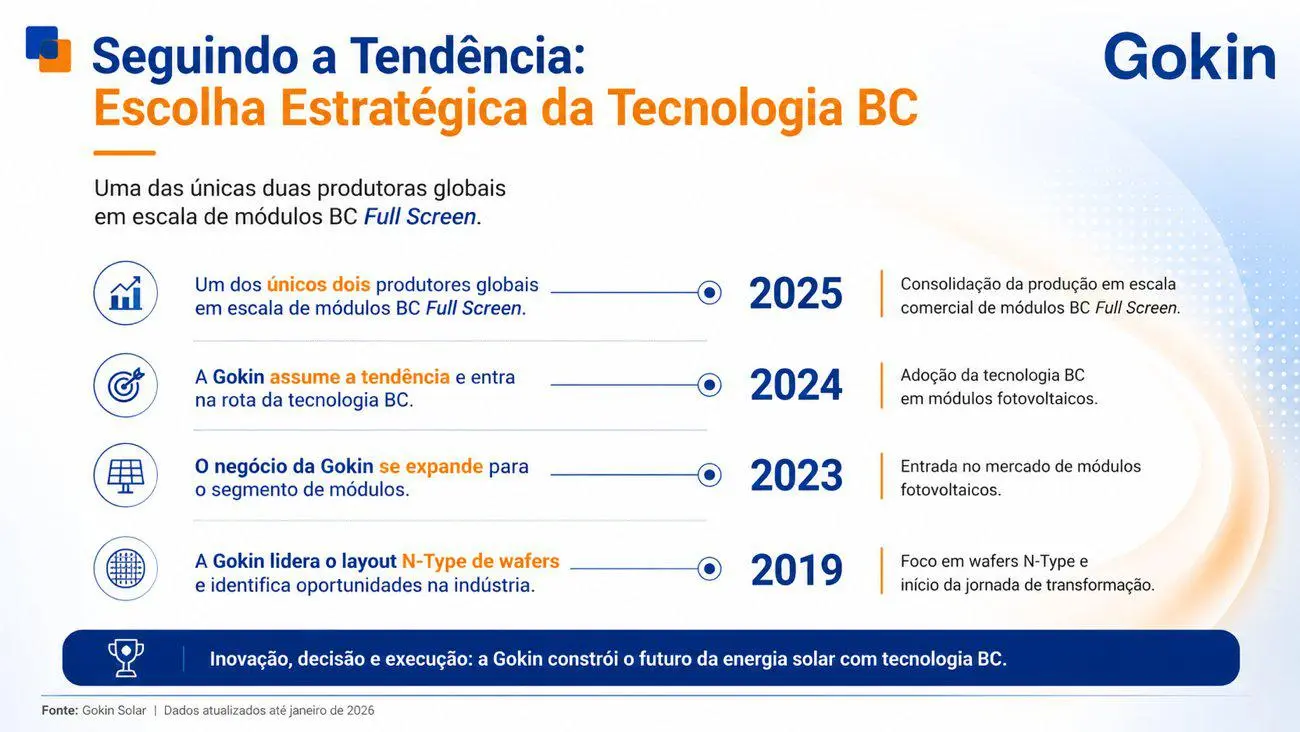
According to the company, the development of BC technology is based on five technical pillars: hidden busbars, precision cell layout, 0-busbar integration, ultra-high resistivity wafers, and true full-screen architecture.
The manufacturer points out that the combination of these solutions aims to increase the surface area available for capturing solar radiation and reduce losses in cell operation.
According to data presented by Gokin, the technologies allow for a 1,4% increase in the light-capturing area, eliminate gaps between cells, and reduce electrical losses.
The company also states that the wafers used can more than double the lifespan of minority carriers, while the combined solutions allow for an increase of more than 3% in the active area of the module.
GK-4-66HGBD: the platform chosen for the Brazilian market.
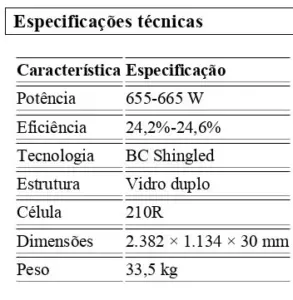
For the introduction of BC technology in Brazil, Gokin selected the GK-4-66HGBD module, which was developed for commercial, industrial, and centralized generation applications; the product combines BC architecture with Shingled technology.
More power using the same available area.
One of the main differentiating factors of BC technology is related to energy density. The company states that in the comparison presented, BC modules of approximately 660 W and TOPCon modules of approximately 620 W have practically the same dimensions.
However, BC technology allows for the installation of more than 6% additional power using the same available area.
This characteristic produces significant impacts:
- More installed power.
- Greater generation per square meter.
- Better use of rooftops.
- Better use of available areas.
Energy density also influences logistics.
In addition to optimizing the installation area, energy density can have implications for the logistics of photovoltaic modules, especially regarding the amount of power transported in the same space.
According to the company, modules with power ratings close to 620 W and 660 W have similar dimensions, meaning that BC technology allows for the transmission of more power using virtually the same physical space.
In practice, this ratio can translate to more power per pallet and per container, impacting both maritime and road transport.
The manufacturer points out that this gain can reduce the relative weight of logistics costs per watt transported, since the same volume of cargo can now concentrate greater nominal capacity.
"In a scenario of high international freight and land transport costs, energy density becomes an important competitive advantage," the company noted.
The impact of temperature on module performance.
Operating temperature is another factor that affects the performance of photovoltaic modules.
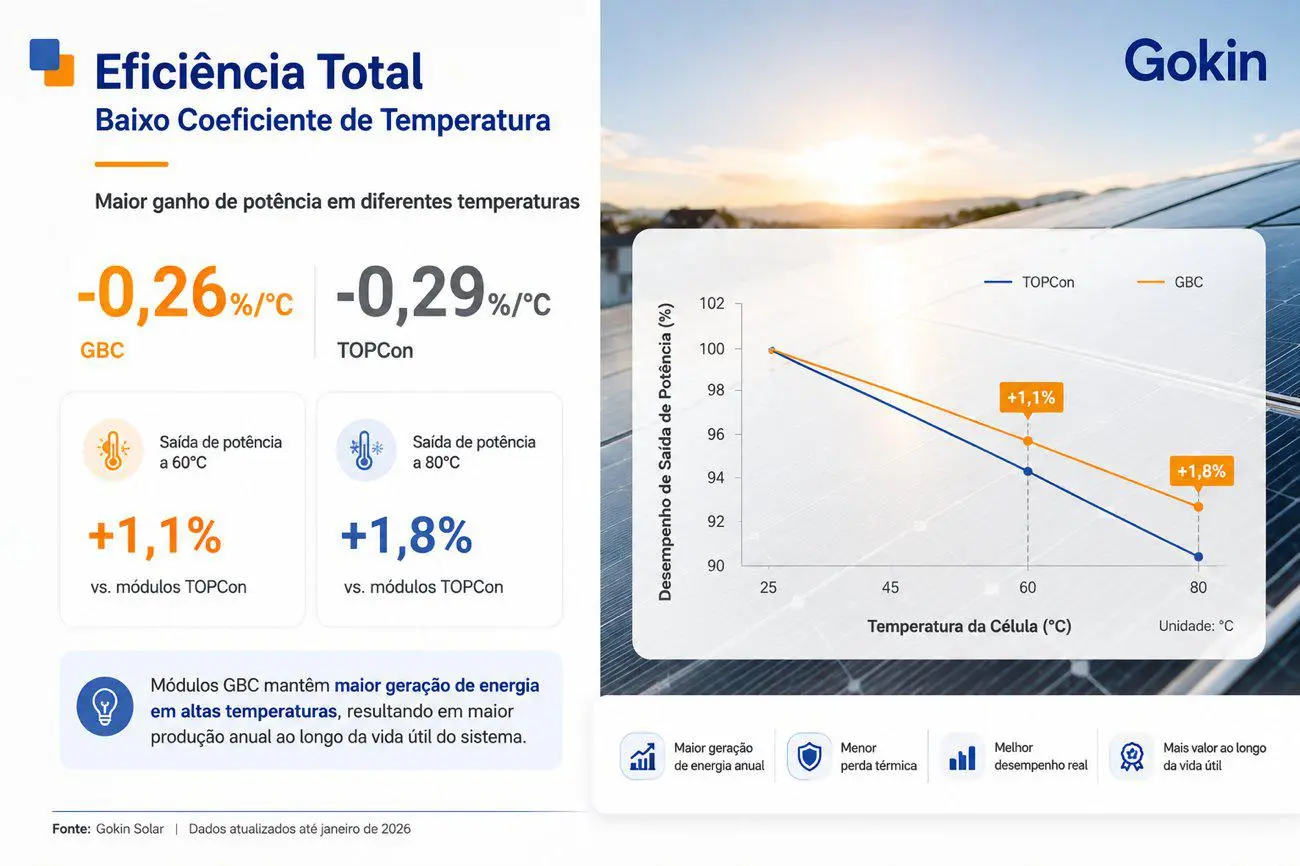
For Gokin, Brazilian climatic conditions represent one of the main challenges for photovoltaic systems. For this reason, the temperature coefficient has become one of the main indicators used to evaluate module performance.
The data presented indicate that BC technology registered a temperature coefficient of -0,26%/°C, while the TOPCon modules evaluated showed -0,29%/°C. In the published comparison, this difference resulted in an energy gain of 1,1% at 60 °C and 1,8% at 80 °C.
Less degradation and greater generation over the lifespan.
The initial power output of the module represents only one part of the economic analysis of a photovoltaic system. The most important variable is the amount of energy produced over time.
Gokin studies show that BC modules retain 92,35% of their original power after 30 years. The TOPCon modules evaluated, however, retain 88,85%.
"In large-scale projects, small differences in degradation rates can represent thousands of additional megawatt-hours over the plant's lifespan," the company added.
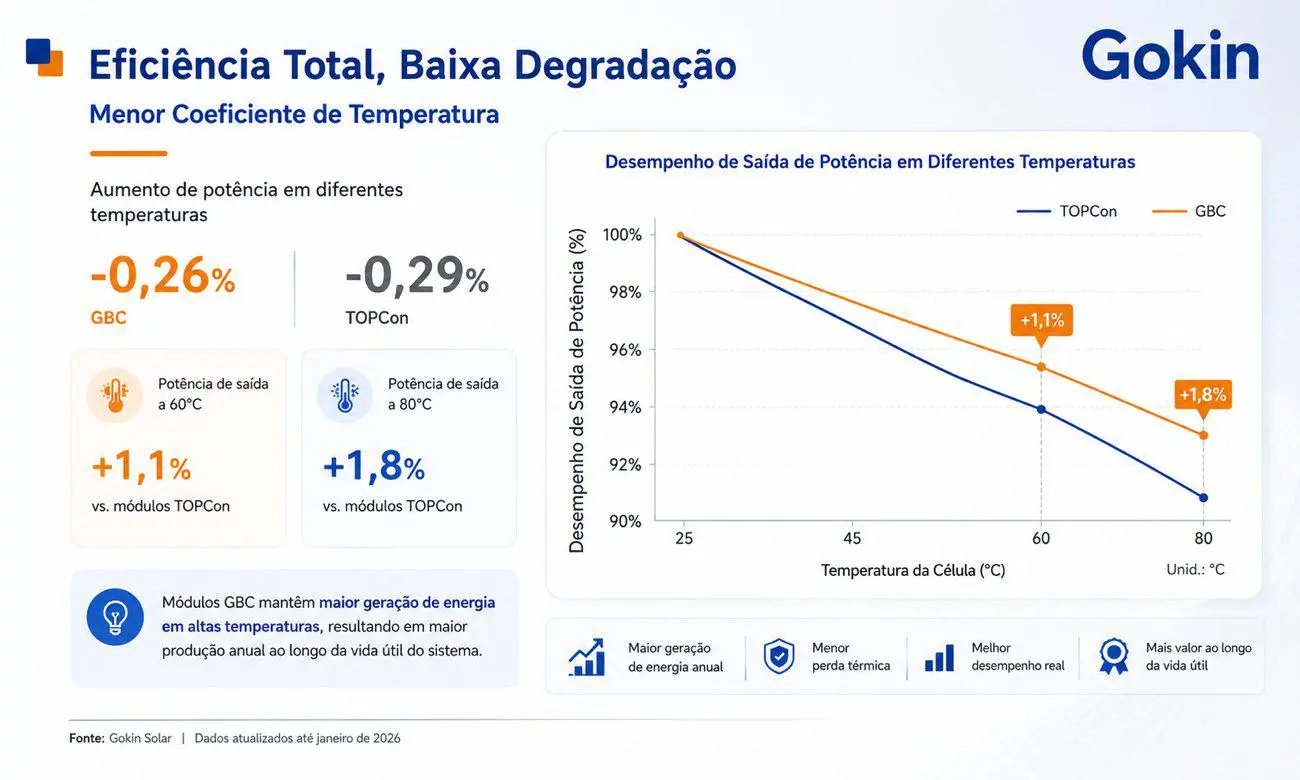
In large-scale projects, small differences in degradation rates can represent thousands of additional megawatt-hours over the plant's lifespan.
Studies conducted under real operating conditions.
The results presented in the analysis also include assessments conducted outside of a laboratory setting. Studies were carried out in four regions of China: Yinchuan, Haikou, Qinghai, and Guangzhou, locations with different operating conditions.
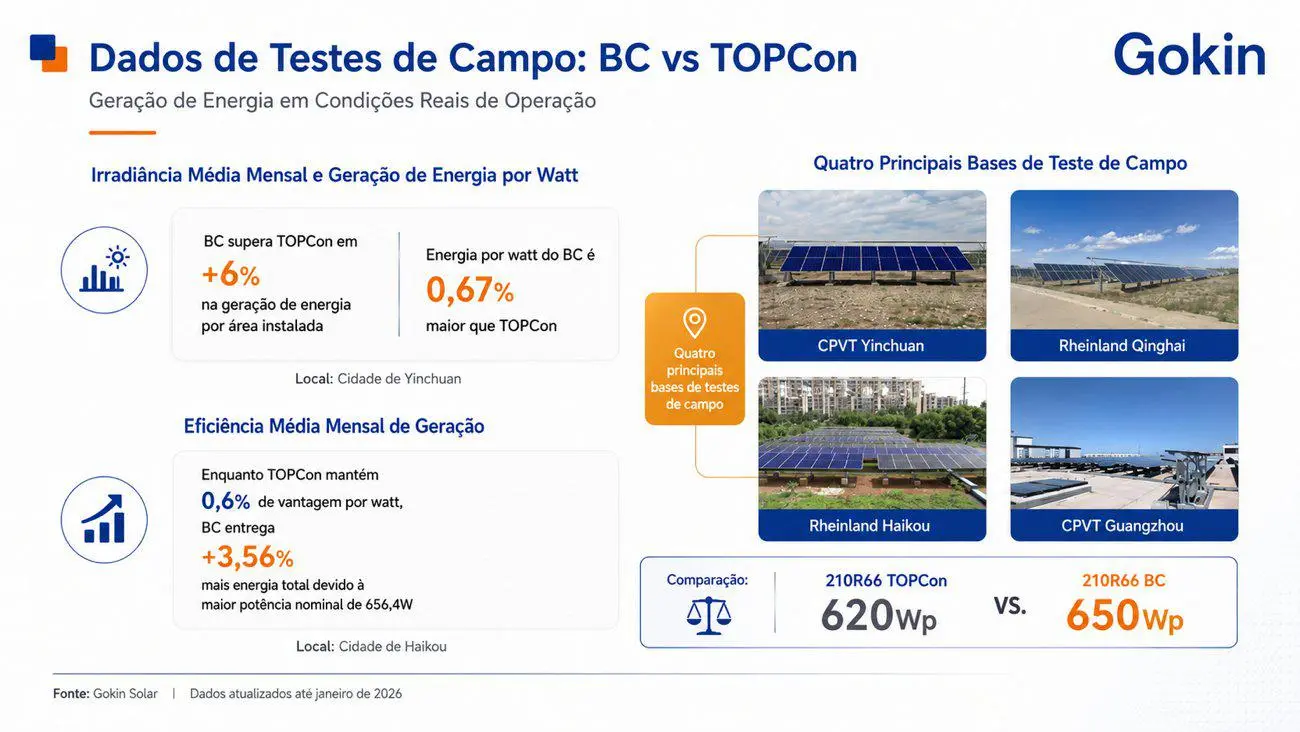
The evaluated modules recorded more than 6% increase in generation per unit area. In certain scenarios, the difference in generation per watt reached 0,67%.
Partial shading and operational safety
Partial shading remains one of the main causes of energy losses in photovoltaic systems.
Studies presented by Gokin indicate that BC technology performs up to 30% better under partial shading conditions.
The tests conducted by the company can be viewed in the videos: Partial shading test — video 1 e Partial shading test — video 2.
Another point evaluated was the occurrence of hot spots, areas of localized heating that can appear in the modules and affect their performance and operation. The BC modules operated below 100 °C, while the conventional modules exceeded 140 °C.
The "I" shaped welding technology also increases resistance to microcracks, contributing to greater reliability throughout the system's lifespan.
The economic impact of BC technology
The adoption of a new technology depends on its ability to generate technical and financial benefits.
Comparative studies conducted for 100 MW systems showed a 2,3% reduction in LCOE (levelized cost of energy), as well as a reduction in BOS (Balance of System) costs.
In the long-term projection presented by the company, BC technology also resulted in 6,8% more cumulative generation over 30 years compared to the study, and an increase in the internal rate of return.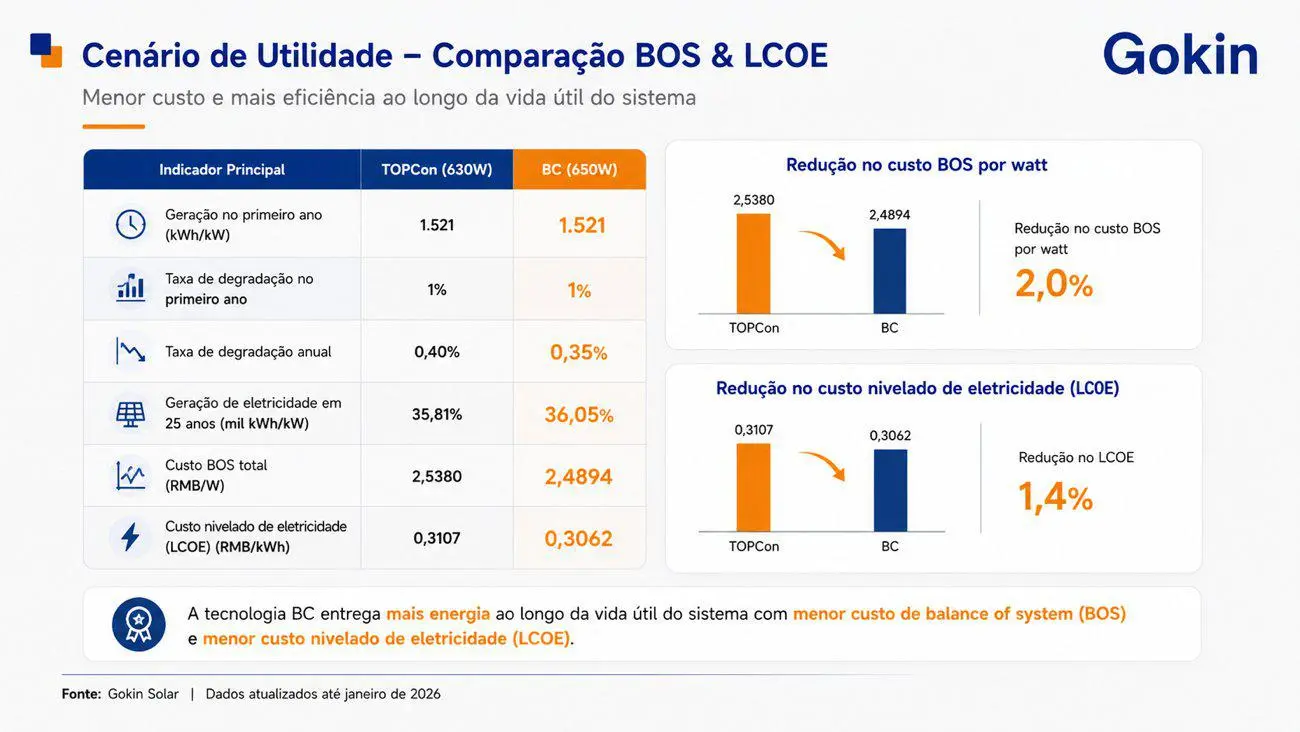
"These results demonstrate that the market is shifting from analysis based solely on module price to a broader evaluation, grounded in system performance throughout its entire lifecycle," the company added.
Conclusion
Back Contact technology represents more than just an increase in module power. It proposes a new way to evaluate the performance of photovoltaic systems.
- Increased efficiency
- Better use of the area
- Less degradation
- Better thermal performance
- Greater energy density
- Highest cumulative generation
all the content of Canal Solar is protected by copyright law, and partial or total reproduction of this site in any medium is expressly prohibited. If you are interested in collaborating or reusing part of our material, please contact us by email: redacao@canalsolar.com.br.



Comments
Comments are moderated before publication.Comments should be respectful and contribute to a healthy debate. Offensive comments may be removed. The opinions expressed here are those of the authors and do not necessarily reflect the views of the author. Canal Solar.