
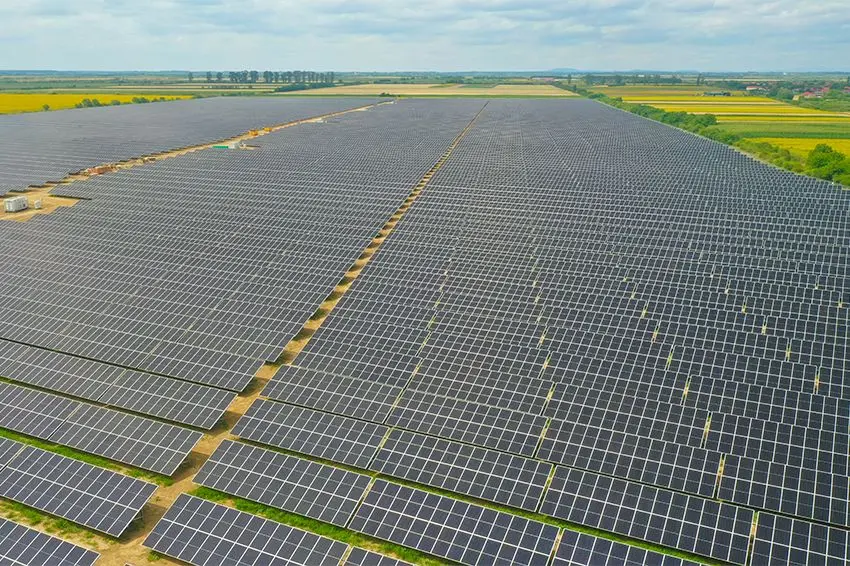
The evolution of photovoltaic modules has brought to market equipment with increasingly higher power outputs. But does this advancement necessarily represent an economic advantage for solar power plants?
The answer depends on how the power increase is achieved. More efficient modules can deliver more watts on the same surface area, while others increase power primarily by increasing physical dimensions.
According to Lucas Monteiro, LATAM Product Manager and Senior Engineer at DMEGC Solar, this distinction is fundamental for evaluating the benefits of each technology.
“When we can deliver more power within the same dimensions, there is a clear opportunity to reduce the number of modules and the area required for a given installed capacity. This can lower assembly, fixing, and infrastructure costs,” he explains.
Larger modules require an analysis that considers the characteristics of the structure, transportation, and installation conditions. Therefore, nominal power should not be used solely as a selection criterion.
Is price per watt sufficient for comparing modules?
The price per watt (R/W or US/Wp) is one of the main commercial benchmarks in the photovoltaic market. Although it facilitates comparison between equipment, the indicator does not account for differences in performance and construction characteristics.
According to Monteiro, a module with a lower purchase price may require more robust structures, offer less efficient use of available space, or have electrical characteristics that are less suitable for the project.
The executive also points out that thermal behavior, degradation, and reliability influence generation throughout the product's lifespan.
“A discount on the purchase doesn’t necessarily mean savings for the investor. The question we ask is: how much does this solution cost to install and how much energy will it deliver during its operation?” he states.
Dimensions and electrical characteristics change the design.
Increasing the power output of the modules can alter different stages of a power plant's deployment, but the effects vary depending on the technology and configuration adopted.
In the anchoring structures, weight, dimensions, support points, and wind loads must be evaluated. Therefore, reducing the number of modules does not necessarily mean a proportional decrease in foundations, profiles, or trackers.
In terms of electrical components, voltage influences the number of modules per string, while current affects conductor sizing, losses, and compatibility with inverters. "More power doesn't automatically mean less cable," Monteiro points out.
Logistics also presents differences. The most appropriate indicator is the power transported per container, considering packaging, weight, and operational limits.
During assembly, using fewer units can reduce fastening and connection operations. However, larger and heavier equipment may require additional handling resources.
Comparison between 620 Wp, 630 Wp and 720 Wp modules
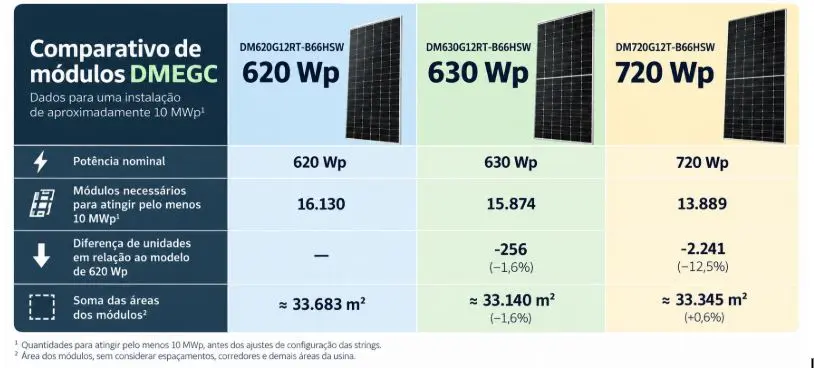
To illustrate these differences, DMEGC Solar presented a comparison between three models from its portfolio: DM620G12RT-B66HSW, 620 Wp; DM630G12RT-B66HSW, 630 Wp; and DM720G12T-B66HSW, 720 Wp.
This exercise considers an installation of approximately 10 MWp. The module data is real, while the sizing and economic assumptions are illustrative and do not correspond to a completed power plant or commercial quote.
Same dimensions, greater efficiency.
The 620 Wp and 630 Wp models have the same physical dimensions. In this case, the increase in power results from greater efficiency, without altering the size of the equipment.
To achieve approximately 10 MWp, the 630 Wp alternative uses 256 fewer modules, a reduction of about 1,6%.
Since the dimensions are the same, the sum of the areas of the modules also decreases by approximately 1,6%, which can improve space utilization and simplify certain assembly operations.
Fewer units, but larger modules.
Compared to the 630 Wp model, the 720 Wp module reduces the required quantity by 1.985 units, or approximately 12,5%.
However, due to their larger dimensions, the sum of the module areas is approximately 0,6% higher than the 630 Wp alternative, according to data provided by the manufacturer.
This means that the 720 Wp model has an advantage in the number of units used, while the 630 Wp model offers greater power density per area in this comparison.
The choice also depends on the layout, which takes into account row spacing, aisle width, slope, shading, and terrain conditions.
What is the financial impact of this difference?
DMEGC presented a simulation to demonstrate how a small variation in efficiency can influence the budget.
Hypothetically considering US$20 per module in a given assembly and accessories package, the reduction of 256 units between the 620 Wp and 630 Wp models would provide savings of US$5.120.
If the 630 Wp module had a price US$ 0,0005/Wp higher, the additional investment in its acquisition would be approximately US$ 5 for a 10 MWp plant.
In this scenario, the reduction in assembly costs would practically offset the difference in equipment prices.
The figures shown are for illustrative purposes only and do not represent DMEGC's commercial prices. A definitive comparison would depend on the budgets and specific conditions of the project.
Do more powerful modules generate more energy?
When two power plants have the same installed capacity, using individually more powerful modules does not guarantee greater annual generation.
Considering a hypothetical specific productivity of 1.700 kWh/kWp per year, a 10 MWp installation would produce approximately 17 MWh annually in the three configurations.
In practice, however, the result depends on factors such as operating temperature, electrical behavior, back irradiance, shading, and losses.
A proper energy simulation should consider the technical files for each module, meteorological data, inverters, and structures used.
Monteiro explains that greater efficiency allows for the installation of more power in a given area, but does not, in itself, represent more energy produced per kilowatt-peak installed.
In the simulation presented, a 1% difference in specific productivity would correspond to approximately 170 MWh per year, a volume that could become more significant over the course of the operation.
Performance and reliability influence LCOE.
In addition to the deployment, the characteristics of the modules affect the levelized cost of energy, known by the acronym LCOE (Levelized Cost of Energy), which relates the costs of the project to the electricity production during its useful life.
Among the most relevant factors, Monteiro highlights efficiency, temperature coefficient, bifacial performance, degradation, and reliability.
The temperature coefficient influences power loss when the cells heat up. In bifacial modules, the additional generation from the rear face depends on conditions such as albedo, installation height, spacing, and structural shading.
Degradation and reliability, on the other hand, determine part of the accumulated performance over decades of operation. "A small difference in the first year can become significant over the course of operation," he notes.
The executive also points out the importance of manufacturing quality, traceability, warranties, and after-sales support, especially given the financial impact of failures and downtime.
Profitability, however, also depends on variables external to the equipment, such as financing, operating costs, and revenue obtained from energy.
The highest power output isn't always the best choice.
There is no ideal power output for all photovoltaic applications. The advantages of each model vary according to the project conditions.
A large module may be suitable for a ground-mounted power plant, but it may present limitations on rooftops with space, load, or access restrictions.
Even in ground-based projects, factors such as wind, terrain characteristics, and tracker configuration can alter the comparison results. "The highest power available in the catalog isn't always the lowest-cost solution," says Monteiro.
According to the executive, the decision should consider three aspects: total investment, expected generation over the lifespan, and operational risk. "The most attractive module is the one that delivers the best balance between investment, energy produced, and reliability throughout the project," he concludes.
all the content of Canal Solar is protected by copyright law, and partial or total reproduction of this site in any medium is expressly prohibited. If you are interested in collaborating or reusing part of our material, please contact us by email: redacao@canalsolar.com.br.


Comments
Comments are moderated before publication.Comments should be respectful and contribute to a healthy debate. Offensive comments may be removed. The opinions expressed here are those of the authors and do not necessarily reflect the views of the author. Canal Solar.