

The popularization of photovoltaic systems, one of the main types of solar energy, has led to the creation of companies with little qualification, and yet they have managed to prosper with great commercial appeal. We often see installations where there are clear errors in the positioning of the photovoltaic inverter – but, after all, where is the ideal location?
To answer this question, we can retrieve the manual (PHB5000T-DS) in order to collect important information for the definition:
- For best performance, the ambient temperature should be below 45°C
- Be sure to install the inverter in a location where it is protected from direct sunlight, rain and snow.
- Make sure the installation location is well ventilated.

With these requirements, we ensure that the inverter is in an environment capable of guaranteeing its optimized energy production. Direct sunlight can worsen its operating conditions and lead to premature equipment failure due to constant thermal stress, greater than designed.
The IP65 protection of this inverter guarantees protection against water jets, however, the inverter must not be installed so that it is exposed to rain, thus avoiding the risk of excessive internal humidity and premature corrosion of components.
Minimum distances
For heat dissipation and convenience during disassembly, the free spaces around the inverter must comply with the standard described below. The installation position must not impede access to the disconnecting means.

Note that there are requirements for the inverter to maintain a good operating temperature. The manual shown here deals with the PHB5000T-DS model, which depends on the physical phenomenon of convection to dissipate heat. The spaces required are the minimum for this to occur satisfactorily.

These distances do not allow the passage of conduits, cable trays or cables, as if this is done, they will act as a restriction to the air flow.
Value of solar energy: how much does installation cost on average?
Safety
Consider the wall's load-bearing capacity. The wall (e.g., concrete or metal) must be strong enough to support the weight of the inverter for an extended period. Inverters should not be installed near explosive or flammable items. All intense electromagnetic fields must be kept away from the installation site.
Regarding the safety of the installation site, as with other electrical equipment, it must be kept away from explosive or flammable substances, including wooden walls. The wall's resistance also needs to be considered, as the mechanical load it will be subjected to may not have been foreseen, thus compromising the safety of the area. Consult a qualified technician before drilling into the wall!
Posicionamento
Install the inverter where it is easily accessible for maintenance and electrical connection. Install the inverter at eye level for convenient operation and maintenance. The installation position should not impede access to the disconnection means. We note here important items to facilitate circuit maneuvers and maintenance. We can refer to the NBR 5410 standard later.
4.1.10 Accessibility of components. The components of the electrical installation must be arranged to allow sufficient space for both initial installation and subsequent replacement of parts, as well as accessibility for the purposes of operation, checking, maintenance and repairs.”
We realized that this is not just something imposed in the manual, but rather a call to what the NBR already said. It is vitally important not only to have easy access to inverters, but also to switching devices such as circuit breakers.
On the other hand, the importance of sticking to this part in places where there are children or simply high traffic of people is also highlighted. In this case, the recommendation is to avoid it completely, neither installing the inverter in an easily accessible position with good visibility nor installing it at higher heights, making maneuvers or interactions with the equipment difficult. Because in any case there will be more risks and negative consequences than advantages.
But after all, where should the inverter be placed?
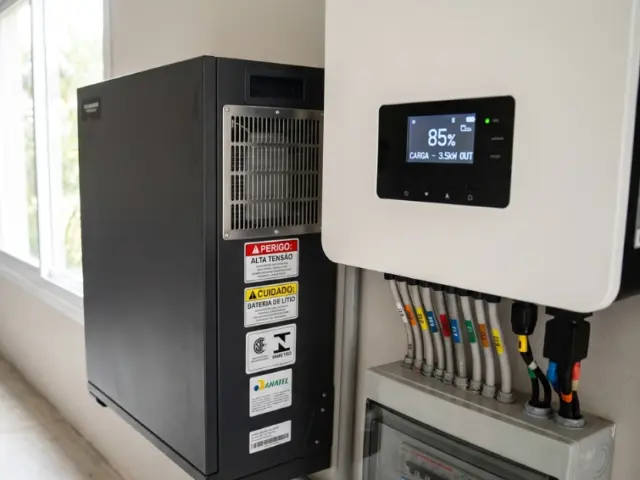
Having considered all the caveats, we can analyze locations that would easily meet the requirements and ensure proper and safe operation of the inverter, as well as all the circuit protection components. In residential environments, the owner or person in charge often seeks a place where the equipment can be "hidden," which makes a lot of sense up to a certain point.
Now, a pantry, laundry room or garage are places that are usually easily accessible, but that people rarely visit or spend much time in. On the other hand, placing it in the attic can be a big mistake, since in maintenance or maneuver events, a ladder would often be necessary to access the place.
Corridors can be interesting because they are underutilized spaces, but due to the constant passage of people and even the constant risk of unsuspecting individuals being in the area, they become a less safe location and therefore not recommended. In commercial or industrial environments, we also have some alternatives. First, we should look for locations where there is no presence of people or traffic of machinery, production or commercial items, among others.
Some attractive locations could be: storage rooms, server rooms, or computer rooms (provided they are air-conditioned). Outdoor environments should respect previously discussed concepts: no exposure to rain and direct sunlight. As a suggestion, an awning could be installed, as seen in the image below.

In this case, both the AC panel and the string box must have an IP65 protection rating to operate correctly. For large power plants, we have the option of constructing the inverter room in masonry or in a skid-mounted container.
Always remember to maintain the temperature of the location, whether through doors and windows or even through air conditioning. It is essential to plan the location of the inverter installation during the negotiation process to anticipate costs (especially for large power plants).

I remember that being careful with distances does not only apply to inverters.

Finally, how about enriching your knowledge with specialized articles? Then download the free Magazine Canal Solar and check out all the news in the renewable energy market.


Comments (1)
Comments are moderated before publication.Comments should be respectful and contribute to a healthy debate. Offensive comments may be removed. The opinions expressed here are those of the authors and do not necessarily reflect the views of the author. Canal Solar.
Don't check out the article with recommendations for the SMA inverter, by the way, it's the best of all!