

In the year 2023, photovoltaic energy surpassed wind energy and became the second largest source of electrical energy in the Brazilian energy matrix.
Much of the installed power in Brazil corresponds to distributed generation, in Brazilian homes with the aim of reducing electricity bills and self-consumption.
However, both large plants and residential systems need correct installation to avoid risks to property or humans.
With this in mind, it is extremely important that there are installation manuals that can be followed, not only in centralized generation projects, but in distributed generation projects as well.
AE Solar provides an installation manual that comprehensively covers the installation of its panels, and can help the installer during their work.
General instructions
General warnings must be considered before starting the installation, the first being to always remember that photovoltaic modules generate electricity, and must be treated with care to avoid risks at all times.
Second, in the case of rooftop installations, modules cannot be installed on top of flammable materials.
Third, these specific modules are class II, so they can be used in systems that operate at 50 V DC or > 240 W.
Finally, modules must be assessed for fire risk at the installation site, and must not be installed without a technical opinion from construction specialists or a civil engineer certifying that the complete structure can be built.
Notices
A series of warnings, from intuitive to specific situations, must be considered before and during panel installation.
All instructions must be read and understood prior to installation.
- The module generates electricity when it receives sunlight, so its surface can cause shocks and burns. And as the generation is by light, magnifying glasses and other light-concentrating materials should not be used in the module.
- Modules with broken glass are a risk of fire and electric shock. They cannot be repaired, and must be discarded.
- To avoid electrical hazards, opaque materials can be used to cover the module during installation. And installation should only be carried out during the day, with installation and maintenance carried out by a qualified installer.
- If batteries are present, the manufacturer's instructions must be followed.
- Do not disassemble the modules, use them as replacements on walls and roofs or place modules in places with flammable gas.
- Do not touch the live terminals with your hands without insulating protection and do not lift the modules by the cables.
- All photovoltaic systems must be grounded. If there are no special instructions, follow national regulations.
- To choose components, it is necessary to consult the NBR 16690 standard, so that changes in normal conditions are taken into account when choosing fuses, cables and other components.
- Keep the modules packaged until installation. When removing the packaging, be careful when unpacking and avoid knocking, which can cause microcracks. Never drop or climb on top of modules.
- Never clean the module with chemicals. Use normal water, and check the module temperature to avoid thermal shock.
- Do not disconnect modules when they are in operation.
- When using anti-reflective technologies, it is normal to see different colors depending on the angle. Modules with anti-reflection technology and without anti-reflection must not be used in the same string.
- String box connectors must not come into contact with oily substances such as lubricants.
- Do not carry the module on your head, but if unavoidable, ensure that the glass is facing the helmet and not the back.
- Dispose of correctly in accordance with local legislation (the symbol for correct disposal of electrical appliances on the side)
Installation
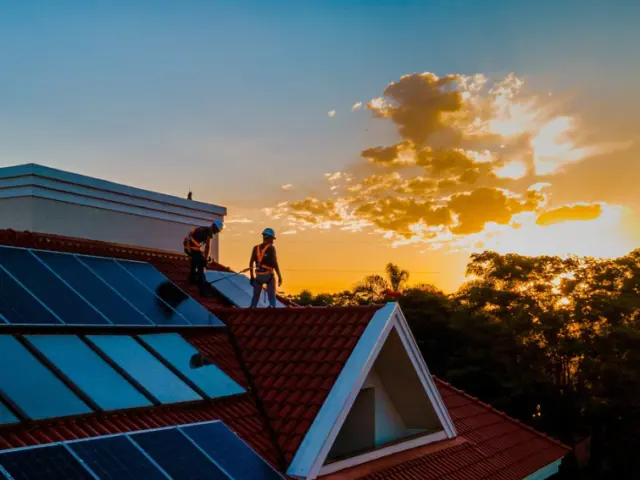
During the installation itself, safety measures must be reiterated, mainly the use of PPE (helmets, insulating gloves and safety shoes with rubber soles). The installer must not touch the panel unnecessarily, and must not work in rain, snow or wind. If the modules are wet, the installer must not touch them. The installer must check that there are no flammable gases nearby, and install the connectors until they hear the click indicating connection.
Regarding climatic conditions, the module supports from -40°C to 85°C, with a humidity of <85 RH%. The module should be facing the sun if possible, and with the inclination that results in the best capture of sunlight and with the minimum of shadows. The site circumstances, slope and shading can be simulated on the computer by the designer. It is worth mentioning that the modules must be installed away from the flow of people and animals, and in the case of batteries, their sizing must also be considered.
During installation, fixing methods may vary depending on the roofs and instruments (screws or clamps), however, the need for the fixing method not to hide the module or come into contact with the glass is constant.
The system must undergo constant inspections to prevent damage resulting from weather phenomena (hail, rain) or wildlife from disrupting the plant's operation. The employee performing the inspection must look for noisy cables, broken glass, loose connections and any object resting on the face of the panel. In the case of uniform or localized dirt, the cleaning instructions follow the initial warnings, do not use any chemical elements, just water and consider the temperature before cleaning. Also, do not use any abrasive cleaning tools.
Conclusion
Installation is a time that can cause inconvenience for installers and customers, so it is necessary to follow the instructions from the manufacturers of the system's modules and equipment. In addition to the installation itself, there are recommendations for moving the modules, cleaning and even visual inspections. For a system to operate efficiently, knowledge is necessary during all installation periods, and instructions like those from AE Solar make a difference in this regard.
The installation manual for AE Solar photovoltaic modules can be found at the link https://ae-solar.com/downloads/
Reference
The opinions and information expressed are the sole responsibility of the author and do not necessarily represent the official position of the author. Canal Solar.

Comments (1)
Comments are moderated before publication.Comments should be respectful and contribute to a healthy debate. Offensive comments may be removed. The opinions expressed here are those of the authors and do not necessarily reflect the views of the author. Canal Solar.
This article is very good, it is extremely important for the installer and those who carry out maintenance.