
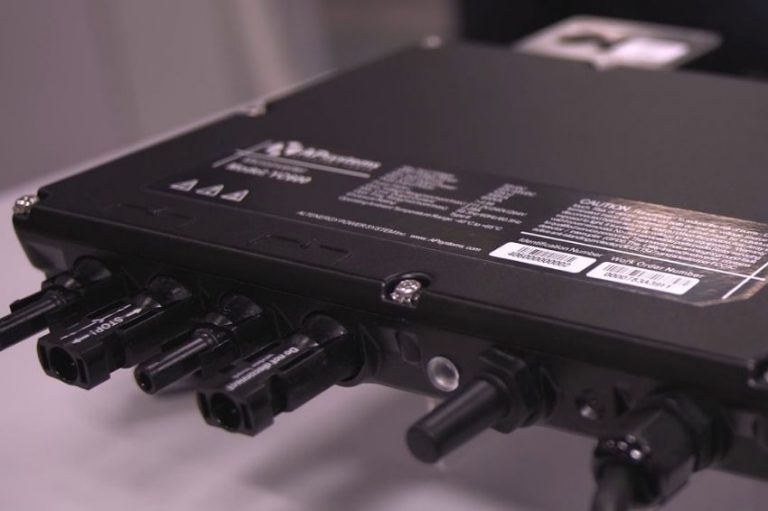
One of the most frequently asked questions in the photovoltaic market is the difference between a solar microinverter and a traditional string inverter and when to use them. If you are planning to purchase a solar energy system for your home or have customers who are still undecided about which product to choose, this article will help you.
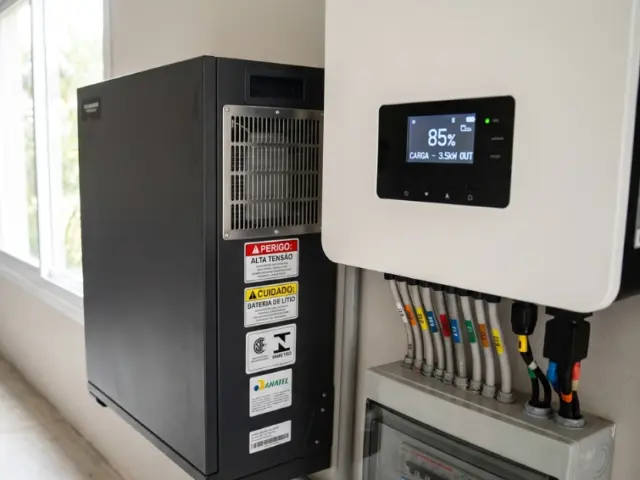
The most striking difference when comparing the two is their size: the string inverter is larger and aims to serve one or more “strings” (set of photovoltaic modules connected in series). The microinverter, as its name suggests, is smaller and aims to serve a maximum of four modules per device, optimizing each one of them individually.
Thus, a system that could be served by just one string inverter can be operated with several microinverters (each one located behind the panels and on the roof). Installing several inverters instead of just one may seem like a disadvantage — but in practice, in many cases the opposite is true: installing several microinverters instead of one string inverter can make a solar system more efficient and economical.
MPPTs or optimizers
This advantage of the microinverter is largely due to the way in which MPPTs (Maximum Power Point Tracking) are used. In a project with microinverters, it is possible to use each MPPT input to benefit each solar module individually, while in the case of the string inverter we can have one MPPT for up to 20 modules (which can considerably reduce the gains with energy optimization).
See also other features
The best distribution of MPPTs (MLPE or Module-Level Power Electronics concept) causes the system as a whole to generate more energy than in the case of string inverters, especially in installations with shading, different panel positions or loss of panel performance — this loss is expected, but in practice occurs in a unequal harming the whole.
In other words, the microinverter enhances the benefits of MPPTs on the system as a whole, preventing the operational differences of individual modules from “bringing down” the performance of the entire array of solar modules (which happens in the case of string inverters).
shading
While the microinverter optimizes photovoltaic panels “individually”, the string inverter will always treat several panels as a set (and thus a difference in any one of them will end up harming them all).
Therefore, if there is shading on one or more panels, the photovoltaic system as a whole is compromised to a greater extent when working with string inverters. With the microinverter, each solar panel will be optimized separately by its independent MPPT. Thus, a localized loss (such as shading of a module) will not harm the entire solar energy system.
Project flexibility
Another advantage of microinverters is that they can be installed in any combination of quantity, panel model, orientation, inclination and even power. The possibility of changing orientations and inclinations is an important benefit, as it allows greater project flexibility and facilitates eventual expansion
When we work with string inverters, we need the connected modules to be positioned in the same orientation and inclination to have identical or similar behavior. We cannot, for example, use the same inverter for panels that face opposite sides or have a different inclination — a condition that greatly limits the possibilities at the time of installation.
Ease of expansion – modularity
In addition to allowing greater flexibility in the installation of a solar photovoltaic project, the microinverter also facilitates the system to be scaled up later, due to the intrinsic modularity of its MLPE concept.
To expand a project with microinverters, simply purchase more photovoltaic modules and add a proportional number of new microinverters to the system. To expand a project with a string inverter, it is necessary to switch to a higher power and analyze, in advance, the new dimensioning of this larger photovoltaic arrangement.
Another important point: when we expand a system supplied by a string inverter, we will most likely mix solar panels purchased at different times (i.e., the modules will have different efficiencies, and when we mix them, the ones with the worst performance will harm the best ones). Microinverters, on the other hand, avoid this problem, as they optimize each solar panel individually (i.e., the panels that are most worn out will not interfere with the operation of the others).
System and installation security
While the microinverter operates at low direct current voltages (60 V), the string inverter uses higher voltages (up to 1.500 V), which can involve risks at the time of installation and later, increasing the chance of electric shocks and even fires. In addition, microinverters already convert direct current (DC) into alternating current (AC) directly on the roof — therefore, the entire electrical circuit works at 220 V or 127 V alternating current, reducing the risk of arc flash, for example, and increasing safety as a whole.
Finally, a last safety advantage for microinverters is the fact that in the event of fires or other types of accidents, the power is already cut off at each microinverter, reducing the risk not only of causing new fires and problems, but also reducing the risk for firefighters or anyone fighting the fire.
Service life and warranty
In these aspects, the microinverter also comes out ahead, usually with a 10 to 15-year warranty — depending on the manufacturer — and a useful life of around 25 to 30 years (approximately the same time that the solar panel reaches). The traditional string inverter usually has a 5 to 7-year warranty, depending on the manufacturer, and its estimated useful life is 10 to 15 years — that is, the string inverter works practically half the useful life of a photovoltaic panel, which will bring additional costs in the future for the replacement.
Maintenance and monitoring
Both microinverters and string inverters have remote monitoring systems, a key feature for monitoring the production and financial return of the solar energy system. However, there is a big difference in this regard, since microinverters monitor each panel individually, while string inverters can only monitor complete strings.
One problem with strings is that, when a defect or loss occurs on a specific board, the energy generation of the entire set will be impacted and will be lower than expected. This characteristic of string inverters also hinders system monitoring — as it is more difficult to find which panel has a problem, since the loss is diluted across the entire series and sometimes is not even noticed.
In the microinverter, energy optimization is individual for each board and, therefore, so is monitoring. This way, we can identify faults faster, as it will be clear which card is performing worse than the others (which also allows us to assess whether the problem is a technical defect, shading, dirt or another factor).
With better monitoring, consequently, project maintenance is also simpler with microinverters. We can easily identify which panel or connection has problems and replace them, preventing the system from being impacted for longer (sometimes years and years in the case of string inverters, due to the difficulty of identifying a specific problem).
What is the best solar inverter?
The inverter is the most complex equipment in a solar energy system and it is essential to choose it carefully. The string inverter has the advantage of requiring the use of few units in an installation (although it requires a more complex infrastructure than the microinverter) and of being a device that is easy to access at any time for maintenance.
Microinverters, on the other hand, make it easier to identify problems in the system because they have individual monitoring, allowing the installer to check fault alerts and monitor individual data from each solar plate in the photovoltaic array.
Depending on the conditions of the installation location — such as the presence of trees or chimneys (among other objects that may cause shadows) — the photovoltaic system with string inverter ends up losing performance as a whole due to shading and dirt.
This situation can be minimized using the microinverter, which employs the MLPE concept, individually optimizing each solar panel. Another differentiator of the microinverter is that it allows the installation of photovoltaic panels with different orientations and inclinations, without a module affecting the energy production of other solar panels.
Regarding price, microinverters tend to be a little more expensive than string inverters, but recent declines in their costs have made them a more competitive option, in addition to the fact that they have a useful life twice as long as string inverters.
Still on costs, it is worth noting that, in the case of the microinverter, the use of the string-box (protection box with fuses, switch and surge protection) on the direct current (DC) side is not required, which also generates savings in project installation.
Another factor that must be taken into account when analyzing the “payback” (return on investment) of each equipment is the useful life. The microinverter has a durability, on average, twice as long as the string inverter, which generates greater cost-benefit in the medium and long term.
Furthermore, the loss of efficiency over time, due to degradation of the solar panels, will always be lower with microinverters — as the absence of high voltages inhibits the PID effect (potential-induced degradation), mainly responsible for the long-term degradation of photovoltaic modules.
In a practical way, microinverters will always be better in adverse conditions (such as shading, different sides of the roof, etc.) and also in smaller systems (up to 15 or 20 kWp), where the difference in cost will be compensated by not using string -box, for simpler installation and general system security. In larger systems or without such conditions, the string inverter may be the best option.
Understanding how to choose the best solar inverter is essential for anyone who works or is interested in the sector. Therefore, keep following the solar energy news No. Canal Solar — your trusted source of industry information.

Comments
Comments are moderated before publication.Comments should be respectful and contribute to a healthy debate. Offensive comments may be removed. The opinions expressed here are those of the authors and do not necessarily reflect the views of the author. Canal Solar.