
Article published in the Magazine Canal Solar. Click here and download now for free!
In the US, recent studies have indicated that 62% of solar installations exhibit critical production problems, with 91% of these being related to DC components [1]. A significant portion of generation problems are related to dirt and connections in the panels, resulting in up to 30% loss of monthly production, depending on the installation location [2].
In fact, practically the vast majority of solar installations in the world may be experiencing serious generation problems, and until now there were no practical and effective diagnostic methods or tools capable of verifying system performance losses; and in Brazil it is no different.
The simplest way to assess performance loss is to predict how much the plant should be generating under current weather conditions. Current methods result in significant uncertainty because they fail to calculate a precise generation reference, thus preventing an accurate analysis of the plant's expected output.
The main method of diagnosing large plants in Brazil is checking the Performance Rate, which is not a literal translation of the English “Performance Ratio” [3].
Fundamentally, the Performance Ratio is an academic term created to compare the quality of installations in different regions and orientations, and represents the relationship between the energy actually produced and the energy that would be produced if the system were working continuously at its nominal efficiency STC (which would assume unrealistic conditions of constant solar radiation of 1000 W/m2 and 25° temperature), never being its objective to monitor plants.
The use of performance rate for performance loss diagnosis has the following limitations:
- The theoretical performance rate simulated during sizing is not the same as that of the installed plant, so there is no reference for comparison, making it impossible to predict the expected generation.
- The performance rate is a priori a quantity for analysis of annual statistical average, since the monthly variance is extremely sensitive to seasonal changes.
- The performance rate is a simplified equation and absolutely cannot represent what the complex generation simulation model does, so small changes in temperature, for example, can be offset by effects due to dirt, and it is impossible to conclude what is happening with the plant.
In fact, PVsyst itself in its tutorials states that the corrections implemented for evaluating the performance rate in short periods (not annual) are not convincing, stating that:
"We implemented this in PVsyst version 6.74. However, the result is not very convincing, because in most PV systems, other contributions are season-dependent." He goes further, stating that "This correction is almost unusable with tracking systems, as seasonal variations due to tracking largely dominate the temperature effect."
Within the same logic of evaluating the performance rate, some services still try to diagnose the current generation of the installation, comparing it with that simulated generally in PVsyst during the design phase using historical meteorological data.
This method is especially inaccurate because year-to-year variation is diluted within the historical average, so the probability that a current month will have the same generation as the historical average is small.
PVsyst itself in its manual states [4]: “Commonly available meteorological (climate) data generally have some uncertainties, of different types, which can produce very significant differences between sources or years within the same source. These can be:
- The annual variability, which is assumed to have a Gaussian distribution,
- The quality of data recording, operator care, positioning, calibration and drift of sensors, disturbances such as shadows, dirt or snow on the sensors, etc.
- The presence of a horizon that is not negligible for terrestrial measurements,
- The location difference (distance from the measuring station) for ground measurements,
- The quality of the models used to interpret satellite data, which has been continuously improving for 20 years,
- Climate evolution. In Europe, radiation appears to have increased by up to 5% since the beginning of the XNUMXst century.
A more recent method, called "Machine Learning" forecasting (which is a subset of so-called "Artificial Intelligence"), analyzes the correlation between temperature and solar irradiance, and the electrical energy generated. This method is used by companies such as Delfos and Prescinto, for example, and is erroneously referred to as Digital Twin.
Thus, it's typically necessary to "train" this correlation with a year's worth of plant data in order to predict the next year's generation. The biggest problem with machine learning is that it merely manipulates data, with no connection to the plant's physical and electrical model. From the description above, we can already see the drawbacks of this method:
- Monitoring can only be implemented after 1 year, and in practice, it's difficult to wait or have plants that old. It's important to note that most inverters only provide 6 months to 1 year of past data, so it's impossible to understand their history for older plants.
- If the model is trained on a plant that already has problems (and this also happens frequently in new plants), the monitoring will continue to say that the plant is in perfect condition, when in fact it is not.
- If the data used for training is not absolutely perfect, Machine Learning, being a "black box", is extremely difficult to interpret, and therefore is not a solution for companies that do not have a Data Science department.
Digital Twin (Virtual Twin) is currently considered the most advanced and reliable technology for analyzing performance losses in solar plants; however, it is implemented only by a few high-tech companies with scientific departments such as General Electric, Engie and Total Energy.
A Digital Twin is essentially a virtual representation of a real power plant, corresponding to its physical and electrical equivalent. How a Digital Twin works is easy to understand: it basically performs generation simulations using current meteorological data.
Simply put, it's the same as running simulations in professional sizing software like PVsyst, PVSol, Solextron, and others, using real-time meteorological data. Thus, Digital Twin is the only monitoring technology capable of providing an absolute reference for power generation, based on the theoretical model.
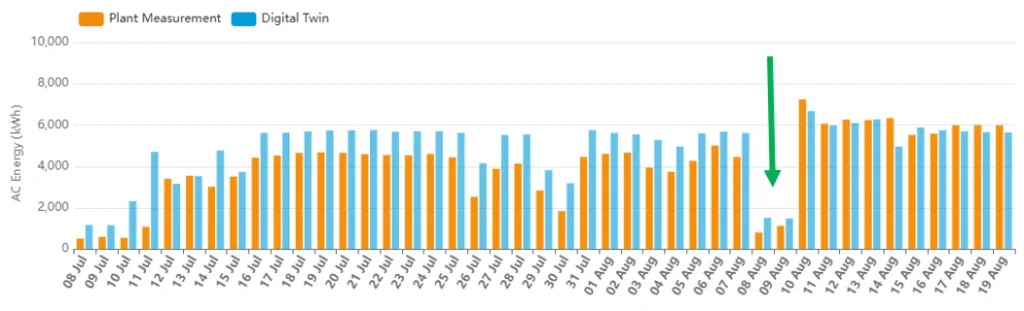
In the following example, a 1.2 MWp power plant installed two years ago had already shown signs of dirt for at least the last year. The orange values indicate the actual generation coming from the inverter, while the blue bars indicate the Digital Twin.
It is clear that until August 8th, when the plant cleaning was carried out (green arrow), the facility exhibited a consistent loss of ~17%, a loss that was eliminated after the cleaning.
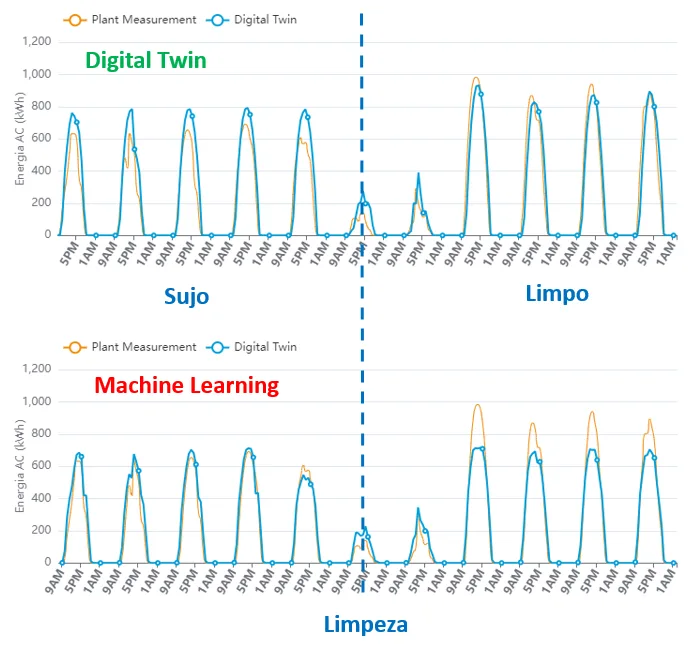
Unfortunately, the facility lost approximately R$300 in the second year alone, and there was no awareness of this due to a lack of effective monitoring. Comparing the monitoring of the same plant with Digital Twin versus Machine Learning in the same example below, it becomes clear that, with the inverter data, Machine Learning erroneously indicated that the generation forecast before cleaning indicated no problems, and after cleaning, that the plant was generating more than it should.
Basically, if there was no cleaning, Machine Learning monitoring would indicate that the plant has no problems, when the Digital Twin clearly indicates that it was dirty and can also quantify the losses.
As the most accurate monitoring methodology available, Bel Energy's Digital Twin significantly impacts solar installations financially in the following ways:
- It drastically reduces the potential for performance losses, which occur prominently in the vast majority of ground-based plants, rural installations, forested and mountainous areas, coastal areas, polluted regions, and near roads. It also reduces the risk of power loss in installations with connection issues, clipping, derating, etc.
- Digital Twin significantly reduces O&M costs, as it reduces the need for a large number of engineers for performance verification and visits, especially since without Digital Twins, it is very difficult to draw analysis conclusions with acceptable uncertainties.
The Digital Twin arrived in Brazil and is a recent reality, and is only available through the Swiss company Solextron, now part of the Belenergy group.
[1] R. Kennedy, “The top causes of solar performance issues”, PV Magazine 2023
[2] A. Kimber et al, “The Effect of Soiling on Large Grid-Connected Photovoltaic Systems in California and the Southwest Region of the United States”, 2006 IEEE 4th World Conference on Photovoltaic Energy Conference
[3] https://www.pvsyst.com/help-pvsyst7/performance_ratio.htm
[4] Project design > P50 – P90 evaluations
The opinions and information expressed are the sole responsibility of the author and do not necessarily represent the official position of the author. Canal Solar.



Comments
Comments are moderated before publication.Comments should be respectful and contribute to a healthy debate. Offensive comments may be removed. The opinions expressed here are those of the authors and do not necessarily reflect the views of the author. Canal Solar.