
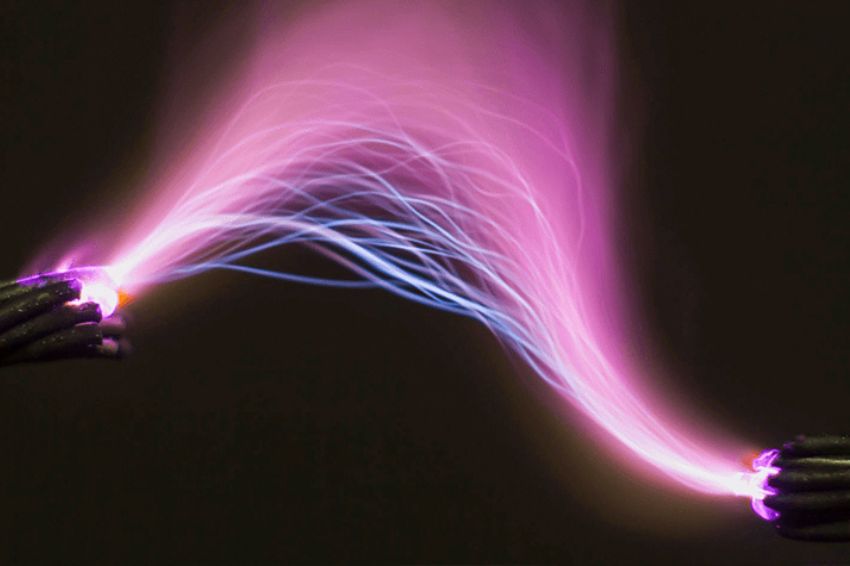
Fires in photovoltaic power plants result in property damage, loss of power generation, damage to buildings and people, and can spread to the surrounding environment, resulting in a series of secondary disasters. DC arc is the most common fault phenomenon in photovoltaic power plants. They can occur due to poor contacts, aging of components, insulation breakdown or poor grounding.
In addition, the damage caused by DC arc is much greater than that caused by AC arc, because there is no zero crossing point in DC arc. Once it occurs, it continues to burn, which is difficult to extinguish, and it is very easy to cause fire accidents. According to statistics, more than half of the fire accidents in photovoltaic power plants are caused by DC arcs.
As the specifications of PV modules become larger, the power and current of the DC side system increase. According to Joule's law Q=I²Rt, the current doubles and the thermal effect of the short-circuit point increases fourfold, thus the risk of causing a fire also increases.
DC arc rating
Unlike traditional electrical products, there is no integral enclosure for PV modules and their wiring to contain arcs and sparks caused by component and wiring failures, while many PV installations are capable of operating at the typical DC voltages that sustain DC arcs. There are three main categories of arcs in PV installations:
- Series arcs can be caused by incorrect wiring or broken series wiring;
- Parallel arcs can be caused by partial short circuits between adjacent lines of different potentials;
- Ground arcs due to insulation failure.
Series arc
Series arcs are usually caused by poor contact of cable plugs between components and poor connection between string cables and combiner boxes or inverters. Due to the large number of series connectors in the PV plant, there are about 2 pairs of connectors in a 1 MW PV plant, for example.
It is difficult to ensure that all connectors are of good quality and compatible in 100% of projects. These hazards can lead to poor contacts and DC arcing. Currently, some inverters integrate arc protection function, but there are two major problems with this protection:
- If there is an arc fault in a string, the entire inverter will shut down, causing extensive damage;
- Without the arc fault location function, operation and maintenance personnel cannot find the location of the arc in time and accurately, which is essentially not a solution.
Parallel arc
Parallel arcs are mainly caused by short circuit of positive and negative conductors caused by line damage or short circuit between string cables. When string cables are squeezed or mechanically worn, arcing occurs between the positive and negative electrodes, or between different strings, which is a parallel arc fault.
There is another situation that can also lead to parallel arcs, which is when the series arcs in the system are not treated in time and the heat from the series arcs burns the cable insulation and generates parallel arcs. When a parallel arc occurs between the main conductors, once the arc can obtain sufficient energy, it is more difficult to extinguish, which will cause a large fire accident.
The series arc can be extinguished by disconnecting the DC bus or corresponding string from the photovoltaic system, but the parallel fault arc cannot be extinguished and can even cause a larger current to pass through the arc path, making the arc more intense.
Currently, the arc protection function integrated in the inverter cannot detect parallel arcs and ground arcs, but the destructive power of parallel arcs is 10 times that of series arcs, and the safety risk is even greater.
Earth arc
Component aging and defects or mechanical damage will lead to discharge to the ground. If the components are placed on metal tiles, ground arcs or leakage will occur. This type of fault is not easy to find, especially on rainy days. Currently, the solution is to turn off the inverter and wait for the ground to dry before turning it on. This method does not effectively eliminate the dangers and increases the risk of personal electric shock.
DC high voltage
In a photovoltaic plant, photovoltaic modules are connected in series to form a high DC voltage circuit, with voltages that can exceed 1000 V. Even when the system is turned off, there is still a high DC voltage of around 1000 V in the circuit. photovoltaic modules.
Especially for rooftop photovoltaic plants, when a fire occurs in photovoltaic systems and buildings, it is difficult to safely rescue; During routine plant operation and maintenance or property maintenance, operators and inspectors are also at risk of electrical shock.
Products in the solar energy market
Several brands offer solutions that aim to minimize the risk of arcs in photovoltaic installations. Among them, the manufacturer BENY. The company has string-level and module-level rapid shutdown devices that control panel voltage to a certain safe level in microseconds. These devices allow you to prevent accidents and improve the safety of the solar energy system.
Rapid shutdown (RSD) solutions from BENY are designed according to CE, TUV, UL standard, complying with the laws and regulations of various countries, such as Thai Electrical Code, NEC2020. As a member of the Sunspec alliance, BENY develops PLC (Power Line Communication) communication RSDs for higher compliance with various string inverters.



Comments
Comments are moderated before publication.Comments should be respectful and contribute to a healthy debate. Offensive comments may be removed. The opinions expressed here are those of the authors and do not necessarily reflect the views of the author. Canal Solar.