

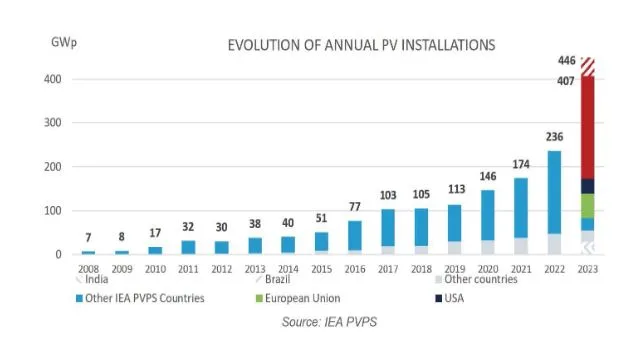
Solar energy, being both a direct and indirect source of most of the energy on Earth’s surface, has immense potential for development. Solar energy reserves are vast, with the Earth receiving approximately 173.000 TW of solar energy every second – the equivalent of burning 5 million tons of coal every second.
Recognizing this enormous potential, the utilization rate of solar energy has been increasing steadily over the past two decades. Relevant research institutions have made the following predictions: solar power generation will account for 20% of the world's total energy demand by 2050 and more than 50% by 2100.
As a result, the generation of solar energy has become one of the most prominent research topics. The use of solar energy for heating and electricity generation, especially through photovoltaic technology, has the greatest potential.
In recent decades, countries around the world have implemented their own solar power generation programs. Among them, the United States, Germany and Japan have been at the forefront, focusing on the development of grid-connected solar technology. China has also made significant progress in recent years, launching its own grid-connected solar technology initiatives.
However, the main challenge for photovoltaic power generation at present is how to improve the efficiency of the system. The characteristics of the photovoltaic cell determine the operational characteristics and energy conversion efficiency of the photovoltaic generation system, which requires the analysis of the operational behavior of the photovoltaic cells.
With the widespread application of photovoltaic power generation systems, an increasing number of distributed photovoltaic power plants and plants on uneven terrain will face more complex and variable lighting environments, requiring the optimization of photovoltaic power generation performance under shading conditions.
Light intensity significantly affects the operating conditions of photovoltaic cells, and lighting conditions can vary both in large solar plants and in distributed generation systems.
When a PV string is shaded by obstacles such as shadows from trees, buildings, clouds or dust, partial shading conditions (PSCs) are created. Under these conditions, the light received by the shaded part differs from the light received by the unshaded part, causing a change in the output characteristics of some PV modules.
This results in a clear mismatch, leading to excessive heat generation in some PV panels, a phenomenon known as the “hot spot effect.” This effect can even cause fires throughout the PV string if not dealt with quickly.
To mitigate the hot spot effect, PV modules are typically equipped with antiparallel bypass diodes. However, these diodes can cause the output characteristics of the PV string to exhibit multiple power peaks.
In these situations, traditional Maximum Power Point Tracking (MPPT) technology can cause the PV string to operate at a local MPP instead of the global MPP, resulting in significant energy losses. According to statistics, 70% of the power loss in commercial PV cells occurs due to partial shading, which causes the system to operate at a local MPP.
Researchers, both national and international, have conducted extensive studies on MPPT methods under partial shading conditions and proposed several solutions. These solutions can be broadly classified into two main categories: hardware improvement methods and software improvement methods.
Hardware improvement methods
I. Connect an independent DC-DC converter to each module of the PV string and use the traditional MPPT method to ensure the maximum output power of each PV module.
II. Connect a voltage and current compensation circuit in parallel to each PV module. When certain modules in the string are affected by partial shading and the output current is lower than that of other modules in the same series branch, the compensation circuit connected in parallel compensates for the current difference, while the voltage compensation circuit ensures that the terminal voltage of the module remains at the MPP. In this way, the original multiple power peaks of the PV string are converted into a single peak, allowing the MPP to be tracked by traditional MPPT algorithms.
III. Using the combined optimization method of the String to overcome the problem that traditional MPPT algorithms are easily influenced by local peaks. By comparing different shadow distribution scenarios on the output power of the PV String, it is concluded that when the shadows are evenly distributed or centralized on the String, the MPP is less affected by the shadowing.
Although the above-mentioned hardware improvement methods can increase solar energy utilization and mitigate the impact of partial shading on the output characteristics of the PV string, they also have some disadvantages, such as increased circuit complexity, greater difficulty in control, reduced system reliability, and increased system costs.
Software Improvement Methods
I) The first category includes intelligent algorithms based on modern control theory or bionics, such as Particle Swarm Optimization (PSO), Simulated Annealing (SA), fuzzy control, Firefly Algorithm (FA), among others. These intelligent algorithms are capable of accurately tracking the global MPP under different shading conditions.
II) The second category is the fixed point method, which determines the global MPP using the intersection of the equivalent load line of the photovoltaic String with the IV curve of the String, employing functions such as Fibonacci and Lipschitz functions to locate the global MPP.
III) The third category includes improved algorithms based on traditional MPPT algorithms. These algorithms first determine the MPP distribution range based on the output characteristics of the PV string under partial shading conditions, and then track the global MPP using the traditional MPPT algorithms together with enhancement methods.
Based on these approaches, CSI developed FRM, a software-based method to solve the partial shading problem, allowing the inverter to operate at global MPP and significantly reducing energy losses.
Technical solution
Next, we will introduce the power tracking of the PV system under no-shading and partial-shading conditions, thus introducing the working principle of CSI FRM.
MPPT in Non-Shaded Conditions
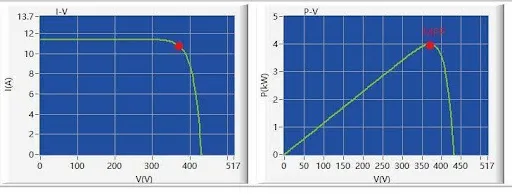
In conditions without shading, there is only one point of maximum power on the photovoltaic curve, called MPP (Maximum Power Point).
The voltage corresponding to this point is called the MPP voltage. To track this point, we collect the voltage and current from the PV array, and then gradually adjust the voltage point using the perturbation and observation method with variable step size.
MPPT in Shading Conditions
Reasons for partial shading
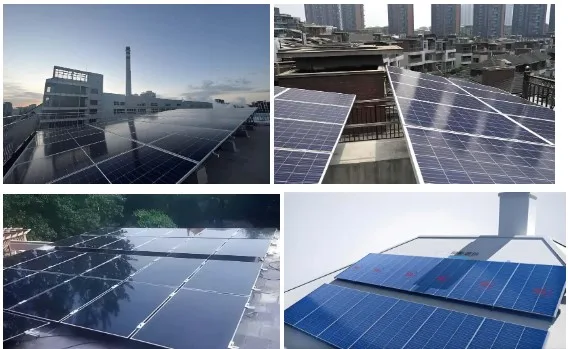
- In the case of a common photovoltaic power generation system, the factors that cause partial shading are very common and varied. As shown in the figure above, photovoltaic systems generally install photovoltaic strings on roofs or other building structures. Due to the presence of various obstacles such as trees, poles and other buildings around, the change in the angle of light causes these obstacles to cast partial shadows on the photovoltaic string. In addition, there may be partial shading caused by elements on the surface of the photovoltaic panel, such as leaves. Other factors are related to the structure of the building itself. For example, some houses with sloping roofs have different orientations and incidence angles when installing photovoltaic panels, which can also cause uneven illumination and lead to partial shading;
- For large-scale photovoltaic power generation systems, cloud shadow and dirt accumulation are the main causes of partial shading in the system;
- The light received by the photovoltaic string can be divided into three types: direct radiation, reflection and scattering. Therefore, when the photovoltaic string receives reflected light from other buildings or scattered light, uneven illumination intensity may occur.
Impacts of partial shading on the photovoltaic power generation system
Partial shading directly affects the output power of the photovoltaic system. This phenomenon can significantly compromise the normal operation of the photovoltaic string, drastically reducing its output power.
If users' electricity demand is not met, it could have a major impact on people's daily lives and work.
A Tokyo University carried out a study on 71 photovoltaic energy generation systems and concluded, through analysis, that power losses due to misalignment and other factors reach around 25%.
Traditional MPPT control under shading conditions
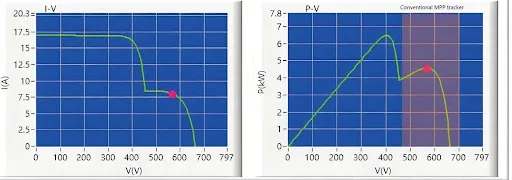
When a PV string frequently operates under inconsistent ambient light intensities, its output characteristics change, transforming the PV characteristic curve from a single-peak shape to a multi-peak curve. As shown in the following figure:
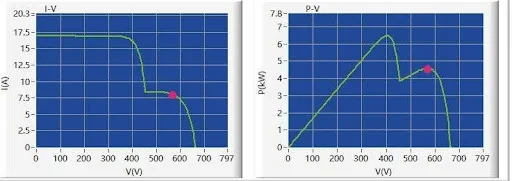
Traditional MPPT tracking will get stuck at the first power peak, resulting in a huge loss of power generation and economic loss.
How FRM works
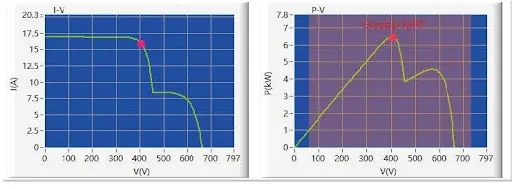
FRM achieves optimization by controlling the duty cycle of the DC/DC conversion circuit, which decreases throughout the process. When the DC/DC conversion circuit is a Boost circuit, the operating point of the PV array constantly moves from the open-circuit voltage area to the short-circuit current area, completing the entire scanning process.
During the scanning process, the maximum output power point of the photovoltaic array and the corresponding voltage are continuously updated. When the duty cycle of the DC/DC conversion circuit is reduced to a predetermined value, the scanning process is completed.
The algorithm process mainly includes the following steps:
- First stage: The movement starts from the open-circuit voltage point towards the voltage reduction. During this movement, the power corresponding to the voltage at two different times is continuously compared, and the information of the point with the highest power is stored. This process is repeated until the voltage approaches the short-circuit current area, thus completing the entire scan;
- Second stage: The traditional voltage disturbance method is used to return close to the maximum power point. The final point found is the ideal value, and the photovoltaic array operates at this maximum power point.
The algorithm requires a fixed timing module to ensure that the scan is performed at regular intervals. In addition, when the power change exceeds the preset threshold, the scan is automatically restarted.
In this way, when the external light intensity changes suddenly, the algorithm can track the maximum power point in real time, allowing the PV array to operate continuously at MPP (Maximum Power Point).
With this design, the FRM can quickly track the global maximum power point within milliseconds, significantly increasing power generation.
Technology Verification
FRM verification is performed based on the following points:
| Solution review | performance test | Comprehensive assessment |
| Is the practical application scenario and its function clear? | How much does power generation increase when scanning in shading conditions? | Technical advancement and application scenario. |
| Feasibility of practical application | Value of technological application. |
Solution Review
This solution can solve most of the shading problems and significantly increase the power generation of the photovoltaic system.
The implementation of this solution can be done through an OTA (Over-the-Air) update, without the need to add hardware configurations, making it economical and convenient.
The opinions and information expressed are the sole responsibility of the author and do not necessarily represent the official position of the author. Canal Solar.




Comments
Comments are moderated before publication.Comments should be respectful and contribute to a healthy debate. Offensive comments may be removed. The opinions expressed here are those of the authors and do not necessarily reflect the views of the author. Canal Solar.