
In collaboration with Oscar Witzig*
Based on large investments in research and technology, the photovoltaic sector has evolved significantly and is increasingly bringing more robust products with different electrical characteristics.
A great example of this are photovoltaic modules which, in a few years, significantly increased their output power, which consequently changed their main electrical parameters such as current and voltage.
Today, it is quite common to come across photovoltaic modules that have a short-circuit current (Isc) with values close to 20 A. This means that the entire chain of elements used in direct current circuits is withstandable for these current values. .
This fact becomes more relevant when we consider that these values close to 20 A are in STC (irradiance conditions of 1000 W/m² and temperature of 25 °C) and, in Brazil, we commonly have irradiances significantly higher than 1000 W/m².
In IV curve tests in different regions of the country, irradiances above 1.100 W/m² are often recorded, reaching, in some cases, close to or above 1.300 W/m².
As the current produced by the module is proportional to the light that reaches the photovoltaic module, that is, it is proportional to the irradiance. This means that if we have 20% more irradiance, this gain will be reflected practically proportional to the current generated.
Thus, photovoltaic modules subjected to irradiances greater than 1.000 W/m² can generate a current higher than that presented in their data sheets, as they are under different conditions to those presented in the equipment data sheet.
An example can be seen in Figure 1, where an irradiance of 1.332 W/m² was measured in commissioning work, performing the IV curve test.

Another aggravating factor is the bifacial gain of the modules. A large number of modules sold in Brazil today are bifacial and these models have the characteristic of having a generation gain from the rear of the modules, which directly impacts the increase in the output current of these modules.
A clear example is the one presented in the datasheet below Figure 2, which presents the electrical data of a photovoltaic module from a large manufacturer on the market. Note that gains of up to 20% are already considered in its data sheet due to the bifacial gain of this module, which significantly changes the current values generated by this equipment.

As connections are extremely important and critical elements to avoid accidents, losses and damages in photovoltaic systems, it is important to have suitable and more robust connectors to withstand the current values of the modules that have been exceeding their values each year. raisin.
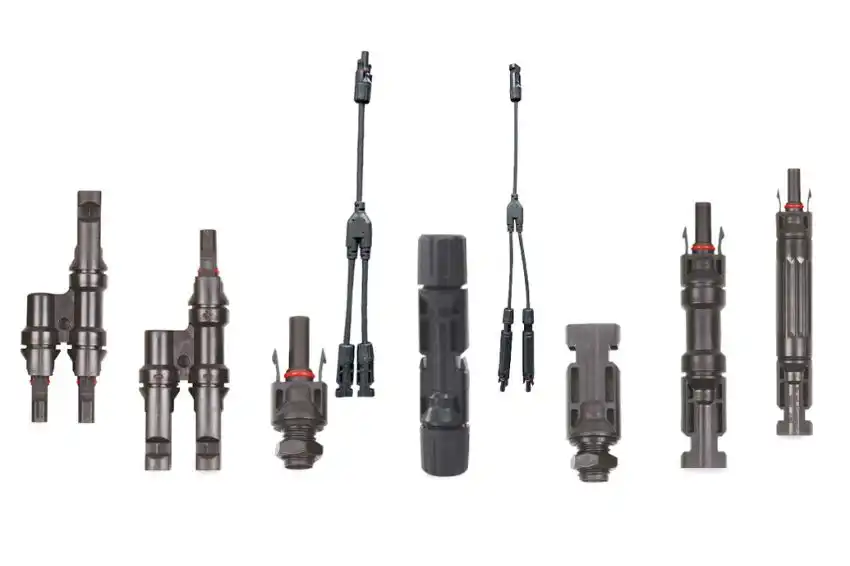
For this purpose, this article presents the connector SC-6 from Proauto Electric, which, in addition to presenting a new and practical way of making photovoltaic module connections, presents supportability a electric current superior to common models of Connectors from the market.
It works with modern photovoltaic module types with higher current capacity such as Trina, Canadian and Jinko. Figure 3 shows an image of the new SC-6 connector.

SC-6 connectors were made with people who use solar energy and other renewable energy sources in mind. A big advantage of Proauto Electric's SC-6 connectors is that they have a new fitting between male and female, being safer than old market models with lower current.
This means it won't let go easily. So, you can trust it to keep everything working properly and avoid connection problems. This brings more quality and safety, making the photovoltaic system more robust at the most critical points of the installation, which are the connections.
Additionally, the connectors on the Proauto Electric support a passage of a volume of energy much larger than the old models. This is because they have a current withstand of up to 50 A, which is crucial in systems that have presented currents increasingly higher.
Figure 4 shows the electrical characteristics of the Proauto Electric connector when compared to other technologies on the market that also support higher currents.

Note that the comparisons presented in Figure 4 refer to other connectors with greater current support. When compared to several other types of connectors circulating on the market, the SC-6 connector has much higher supportability, which makes it suitable for current modules with higher currents.
Figure 5 presents a complete breakdown of the data for Proauto Electric's new SC-6 connector.

Having a higher current capacity becomes more important as connectors can be installed in different ways and installers are often instructed to make several different connection schemes. strings where It is necessary to perform parallelism due to some technical factors.
This parallelism, often made by well-known Y connectors, causes twice the current to be present in a circuit, that is, it is essential to use a connector with a withstand capacity at least double the value of the worst current that can flow through this string, so the connector has to withstand a higher current. Emphasizing the use of connectors with greater current circulation supportability.
Furthermore, Proauto Electric's SC-6 connector is TUV-NORD 62852:2014 certified, following international standards, ensuring maximum connection quality. And it has an IP-68 degree of protection, resistant to water and dust – and can be used even in the most critical places and with less favorable conditions.
In short, Proauto Electric's new connectors are an ideal choice if you need to connect strings of solar energy systems in a more robust, reliable and safe way. It is compatible with several different types of connectors and is designed to last a long time.
*Oscar Witzig is an electrical engineer specializing in Alternative Energies, graduated from the College of Engineers HSR Hochschule für Technik Rapperswil / Switzerland. Specialist in Protection Systems Against Surges and Atmospheric Discharges. Lectures on Protection Systems at the Colegio de Ingenieros el Perú and Guatemala, AMERIC Mexico and the National University of Colombia.
The opinions and information expressed are the sole responsibility of the author and do not necessarily represent the official position of the author. Canal Solar.

Comments
Comments are moderated before publication.Comments should be respectful and contribute to a healthy debate. Offensive comments may be removed. The opinions expressed here are those of the authors and do not necessarily reflect the views of the author. Canal Solar.