
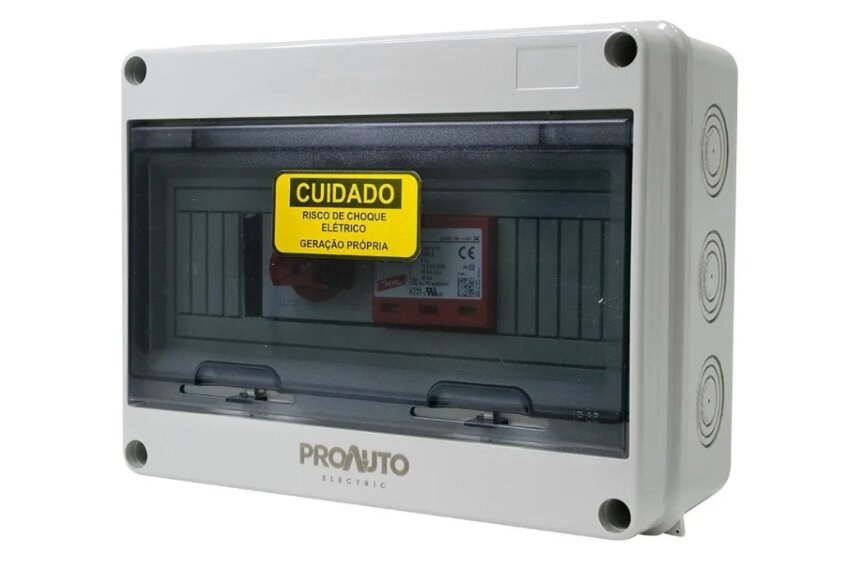
In most projects the stringbox It is treated as an individual component and is purchased ready for use. There are rare photovoltaic system projects, especially of microgeneration, in which the stringbox is assembled by the installer itself.
the concern of designer It is almost always found only in the specification and choice of the stringbox, indicating a model from a manufacturer that has the desired characteristics.
It is important that the designer knows the specifications of the stringbox, whether to purchase this prefabricated component or to make his own stringbox for special projects. The stringbox specification is based on two main electrical parameters: the circuit current and maximum voltage of the photovoltaic system.
In this article we want to address the choice of disconnector switch, taking as an example a stringbox for a microgeneration system, with one input and one output.
The sectioning capacity of the disconnector switch depends on the working voltage of the system. The same switch may be capable of disconnecting a current of 32 A, for example, working at 600 V, while it can only disconnect 16 A if working at a voltage of 1000 V.
In this example, we want to size the disconnector switch for the stringbox shown in the figure below.

From the characteristics of the string we can determine the maximum voltage of the system and the current to which the disconnector switch will be subject.

According to the characteristics of the string, a short-circuit current (Isc) of 9,45 A is required. The current value to be considered, however, must follow the guidance of the NBR 1669 standard.
Also from the string characteristic we find the value of the system's maximum voltage, which is 372 V. Strictly, the open circuit voltage (Voc) of the string must be corrected for the lowest temperature found in the location. Typically the voltage variation of the photovoltaic module is less than 3 V for a temperature variation of -20 ºC.
As we have 10 modules in this string, we can expect an increase of 30 V at an ambient temperature of 5 ºC (= 25 ºC – 20 ºC). So, in summary, the maximum system voltage will be around 402 V in open circuit. This is the voltage value that we must consider when sizing the disconnector switch, as well as other components of the system.
Table 5 of the NBR 16690 standard, reproduced below, shows how the current value is calculated for sizing conductors and other circuit elements (such as circuit breakers and disconnecting switches).

The norm NBR 16690 It also states, in section 6.3.7.2, that isolating devices and switch-disconnector devices must have a nominal current equal to or greater than the minimum current capacity required of the circuit to which they are connected, in accordance with Table 5.
According to the previous table, the circuit current to be considered is 1,5 x 9,45 A = 14,17 A. And according to section 6.3.7.2 we must use this current value to size the disconnector switch . Analyzing, for example, the data sheet from the manufacturer Projoy Electric, we find several models (part numbers) of disconnect switches that may be suitable for this project.
The table below shows the recommended models to operate with 1 string. There are 2-pole models that can offer switching capacity from 9 A to 32 A (depending on system voltage), while models with 4S, 4B and 4T ends offer 32 A switching capacity for any voltage between 600 V and 1200 V (range suitable for this project).

For 600 V operation, for example, any model (part number) from this table would be suitable. For any model chosen, the interrupting current would be 32 A, greater than or equal to the current capacity of the circuit (14,17 A), thus satisfying section 6.3.7.2 of the standard NBR 16690.
For operation at 1200 V, only models PEDSC100-R-a32x-4S, PEDSC100-R-a32x-4B and PEDSC100-R-a32x-4T would be suitable, also presenting an interrupting capacity of up to 32 A in this condition.
There are several stringbox manufacturers on the Brazilian market, who offer models suitable for the most common projects. Let's analyze, for example, the SB-1E-1S-1005DC stringbox from Proauto Electric, which has 1 input and 1 output, as required by this project.

It can be seen that the aforementioned stringbox model uses the PEDSC100-R-a32x-4T disconnector switch, with sectioning and interruption capacity of 32 A at 1200 V, being suitable for sectioning and interrupting the string of 10 modules in this example.



Comments (1)
Comments are moderated before publication.Comments should be respectful and contribute to a healthy debate. Offensive comments may be removed. The opinions expressed here are those of the authors and do not necessarily reflect the views of the author. Canal Solar.
1 – Table 5 is for cable sizing. It implies that the fuses for more than two strings in parallel are calculated by the formula Inp+1,5 Isc(SPo-1). If so, shouldn't the 1,5 factor be 1?
2 – In the example given, the voltage VMPT = 372V was considered, which, corrected for temperature, remained at 402 V in open circuit. Shouldn't the voltage Voc (corrected for temperature) have been considered, since this voltage will arise when the String Box disconnect switch is open?