GC Solar 23.61 GW GD Solar 53.65 GW
Canal Solar
  • HOME
  • Latest News
    • Market & Investments
    • International market
    • Politics & Regulation
    • Projects & Applications
    • Sustainability & ESG
    • Technology & Innovation
  • Articles
    • Opinion Article
    • Technical Article
    • Manufacturer's Article
  • Latam
  • Consumer Guide
  • Business Directory
  • Magazine
  • Videos
  • Electric Vehicles
  • Firmare
Solar Energy Courses
  1. Home
  2. Technical Article
  3. Structural reinforcement for the installation of photovoltaic systems
Technical Article

Structural reinforcement for the installation of photovoltaic systems

In several cases it is necessary to make reinforcements so that the structure supports the installation of the panels.

Author Bruno Kikumoto
Published 10 March 2019, 18: 28 Updated 27 May 2021, 09: 03
Reading 5 min read
Share Canal on WhatsApp
Structural reinforcement for the installation of photovoltaic systems

The installation of photovoltaic systems on the roofs of Brazilian buildings has grown dramatically due to all the benefits that solar energy provides.

Among them, savings on energy bills, predictability of expenses, environmental issues, enhancement of the company's image and guaranteed return on investment, among other advantages.

However, buildings are often not prepared to receive the additional load from solar panels, as their roofs and structures were not designed or built properly.

Contextualizing the problem

Building structures must withstand the following loads:

  • Own weight;
  • Weight of the tiles;
  • Utilities (loads added by electrical conductors, cable trays, water and refrigeration pipes, etc.);
  • Overload (load added by people and equipment that will work momentarily on the roof, items hanging from structures – such as banners);
  • Additional loads (photovoltaic panels);
  • Wind action.

Contrary to popular belief, the actions of the winds must also be considered. In fact, in most cases wind is the most significant load that the structure will have to support.

The norm ABNT NBR 6123 – Forces due to wind in buildings determines the considerations that must be made due to the forces exerted by winds on buildings.

More details about standards and issues that must be evaluated can be found in the article Prior assessment of roofs before installing photovoltaic systems.

The remedy to ensure that panel installation does not become a nightmare for the owner and the installing company is to have the structure analyzed by a competent specialist.

This analysis must accompany a report with the respective ART stating whether or not the structure is ready to receive the installation of photovoltaic systems.

Structural reinforcements

In several cases it is necessary to make reinforcements so that the structure can support the installation of photovoltaic systems.

This occurs mainly in warehouses and sheds where, for cost reasons, structures are often designed and built within the limit permitted by standards or even outside the recommendations of technical standards.

When there is a need for reinforcement, the responsible professional must provide a calculation report and an executive project showing the assembly details, in addition to obviously providing the respective ART.

In general, the costs of structural reinforcements do not exceed 5% of the investment in the photovoltaic system, extending the operating time. payback (return time on investment) in a maximum of two or three months. The deadline for carrying out the reinforcement is also not long, and can be carried out in a few weeks. In this way, carrying out structural reinforcement, when necessary, does not make the photovoltaic project unfeasible. Let's look at some examples of reinforcements most commonly used to install panels.

Installation of pillars

In some cases it is necessary to install pillars to better distribute the diagonal forces of the building. Attention must be paid to the positioning of the pillars, as most of the time the best position from the point of view of mechanical efforts does not meet the needs of the flow of people, machines and cars. You should look for an option that meets all your needs.

Reinforcement in roof purlins and shears

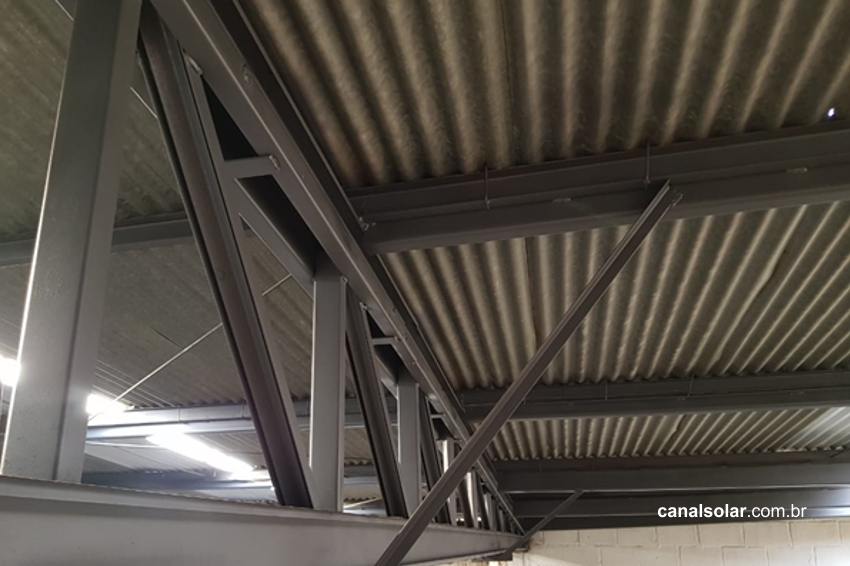
Purlins are the structural elements to which roof tiles are attached. The shears, in turn, are the structures supported on the pillars and on which the purlins are mounted.

Generally, the purlins are the ones that directly receive the loads from the panels, regardless of the installation method used (studs, flat-rail ou speed rail).

In these cases, when necessary, reinforcement consists of fixing a tube or beam in parallel along the entire length of the purlin. Fixation can be done using screws or welding.

The choice of method depends on the viability of the installation, considering the execution time and the environment where it will be carried out (environment with flammable materials, high flow of people, etc.). In structures with a ceiling, it may be necessary to remove the tiles to carry out the work.

Figure 1: Example of reinforcement carried out in the purlins of a metal structure roof
Figure 2: Example of reinforcement carried out in the shears of a metal structure roof

Alternative to reinforcement

In some cases it is possible to install the panels without reinforcing them. To do this, you need to work on a layout of the arrangement that distributes the panels in more robust points, which support the additional load – a structural calculation must, however, be carried out to verify the weight limit that can be applied to the elements.

An example is seen below, where structural analysis showed that the purlins would not withstand the additional stresses due to the installation of the panels.

To avoid reinforcement in the purlins, it was decided to position the panels aligned with the scissors, within a maximum occupancy margin of 1,5 m on each side.


Figure 3: Example of a roof where it was not possible to carry out structural reinforcements. The option was to concentrate the weight of the solar panels on the structural shears, avoiding overloading the purlins
 

installation of photovoltaic systems structural reinforcement Photovoltaic systems roofs
Bruno Kikumoto
About the Author
Bruno Kikumoto

Electrical Engineer from UDESC. Master in Electrical Engineering from UNICAMP. Director of Canal Solar. Specialist in project management, inspection and commissioning of photovoltaic systems, with over 10 years of experience in the industry and the energy market.

Comments

Comments are moderated before publication.

Comments should be respectful and contribute to a healthy debate. Offensive comments may be removed. The opinions expressed here are those of the authors and do not necessarily reflect the views of the author. Canal Solar.

Leave your comment Cancel reply

Posts

What could change with the White Tariff?
Technical Article

What could change with the White Tariff?

Lais Andrade · Oct 23
Photovoltaic O&M as a recurring revenue stream for integrators
Technical Article

Photovoltaic O&M as a recurring revenue stream for integrators

Raone Silva · Sep 18
Canal Solar Round-Trip Efficiency and its viability in battery storage projects.
Technical Article

Round-Trip Efficiency and its feasibility in battery storage projects

Thiago Farias · Aug 27
Technical Article

Certification of battery-based storage systems

Geraldo Silveira · Aug 27

Most Read

01

Check out the ranking of the 10 largest energy consumers in the world

Brazil ranks eighth on the list with 509 TWh, according to Worldometer

02

Solar energy certification: what is it, when and how to do it?

Find out why this process is essential and how to carry it out simply and efficiently

03

Battery for solar system: understand if it is worth installing

Learn about the different types of batteries, backup applications and benefits

04

The power went out during voting: will the electronic voting machine still work?

The devices have internal batteries with a runtime of approximately 12 hours; four models will be used this year.

05

Saving cables with leap-frog connection of photovoltaic modules

Understand the leap-frog strategy and learn how it allows you to reduce the cost of electrical cables in facilities

Categories

Market & InvestmentsInternational marketPolitics & RegulationProjects & ApplicationsSustainability & ESGTechnology & Innovation

Receive the news in your email.

Daily bulletin with the essentials of the solar sector.

✓ Registration confirmed!
Share
Canal Solar

This is a news and information channel about the photovoltaic solar energy sector. The content is protected by copyright law.

Categories
  • Market & Investments
  • International market
  • Politics & Regulation
  • Projects & Applications
  • Sustainability & ESG
  • Technology & Innovation
Institutional
  • About Us
  • Contact
  • Privacy
  • Quality policy
  • We’re hiring!
Place your ad

Your brand where energy sector decisions happen.

Download media kit
Group Canal Solar
Canal Solar EducationalCS ConsultingCanalVE
Associations and certifications
ABGDIEEECIGRÉCREA-SPABSOLAR Associate
Copyright © 2026 Canal Solar. All rights reserved. CNPJ: 29.768.006/0001-95 Developed by Softeo Technology
GDPR Cookie Banner

We use cookies to make your experience on this site better Find out more about the cookies we use or turn them off in your .

Canal Solar
Powered by  GDPR Cookie Compliance (opens in a new tab)
Privacy

This website uses cookies so that we can provide you with the best user experience possible. Cookie information is stored in your browser and performs functions such as recognizing you when you return to our website and helping our team to understand which sections of the website you find most interesting and useful.

Cookies strictly required

Strictly Necessary Cookie should be at all times so that we can save your preferences for cookie settings.

Cookies for third parties

This website uses Google Analytics to collect anonymous information such as the number of visitors to the site, and the most popular pages.

Keeping this cookie enabled helps us to improve our website.