• Tuesday, January 20, 2026
Facebook X-twitter Instagram Youtube LinkedIn Spotify
  • GC Solar: 17,95 GW
  • GD Solar: 41,3 GW
  • TOPCon Modules: $0,088/W
  • P-Type Cells: $0,034/W
  • N-Type Cells: $0,032/W
  • HJT Modules: $0,10/W
  • N-Type Wafer: US$0,128/pc
  • Polysilicon: US$ 19,00/kg
  • GC Solar: 17,95 GW
  • GD Solar: 41,3 GW
  • TOPCon Modules: $0,088/W
  • P-Type Cells: $0,034/W
  • N-Type Cells: $0,032/W
  • HJT Modules: $0,10/W
  • N-Type Wafer: US$0,128/pc
  • Polysilicon: US$ 19,00/kg
  • advertise here
  • About us
  • Expedient
logo site solar channel
  • News
    • energy storage
    • Market and Prices
    • Investments & Business
    • Policy and Regulation
  • Articles
    • Batteries
    • Opinion Article
  • Renewable
  • Latam
  • Blog
  • Solar Energy Companies
  • Integrators
  • Magazine
    • Magazine Canal Solar
    • Conecta Magazine
  • Events
  • Videos
  • Electric Vehicles
  • Consultancy
  • Academics
  • News
    • energy storage
    • Market and Prices
    • Investments & Business
    • Policy and Regulation
  • Articles
    • Batteries
    • Opinion Article
  • Renewable
  • Latam
  • Blog
  • Solar Energy Companies
  • Integrators
  • Magazine
    • Magazine Canal Solar
    • Conecta Magazine
  • Events
  • Videos
  • Electric Vehicles
  • Consultancy
  • Academics
  • News
    • Brazil
    • World
    • Technology and inovation
  • Articles
    • technicians
    • Opinion
  • Renewable
  • Latam
  • Blog
  • Solar Energy Companies
  • Integrators
  • Magazine
    • Conecta Magazine
  • Events
  • Videos
  • About Us
  • Advertise Here
  • CS Consulting
  • Canal VE
  • Academics
  • News
    • Brazil
    • World
    • Technology and inovation
  • Articles
    • technicians
    • Opinion
  • Renewable
  • Latam
  • Blog
  • Solar Energy Companies
  • Integrators
  • Magazine
    • Conecta Magazine
  • Events
  • Videos
  • About Us
  • Advertise Here
  • CS Consulting
  • Canal VE
  • Academics
logo site solar channel
Home / Articles / Technical Article / The risks of polarity inversion in photovoltaic systems

The risks of polarity inversion in photovoltaic systems

The negligence of some installers may cause the system to not boot
Follow on Whatsapp
  • Photo by Rafael Gallo Rafael Gallo
  • April 1, 2021, at 18:39 PM
4 min read

A constant doubt for photovoltaic system integrators is linked to the installation of the string box. With worrying frequency we find incorrect installations in which the polarities of the cables are mounted inverted, a situation that could be avoided through simple electrical tests that professionals in the area must carry out during the commissioning of the systems.

When purchasing the various pre-assembled string box options available on the market, integrators often encounter great difficulty due to the variety of standards adopted by manufacturers. It is common for string box manufacturers to have their own particularities and provide manuals and explanatory diagrams for the use of their equipment. However, negligence on the part of some installers may cause the system to not start up.

When a system fails to start up, the integrator usually tries to attribute the problem to other components, such as the inverter, without paying due attention to all aspects of the project. Polarity inversion can occur due to a simple mistake in making the connections that start in the modules, pass through the string box and end in the inverter.

Some brands of inverters available on the market even warn about the failure through their displays. However, many models use their own connection to solar panels to power their electronics.

When inverted, they do not work and generate dissatisfaction among the installer and waste of time during installation due to the search for a solution to the problem. In addition to these situations, it is possible to run the risk of inverting the polarities between the photovoltaic arrays, breaking the voltage limits of the modules, the string box or even the inverters.
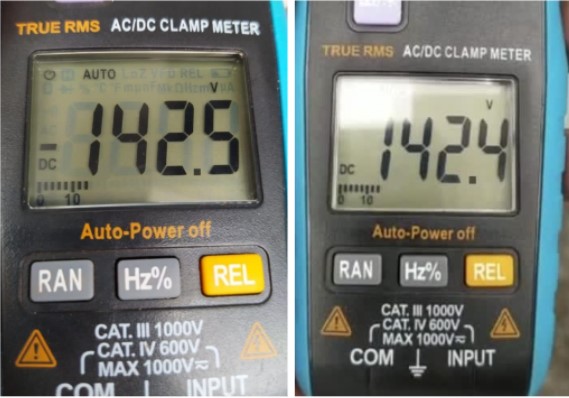
The risks of polarity inversion in photovoltaic systems
Figure 1 – Left: reading with inverted polarity on the voltmeter. Right: correct photovoltaic string voltage reading

To avoid this type of occurrence, it is a good idea to carefully study the diagrams and manuals that come with the string box and identify the particularities between the connections of the terminals, DPS, disconnect switches or fuse bases. In addition, measurements should be taken with a multimeter at each connection point to confirm that the voltage values ​​and polarities are adequate at the inputs and outputs of the components.
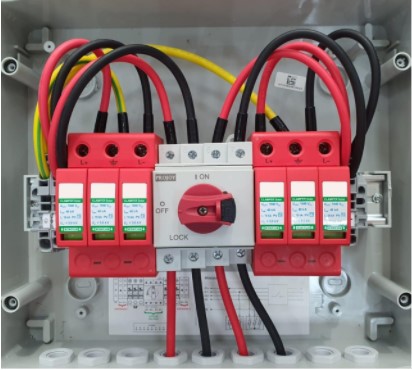
The risks of polarity inversion in photovoltaic systems
Figure 2 – String box assembled with inverted polarities
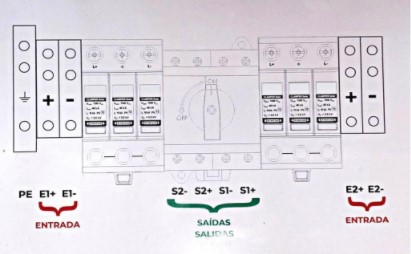
Figure 3 - Guiding diagram for assembling the string box
Figure 3 – Guiding diagram for assembling the string box

A practical example of the situation mentioned above consists of building a string where the modules have an open circuit voltage of 45,84 V. With a string of 10 modules we will have a total voltage of 458,4 V. Small variations are expected due to external factors such as temperature, orientation and inclination.

It is also important after this step that the professional pays attention to the correct values ​​presented in the multimeter reading and the polarity when connecting the string box. A reading of -447 V indicates an acceptable voltage drop, but reverse polarity in relation to the multimeter probes.

Another recurring situation occurs when the connection pattern in a string box changes in relation to the models used by the installer, familiar with another supplier.

Some manufacturers use equipment such as bipolar disconnector switches with direct passage, while others use tetrapolar switches with crossed outputs, which, when falling into the hands of an inattentive professional, can generate an inversion in the polarities at the output of the string box, which can be avoided by means of a new reading of potentials and polarities.

After leaving the string box and passing the cables, a final reading of the corresponding parameters is interesting.
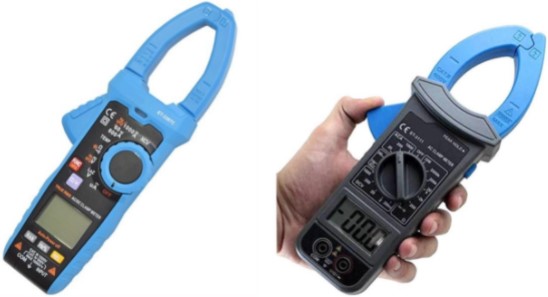
The risks of polarity inversion in photovoltaic systems
Figure 4 – The multimeter is a powerful ally for the installer to check whether the polarities of the string terminations and string box outputs are correct

The development of monitoring and measurement processes throughout the installation of photovoltaic systems is essential to avoid risks and discomfort for integrators and their customers. The use of appropriate materials and equipment, such as a multimeter with a complete clamp meter, capable of measuring direct and alternating current on the project scales, will be the necessary aid for a good installation. Distributors have a technical team prepared to assist integrators and ready to answer any questions that the installation professional may have.


commissioning photovoltaic system stringbox
Photo by Rafael Gallo
Rafael Gallo
Technical supervisor at BelEnergy, part of the Belenus Group in Brazil. Graduated in Control and Automation Engineering. It has been operating in the photovoltaic market since 2017.
PreviousPrevious
NextNext

An answer

  1. Avatar Valmir Lopes said:
    12 April 2021 17 gies: 59

    Congratulations on the very enlightening article, installers really need to pay attention to these details.

    Reply

Leave a comment Cancel reply

Your email address will not be published. Required fields are marked with *

Comments should be respectful and contribute to a healthy debate. Offensive comments may be removed. The opinions expressed here are those of the authors and do not necessarily reflect the views of the author. Canal Solar.

News from Canal Solar in your Email

Posts

The role of smart storage in the new energy landscape.

The role of smart storage in the new energy landscape.

And how long will the grounding system at your power plant hold up?

And how long will the grounding system at your power plant hold up?

More news

Read More
Canal Solar - Rain causes new blackout in São Paulo, leaving 130 without power.
  • January 20, 2026
Photo by Henrique Hein
Henrique Hein

Heavy rains cause another blackout in São Paulo, leaving 130 without power.

Canal Solar - ANEEL It forecasts growth of 9,1 GW in the electricity matrix in 2026.
  • January 14, 2026
Photo by Henrique Hein
Henrique Hein

ANEEL It forecasts growth of 9,1 GW in the electricity matrix in 2026.

Ranking of investors in the first half of 2025, according to Wood Mackenzie.
  • January 7, 2026
Photo by Wagner Freire
Wagner Freire

Ranking of investors in the first half of 2025, according to Wood Mackenzie.

It is a news and information channel about the photovoltaic solar energy sector. Channel content is protected by copyright law. Partial or total reproduction of this website in any medium is prohibited.

Facebook X-twitter Instagram Youtube LinkedIn Spotify

Site Map

Categories

  • News
  • Articles
  • Interviews
  • Consumer Guide
  • Authors
  • Projects
  • Brazil
  • World
  • Technical Articles
  • Opinion Articles
  • Manufacturer Items
  • Electrical Sector
  • Biddings
  • Products

Channels

  • About Us
  • Contact
  • We’re hiring!
  • Privacy
  • Expedient
  • advertise here

Membership and certifications

Copyright © 2025 Canal Solar, all rights reserved. CNPJ: 29.768.006/0001-95 Address: José Maurício Building – Mackenzie Avenue, 1835 – Floor 3, – Vila Brandina, Campinas – SP, 13092-523

We use cookies to make your experience on this site better Find out more about the cookies we use or turn them off in your .

Receive the latest news

Subscribe to our weekly newsletter

Canal Solar
Powered by  GDPR Cookie Compliance
Privacy

This website uses cookies so that we can provide you with the best user experience possible. Cookie information is stored in your browser and performs functions such as recognizing you when you return to our website and helping our team to understand which sections of the website you find most interesting and useful.

Cookies strictly required

Strictly Necessary Cookie should be at all times so that we can save your preferences for cookie settings.

Cookies for third parties

This website uses Google Analytics to collect anonymous information such as the number of visitors to the site, and the most popular pages.

Keeping this cookie enabled helps us to improve our website.