
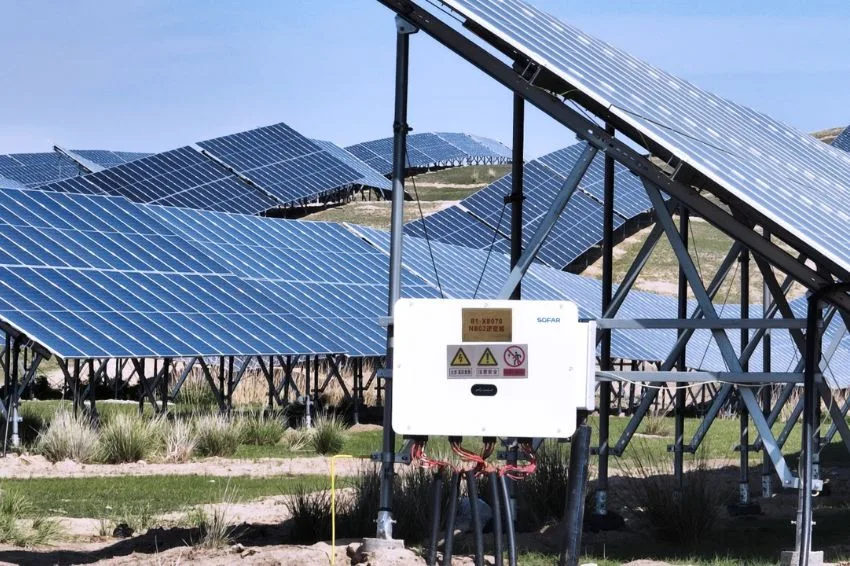
Fake power is an English term that, when translated directly, would be expressed in Portuguese as "false power." This term is used for equipment that does not reach the nominal power indicated in the datasheet, whether due to poor product quality, the use of low-quality raw materials and components, poor performance under normal operating conditions, or any other reason that may impair the equipment's proper functioning.
In the solar market, the topic has already been addressed previously, exposing photovoltaic modules that exhibited this behavior, not reaching the maximum power in Wp declared in the datasheet when subjected to laboratory tests.
Fake power in solar inverters
Recently, as has already occurred in the module market, fake power behavior has also been observed in inverters, bringing the subject back into discussion.
The IEM (Institute of Energy and Mobility) laboratory, an agency affiliated with UFSM (Federal University of Santa Maria), conducts compliance assessment tests on photovoltaic inverters in accordance with Inmetro regulations. A series of tests were conducted and some equipment showed performance that differed from that expected and specified in the datasheet.
SOFAR and its commitment to product quality
In response to the resurgence of the issue of fake power in the market, already discussed above, SOFAR decided to voluntarily carry out tests on its own products to demonstrate the brand's quality and commitment to the Brazilian market.
A sample of a single-phase inverter and a three-phase inverter, models 5KTLM-G3 and 75KTLX-G4-LV, respectively, were selected. To ensure impartial testing and using current products, the two inverters used for the tests were sent to the laboratory directly responsible for the inventory of Bold, a partner distributor that has been selling SOFAR products in the domestic market since 2022. The laboratory that performed the tests is part of the IEM.
The test performed consisted of applying a constant DC voltage, a DC input power of 170% and 200% of the nominal power (70% and 100% overload) and during operation the temperature was varied from 25º to 60º.
This allowed us to observe how the inverter's AC output behaved in each temperature range and within the established testing conditions. The chosen overload level is within current market practices and above the standard overload used in some tests. The goal is to subject the equipment to testing, referring to its actual use and obtaining results that more closely reflect its field use.
To establish a reference, Inmetro ordinance 140 of 2022 brings some points that must be respected by equipment that is nationalized, two of which are relevant to the subject in question.
The first one says that “On-grid inverters, when operating with overload on the photovoltaic port(s), must present a measured power value on the AC port equal to the nominal power value declared by the manufacturer in the datasheet or in the product manual, at the declared nominal voltage, with a tolerance of ±2%” and also that “The reference ambient temperature must be 25 oC (±3ºC) and with the inverter in permanent thermal mode”.
Another point addressed by the ordinance is that “Inverter power reduction due to temperature cannot occur at ambient temperatures below 40°C.” When comparing these numbers with numbers observed in the field, it is clear that in some real operating situations the ambient temperature can exceed 40ºC, causing the inverter to operate in even more severe conditions than those subjected to in the tests.
Test results
Below are the test results for each inverter. The tests were efficiency and performance, totaling seven tests, as shown in Table 7 below:
Table 1: Tests performed on each Inverter model.
| Córdoba | Test Reference No. | Test type |
| 5KTLM – G3 | 202411061748A | Efficiency |
| 5KTLM – G3 | 202411061748B | Efficiency |
| 5KTLM – G3 | 202411061748D | Derating |
| 5KTLM – G3 | 202411061748C | Efficiency |
| 75KTLX – G4 – LV | 202411061748F | Efficiency |
| 75KTLX – G4 – LV | 202411061748E | Efficiency |
| 75KTLX – G4 – LV | 202411061748G | Derating |
In the case of the 5kW inverter, performance was observed above that declared in the datasheet, as can be seen in Table 2 and Figure 2 below, taken from the report issued after the test.
Table 2: 5KTLM-G3 inverter operating power test results.
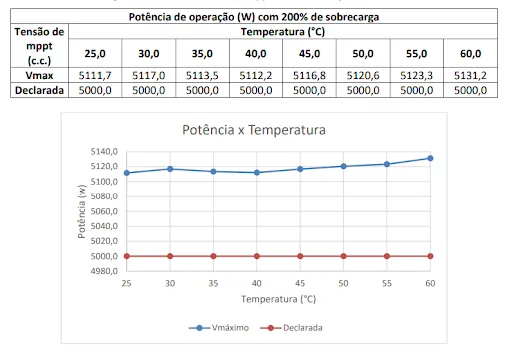
The graph shows the evolution of the output power (Y-axis) in relation to the temperature variations (X-axis) experienced by the device throughout the test. On the X-axis, there are two lines: the red line is the reference line and the blue line represents the power measured during the test.
The DC voltage used during the tests was 487,5Vdc and an overload of 100% (200% DC overload). In the test, it is possible to observe that the measured power (blue line in Figure 1) is always above the reference line (red line in Figure 1) for all temperatures tested.
Performance was also above expectations, as the inverter's output power exceeded datasheet data in all measurements, demonstrating the equipment's solid construction and robustness against temperature variations and applied overload. This confirms the inverter's operational capability, even in the harshest environments under real-world use.
The same test was repeated for the 75KTLX-G4-LV inverter and the result is shown in Table 3 and Figure 2 below.
Table 3: 75KTLX-G4-LV inverter operating power test results.
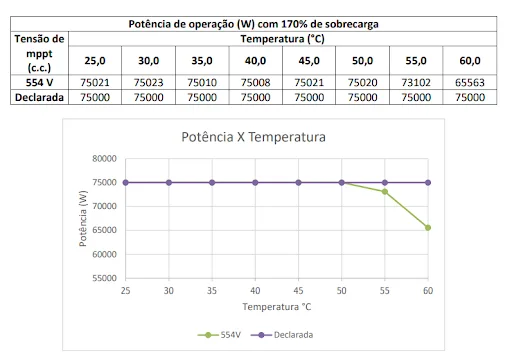
As with the test performed on the 5kW inverter, the output power of the 75kW LV inverter can be observed throughout the test temperature ranges. The purple line represents the test reference, and the green line represents the actual power measured in each temperature range. The table above the graph shows the exact values measured during the test. This test used a 70% overload (170% DC overload) and a string voltage of 554V DC.
As observed in the single-phase, the 75KTLX-G4-LV inverter also performed above expectations, delivering nominal power up to 40ºC as required by ordinance 140 and easily exceeding the test parameters, presenting derating in relation to the reference only at 55ºC.
Again, it is possible to conclude that in real overload and temperature situations, the inverter has the capacity to operate with a certain margin of slack, guaranteeing the plant's performance.
With the results of these tests, SOFA clearly demonstrates not only that it seriously follows all the operating requirements of the inverters, but that it goes further, delivering equipment that will have guaranteed performance in the field, satisfying the customer and guaranteeing energy generation even in the most extreme environments.
This performance is only possible with a well-built product designed to best serve the Brazilian market with affordable and reliable equipment that maintains a high standard of quality, with a low failure rate and high performance.
When choosing the inverter for your project, Sofar recommends always taking into account the technical characteristics as well as the performance in real situations so that there are no surprises regarding the energy delivery to the customer as well as additional unforeseen costs inherent in premature replacements or rework due to the low quality of the equipment.
The opinions and information expressed are the sole responsibility of the author and do not necessarily represent the official position of the author. Canal Solar.



Comments
Comments are moderated before publication.Comments should be respectful and contribute to a healthy debate. Offensive comments may be removed. The opinions expressed here are those of the authors and do not necessarily reflect the views of the author. Canal Solar.