
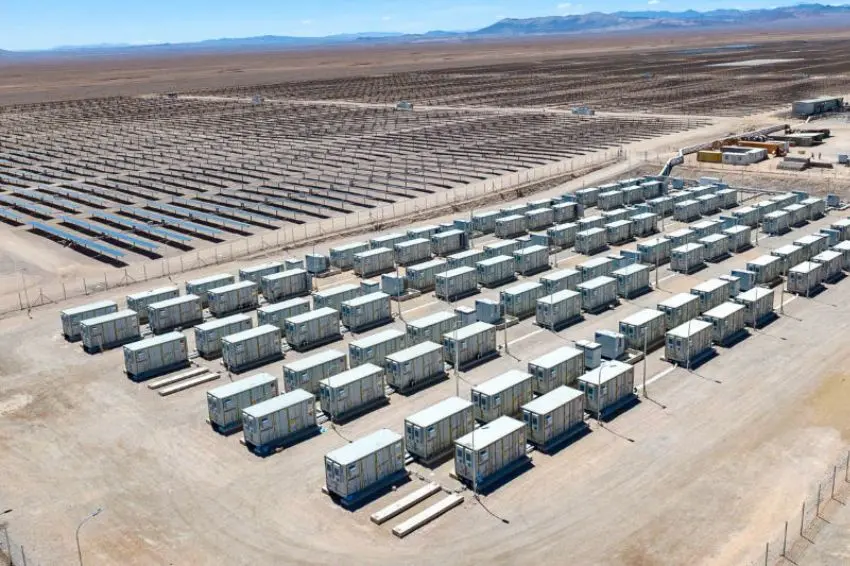
BNDES (National Bank for Economic and Social Development) It has already accredited seven companies to supply battery storage systems under the national content modality, focusing on Brazil's first battery auction.
The list includes the Brazilian companies WEG, Moura, and You.On.in addition to four Chinese groups: TBEA, Gotion, Trina and BYD.The bank will continue to analyze other processes, and new companies are expected to be approved in the future.
With the current approval, these seven companies will be able to move forward with the registration process for the systems they intend to provide to the projects competing in the national category of the bidding process. It is important to note, however, that being on the list does not yet mean that the equipment from these companies is considered domestically produced..
The systems (known as SAEs) will also need to undergo a new technical evaluation by the bank to prove compliance with the local content requirements established for the LRCAP (Capacity Reserve Auction).
Among Brazilian companies, WEG and Moura already have local production related to energy storage, while You.On works in the engineering and integration of the equipment that makes up these systems.
In the case of TBEA, Gotion, Trina, and BYD, the fact that they are Chinese groups does not prevent their systems from meeting national content regulations. To do so, they need to demonstrate that the equipment and processes carried out in Brazil comply with the [relevant regulations/standards]. requirements established by BNDES.
Global manufacturers are making progress in nationalizing battery production.
The anticipation surrounding Brazil's first battery auction has influenced the strategies of major global storage manufacturers, who have been seeking local partners to structure their participation in the bidding process.
As reported by Canal SolarCompanies such as CATL and Jinko ESS announced agreements with Moura and UCB Power, respectively, at the end of last month, aiming to advance the national production of equipment.
With an eye on LRCAP, global manufacturers are advancing the nationalization of batteries in Brazil.
Auction will feature a specific product for national systems.
Brazil's first battery auction will be divided into two rounds. The first, called LRCAP 2026 – National Storage, is scheduled for December 2nd and will be exclusively for systems that meet the minimum nationalization requirements established based on the criteria of the BNDES CFI System.
Two days later, on December 4th, the 2026 LRCAP – Storage tender is scheduled, also open to projects that use imported equipment. The tenders will contract the availability of power from new storage systems connected to the SIN (National Interconnected System).
According to the MME (Ministry of Mines and Energy), the auction for national content will be held first and will have priority in meeting demand. The start of supply for the contracted projects is scheduled for August 1, 2028.
Over 6 registered projects
The volume of interested companies gives an idea of the expected competition for the country's first battery auction. EPE (Energy Research Company) recorded... 6.091 distinct projects, totaling approximately 296,8 GW of power.considering the projects registered for both modalities.
Since thousands of projects were registered in both categories, the numbers should not be added together to determine the total number of projects. Registration also does not mean that all these projects will actually participate in the bidding process, as the projects still undergo a process of analysis and technical qualification before the auctions.
all the content of Canal Solar is protected by copyright law, and partial or total reproduction of this site in any medium is expressly prohibited. If you are interested in collaborating or reusing part of our material, please contact us by email: redacao@canalsolar.com.br.


Comments
Comments are moderated before publication.Comments should be respectful and contribute to a healthy debate. Offensive comments may be removed. The opinions expressed here are those of the authors and do not necessarily reflect the views of the author. Canal Solar.